Life-Cycle of Stars
Types of Stars
H-R Diagram
Seasons
Moon
100
A large cloud of gas and dust from which a star begins is known as a —
A. black hole
B. quasar
C. super nova
D. nebula
D. nebula
100
Our Sun is what type?
O B L G
Our Sun is a G
100
The Hertzsprung-Russell diagram shown is divided into four sections.
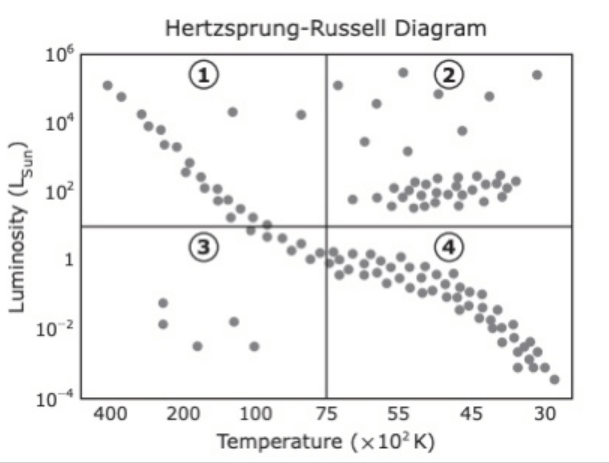 Which section of the diagram includes the coolest, brightest stars?
Section 2
100
What is the tilt of the Earth's axis?
A. 23.5 degrees
B. 45 degrees
C. 68.5 degrees
D. 90 degrees
A. 23.5 degrees
100
True or False
The lunar regolith is the layer of charcoal-gray, powdery dust and rocky debris on the Moon.
TRUE
200
A region in space that is so dense that nothing, even light energy, can escape its gravitational field is known as a —
A. nebula
B. black hole
C. pulsar
D. black dwarf
B. black hole
200
Which type of stars are the hottest and bluest?
A. M-type stars
B. G-type stars
C. O-type stars
D. K-type stars
C. O-type stars
200
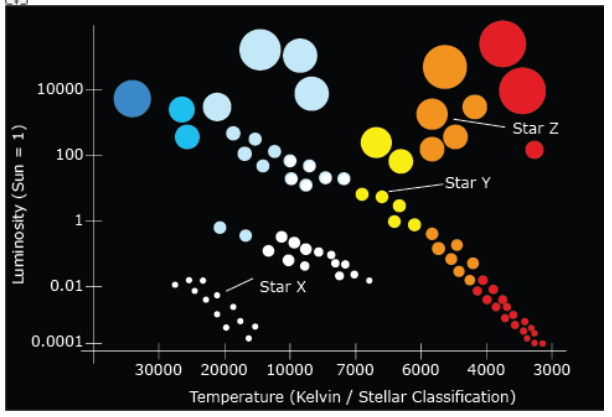
Three different stars have been labeled on the HR diagram displayed. When analyzing Stars X, Y, and Z, which star would have the greatest luminosity and lowest surface temperature?
Star Z
200
In which position (A, B, C, or D) is the Northern Hemisphere experiencing Summer? 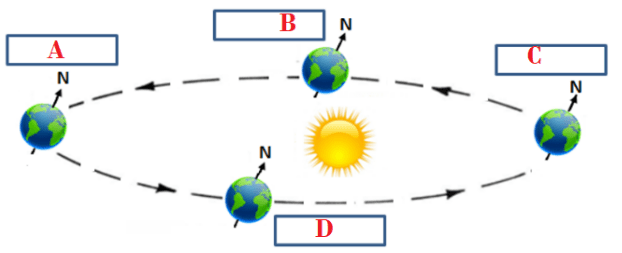
A When the northern hemisphere is titled toward the Sun
200
When the moon appears to be getting larger, it is______.
a) crescent b) gibbous
c) waxing d) waning
c) waxing
300
As a star uses up its hydrogen supply, it changes from a main sequence star to a -
A. black hole
B. supernova
C. red giant
D. dwarf
C. red giant
300
The spectral classes of four stars are shown in comparison with a Hertzsprung-Russell diagram.
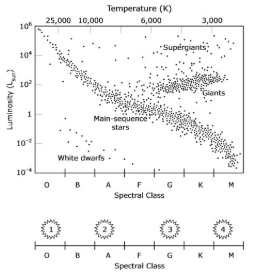 Based on the information, which star is most like the sun?
Star 1 or 2 or 3 or 4
Star 3
Our Sun is a G
300
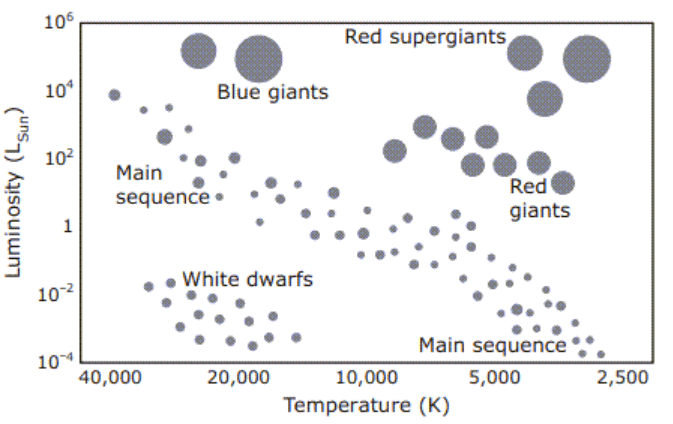
A star that has a luminosity of 10-2 and a temperature of 20,000 K is most likely a —
White dwarf
300
In which position (A, B, C, or D) could the Northern Hemisphere be experiencing Winter Solstice? 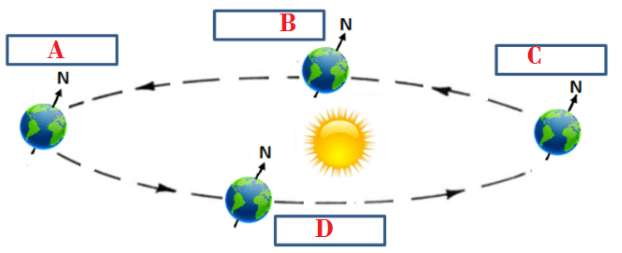
C When the northern hemisphere is tilted away from the Sun
300
After the full moon, which of these phases will the student observe next?
A. Waxing crescent moon
B. Waxing gibbous moon
C. Waning crescent moon
D. Waning gibbous moon
D. Waning gibbous moon
400
Which statement about stars is correct?
A. Star formation begins in a nebula.
B. White dwarfs become main-sequence stars when they gain mass.
C. Supergiants are stars that can absorb black holes.
D. Main-sequence stars are formed by comets.
A. Star formation begins in a nebula.
400
**OFF TOPIC** Extra 200 pts
What type of animal was the first animal in space and what was it's name?
Laika the dog :(
400
**OFF TOPIC** Extra 200 pts
The old guy that wrote the Almagest, listing 48 of the constellations was:
Ptolemy
400
What causes the seasons?
The tilt of the Earth's axis
Bonus 200 pts - and it's orbit around the Sun
400
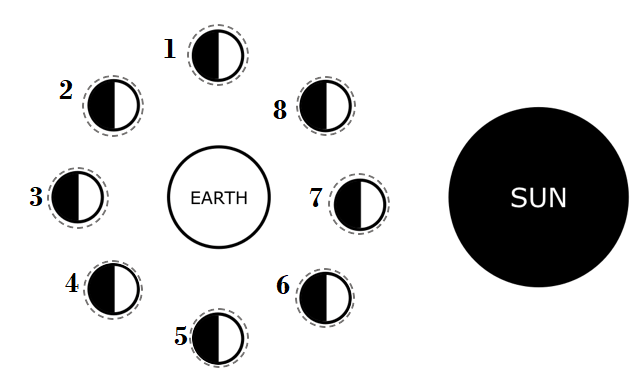
At which position would you experience a solar eclipse?
7
Earth -> Moon -> Sun
500
Put the following phases of the life cycle of a star in order from youngest to oldest:
- main sequence
- protostar
- black dwarf
- nebula
- white dwarf
- red giant
- nebula
- protostar
- main sequence
- red giant
- white dwarf
- black dwarf
500
**OFF TOPIC** extra 200 pts
What is the name of the asterism in Sagittarius?
Teapot
500
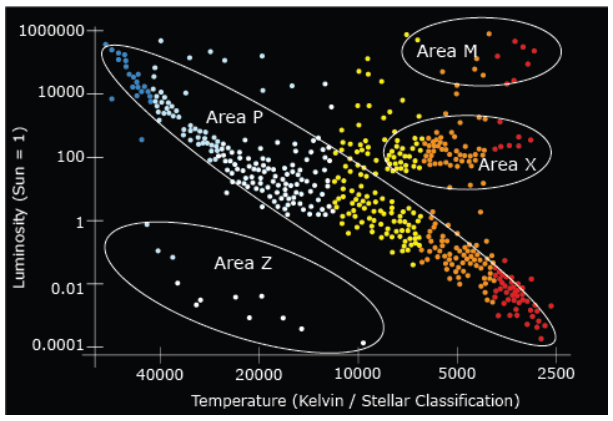
In which area of the HR diagram would the Sun be found?
Area P
The Sun is a main-sequence star
500
**OFF TOPIC** Extra 200 pts
Put the planets in order from the Sun.
Mercury Jupiter
Venus Saturn
Earth Uranus
Mars Neptune
500
Which moon phases are associated with the Spring tides? PICK 2
A. full
B. first quarter
C. new
D. third quarter
A. full and C. new