Seasons + Tides
Moon Phases
Space Hierarchy
Solar System Properties
Star Properties
Models of the Solar system
100
What season is it in Northern Hemisphere at A?
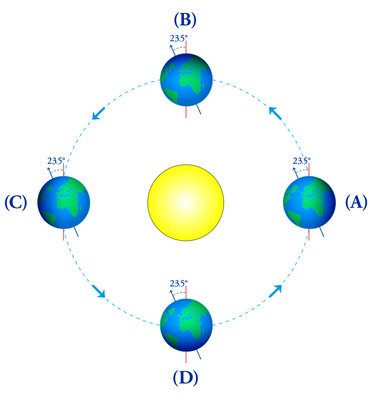
Summer
100
What is this?

Solar Eclipse
100
What is a galaxy and how many stars are in a galaxy?
A collection of a billion stars, gas, dust, and other objects held together by gravity.
100
What force keeps planets orbiting the Sun?
Gravity
100
What star color is generally associated with the highest temperatures: red or blue?
Blue
100
What is the difference between the heliocentric and geocentric models?
The object at the center of the solar system, in the heliocentric model it is the sun and in the geocentric model it is the Earth.
200
What is the Season in Northern hemisphere at position D?
Spring
200
What moon phases comes after this?

Waning Crescent
200
Why do scientists use light-years instead of miles or kilometers to describe distances between stars and galaxies?
Because distances in space are so enormous that light-years are a more practical measurement.
200
How does the length of a planet's year generally change as its distance from the Sun increases?
The year becomes longer.
200
What is the difference between apparent brightness and luminosity?
Apparent brightness is how bright a star looks from Earth; luminosity is how much light the star actually produces.
200
Geocentric, heliocentric, or both: In which model does the Moon orbit Earth?
Both
300
What type of tide occurs during a New Moon and a Full Moon?
Spring tides
300
What moon phases comes after this one?
Full moon
300
A star appears brighter than another star in the night sky. Give one reason this might happen besides the star actually producing more light
It may be closer to Earth.
300
Which planetary property is most likely to decrease as distance from the Sun increases: average temperature, length of year, or orbit size?
Average temperature.
300
What layer of a star is responsible for the cycling of gases, moving between hot and cold?
The convective zone
300
According to the Law of Universal Gravitation, what role did gravity play in the formation of the solar system?
What is gravity pulled matter together to form the Sun, planets, moons, and their orbits?
400
During which moon phases do neap tides occur?
First Quarter and Third (Last) Quarter Moon phases?
400
What is two moon phases after this one?
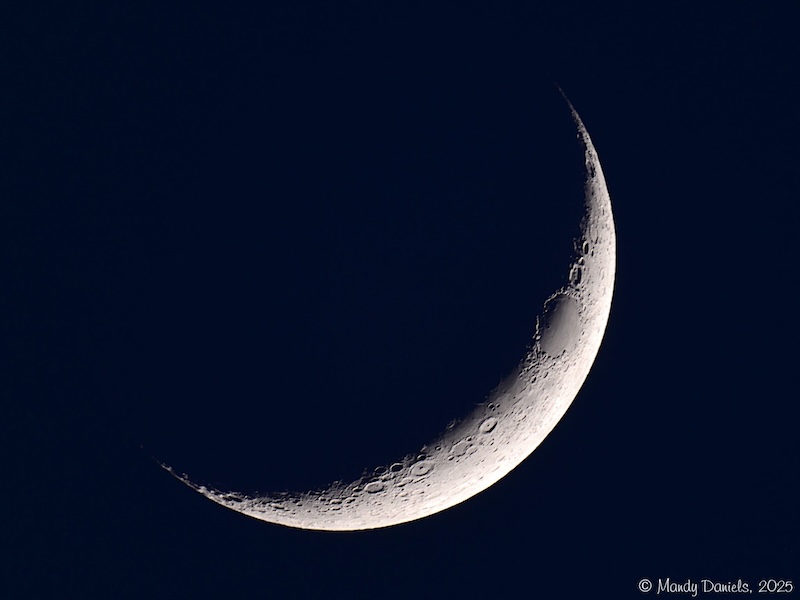
First quarter then, Waxing Gibbous
400
Two stars appear equally bright when viewed from Earth. Scientists discover that Star A is much farther away than Star B. What can be concluded about the stars' luminosities?
Star A must have a greater luminosity because it appears just as bright as Star B despite being much farther away. The evidence is the combination of apparent brightness and distance.
400
Astronomers are examining a planet that has several moons, rings, and a much thicker atmosphere. Name what group of planets it could relate too.
Gas giants
400
How can a solar flare affect Earth?
It can interfere with satellites, communications, GPS systems, and power systems.
400
What are the three factors of a planets orbit?
Gravity, speed, and direction
500
Two coastal towns are recording tides. Town A is experiencing unusually high high tides and unusually low low tides. Town B is experiencing only small differences between high and low tides. Identify the type of tide each town is experiencing and explain why.
Town A is experiencing a spring tide because the Sun's and Moon's gravitational pulls are working together. Town B is experiencing a neap tide because the Sun and Moon are pulling in different directions, reducing the overall tidal effect.
500
Why don't solar and lunar eclipses occur every month even though the Moon orbits Earth every month?
Because the Moon's orbit is tilted, the Sun, Earth, and Moon are not perfectly aligned every month.
500
Draw me a HR diagram, include the labels of axes in the correct position.
X axis = Temperature and Y axis = Luminosity
500
Scientists discover two planets orbiting the same star. Planet X is much farther from the star than Planet Y. Predict two differences scientists would expect to observe and explain your reasoning.
They should expect to see a difference in mass, temperature, composition, etc.
500
A red star and a blue star appear to be the same size. Using what you know about star color and temperature, explain which star is likely producing more energy and why.
The blue star is likely producing more energy because blue stars have higher surface temperatures than red stars. Higher temperatures generally indicate greater energy output.
500
What is the relationship between gravitational pull and size AND between gravitational pull and distance?
Gravity increases with increasing mass, and decreases with increasing distance.