Identifying and Describing Transformations
Is it Rigid?
Congruence
Random
Angles
100
What are the first three types of Rigid Transformations that we learned?
Reflection, Rotation, and Translation
100
Can a rigid transformation take blue triangle to the yellow triangle? If so, which transformation?

No!
100
How do we know if two figures are congruent? (Hint: Do not just say "they are exactly the same.")
If there is a rigid transformation that takes one to the other.
100
How many triangles can be created with a 20 degree, 100 degree and 70 degree angles?
NONE
100
What is the vocab word for two angles that add up to 90 degrees?
Complementary
200
The image shows an example of which transformation?

Translation
200
Does the following image represent a rigid transformation? If so, identify which one.

Yes, a rotation.
200
If two quadrilaterals have the same four side lengths in the same order, are they always congruent?
No! (Example: a rectangle and parallelogram)
200
How many triangles can be created with sides of 7cm, 8cm, and 10cm?
1
200
What is the 3 LETTER NAME of the angle that is equal to angle ZOX? 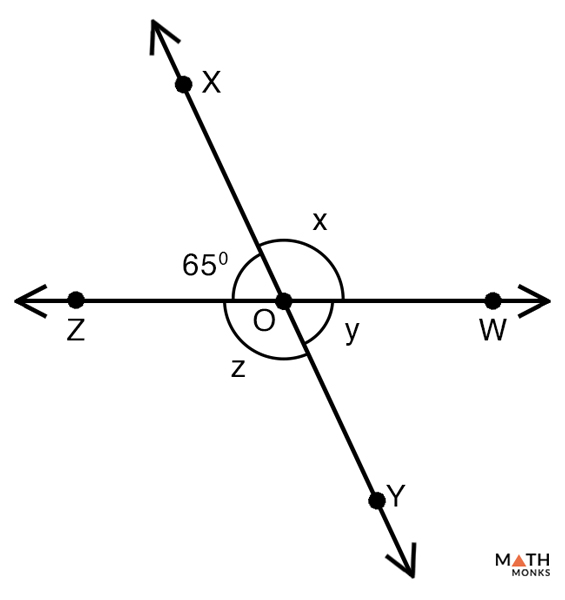
WOY or YOW
300
The image shows an example of which transformation?

Reflection
300
Name some kind of transformation that IS NOT rigid.
Dilation, slicing, stretching, compressing, etc.
300
You order a small pizza and I order a large pizza. Are they congruent? EXPLAIN
No --> difference sizes
300
Define Congruence
Same shape, same size
300
What is the measure of angle WOX?
115 degrees
400
Please find the line of reflection.
Y-axis or Y=0
400
In order to describe a rotation, you must include what?
The center of rotation (a point), the angle of rotation (how many degrees), and the direction (clockwise or counterclockwise.
400
My triangle has angle measures of 90, 45 and 45 degrees. If you draw a triangle with the same angle measures, does it have to be congruent? EXPLAIN.
No --> could be different side lengths.
400
Define Corresponding
Same thing, same location
400
What is the term for two angles on opposite sides of a vertex, which are always equal in measure?
Vertical Angles
500
Please identify the transformation. (3 pieces of information needed)

Rotation 1:90* 2:Clockwise 3:Around vertices (1,-3)
500
In order to describe a reflection, what must you include?
Line of reflection
500
Imagine two triangles:
In the first triangle, all three angles equal to 60 degrees. In the second triangle, all three angles are equal to 60 degrees.
Is it true that these triangles MUST be congruent?
No, they could be different sizes.
500
What is the difference between congruent and similar?
SIZE
500
What is the word for two angles that add to 180 degrees?
Supplementary