Sedimentary
Igneous
Metamorphic
Properties
Properties 2
100
What is one way to describe a sedimentary rock?
 A. lightweight, with rough surfaces full of holes
B. many small grains of sand in different layers
C. solid black color, smooth texture, and sharp edges
D. large crystal shape, smooth sides, almost clear
B. many small grains of sand in different layers
100
Granite is formed by the slow cooling of Earth’s magma. What is granite?
A. Granite is a fossil.
B. Granite is a mineral.
C. Granite is an igneous rock.
D. Granite is a metamorphic rock.
C. Granite is an igneous rock.
100
Metamorphic rock is formed when ___________ heats existing rock?
A. minerals
B. fossils
C. sediment
D. magma
D. magma
100
Jane found a necklace with a stone that looked like a diamond. Her friend thought the stone was glass. Which test would best help Jane determine if the stone was a diamond or glass?
A. color
B. luster
C. streak
D. hardness
D. hardness
100
How can a hardness test be performed on a mineral?
A. by placing the mineral on a scale
B. by rubbing the mineral with strong acid
C. by breaking the mineral with a hammer
D. by scratching the mineral with different objects
D. by scratching the mineral with different objects
200
Which natural processes could result in the formation of sedimentary rocks?
A. weathering and erosion
B. earthquakes and weathering
C. erosion and volcanic eruptions
D. volcanic eruptions and earthquakes
A. weathering and erosion
200
Granite is a rock that forms when magma crystallizes beneath the earth. Which rock type is granite?
A. igneous
B. sediment
C. sedimentary
D. metamorphic
A. igneous
200
Which is the best example of how metamorphic rocks are formed?
A. by being dissolved in water
B. by being melted in a hot fire
C. by being broken off a mountainside
D. by being changed by heat and pressure
D. by being changed by heat and pressure
200
A boy examines an unknown mineral. He looks along the lines where it is broken. What physical property is he looking for to help him identify the mineral?
A. luster
B. streak
C. hardness
D. cleavage
D. cleavage
200
A boy examines an unknown mineral. He looks along the lines where it is broken. What physical property is he looking for to help him identify the mineral?
A. luster
B. streak
C. hardness
D. cleavage
D. cleavage
300
The notes taken by a scientist observing limestone are shown below.
- It forms near warm, shallow water.
- It is created when small fragments of coral and other marine organisms cement together.
- It fizzes rapidly when exposed to vinegar.
Which rock type classifies limestone?
A. volcanic
B. sedimentary
C. igneous
D. metamorphic
B. sedimentary
300
Igneous rocks are formed by the cooling of ________ on Earth’s surface?
A. magma
B. fossils
C. sediment
D. sand crystals
A. magma
300
A metamorphic rock is formed when magma heats ___________ ?
A. fossils
B. existing rock
C. sediment
D. minerals
B. existing rock
300
A scientist closely observed a group of minerals and noticed one was split along smooth flat planes. What physical property did the scientist observe?
A. color
B. streak
C. cleavage
D. hardness
C. cleavage
300
A class tested unknown minerals by scratching them with a penny. Which physical property of the unknown minerals did the class test?
A. color
B. luster
C. streak
D. hardness
D. hardness
400
As Andy is traveling in California, he sees a sedimentary cliff. He knows it is Sedimentary because it contains
A. crystals
B. layers and fossils
C. inorganic rock
D. metamorphic rock
B.layers and fossils
400
What happens to the lava produced by a volcano?
A. It is absorbed into the soil around it.
B. It flows back under the Earth’s surface.
C. It hardens and turns into igneous rock.
D. It evaporates into the atmosphere.
C. It hardens and turns into igneous rock.
400
Marble is a type of rock formed from extreme heat and pressure. What type of rock is marble?
A. igneous
B. mineral
C. sedimentary
D. metamorphic
D. metamorphic
400
Sarah has a mineral she wants to identify. How could she perform a streak test to help her identify the mineral?
A. by measuring the width of the mineral
B. by observing the mineral in the sunlight
C. by rubbing the mineral on a ceramic plate
D. by scratching the mineral with a fingernail
C. by rubbing the mineral on a ceramic plate
400
Which test would a geologist use to test the hardness of a mineral?
A. Break a piece of talc in half and observe its cleavage.
B. Drop a piece of talc into a cup of water and observe whether it floats.
C. Scratch a piece of talc with a nail and observe whether it produces a dent.
D. Rub a piece of talc across a surface and observe whether it produces a shiny streak.
C. Scratch a piece of talc with a nail and observe whether it produces a dent.
500
This type of rock can be formed when glaciers carry _____ down a mountain, depositing eroded materials.
A .lava
B. rocks that have been changed
C. sediment
D. minerals
C. sediment
500
The chart below shows a rock collection.
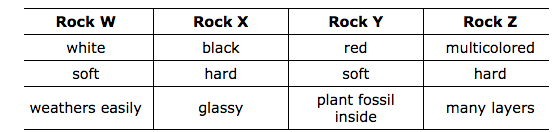 Which rock is an igneous rock?
A. Rock W
B. Rock X
C. Rock Y
D. Rock Z
B. Rock X
500
A metamorphic rock always starts as
a. igneous or sedimentary
b. fossils
c. minerals
d. magma or lava
a. igneous or sedimentary
500
Cubic zirconias look like diamonds. Which test could best be used to tell the difference between them?
A. observe which one can scratch different substances
B. observe how shiny each is, using a magnifying glass
C. break them with a hammer and observe the shape of the pieces
D. rub both across a rough surface and observe whether any color appears
A. observe which one can scratch different substances
500
All rocks are made up of
A. salts
B. minerals
C. particles
D. quartz
B. minerals