Rocks
Rocks (again!)
Soil / Erosion
100
What test do you perform when trying to find out what rock is harder than another?
A. The hardness test
B. The scratch test
C. Moh's Hardness Scale
D. Feeling the rock
B. The scratch test
100
Ms. Castagner's 3rd Grade class collected rocks from the recess area. They scratched the rocks against the mineral topaz. What property are the students trying to investigate?
A. Color
B. Texture
C. Hardness
D. Luster
100
Ms. Gail needs help figuring out the correct order of steps she needs to follow when investigating which soil type is best for growing plants. She wrote down the three steps below, please list them in order.
Water the plants regularly and measure their growth over a few weeks, Plant the same type of seeds in three separate pots, and Fill one pot with sand, another with clay, and the third with loam.
Step 1: Plant the same type of seeds in three separate pots
Step 2: Fill one pot with sand, another with clay, and the third with loam
Step 3: Water the plants regularly and measure their growth over a few weeks
200
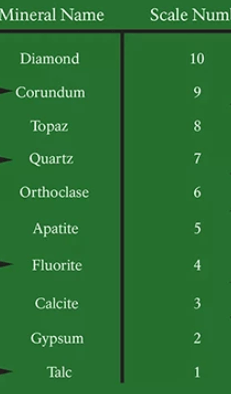
Which mineral is the hardest? Which is the softest? How do you know?
Diamond is the hardest because it is a 10 on the Mohs Hardness Scale. Talc is the softest because it is a 1 on the Mohs Hardness Scale.
200
Rock Observations From Ms. Ganon's class:
Rock 1 is rough with jagged edges. It is black with grey spots.
Rock 2 is smooth and brownish-white.
Rock 1 and 2: Rock 1 scratched Rock 2. Rock 2 did not leave a mark on rock 1.
What question should the students ask to help classify the rocks?
A. What are rocks?
B. Do the rocks reflect light?
C. Where do we find rocks?
D. Which rock is harder?
D. Which rock is harder?
200
What would the best reason be for soils looking different?
A. Soil looks different because it does
B. Different plants grow in the different soil
C. Soils are not all the same color
D. Soils are exposed to different amounts of wind and water
D. Soils are exposed to different amounts of wind and water
300
Which mineral is the hardest? Why?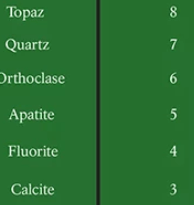
Topaz is the hardest because it is an 8 and that is the highest number on the scale shown.
300
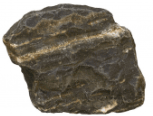 What observations would describe the rock above?
A. Black, dull, smooth
B. Grayish-tanish, shiny, smooth
C. Grayish-tanish, dull, bumpy
D. Tanish-white, dull, jagged
C. Grayish-tanish, dull, bumpy