Angular Kinematics
Torque
Moment of Inertia
Angular Momentum
Miscellaneous
100
A wheel is spinning initially with a velocity of 2.5 rad/s. It then undergoes an angular acceleration of 1.2 rad/s^2 for 10 seconds. What is its final angular velocity?
14.5 rad/s
100
What direction should a force point (compared to the lever arm or radius) to create the maximum amount of torque?
Perpendicular
100
The moment of inertia for a rod spun around its middle point can be found by (1/12)ML^2, where L is the length of the rod.
A baton twirler wants to know the moment of inertia of her baton, which is 0.8 m long and has a mass of 0.24 kg.
0.0128 kg*m^2
100
When is the angular momentum of an object not conserved? (What causes a change in angular momentum?)
An external torque
100
Why do people use long levers to lift heavy objects?
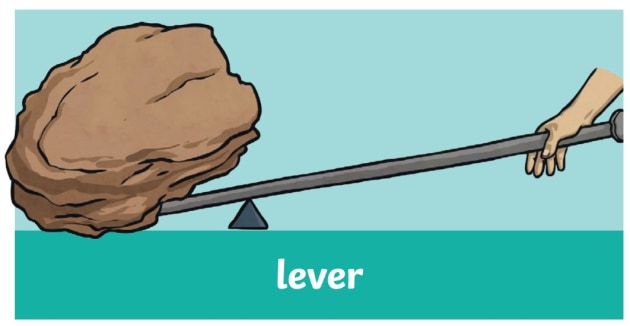
Left side: large force of gravity from rock but close to fulcrum
Right side: far from fulcrum, so less force required to lift rock
200
If it takes a bike wheel 3 seconds to complete one revolution, what is the wheel's angular velocity?
2.09 rad/s
200
What does r represent in the torque equation?
The distance from the axis of rotation to the point where the force is applied.
200
Which has a larger moment of inertia, a figure skater with their arms out or in? Why?
Arms out because there is mass further away from the axis of rotation.
200
Give an example of an object that has both angular momentum and linear momentum.
Example: the wheels on a car, bike, etc.
200

What show is this character from?
Community
300
What is the angular velocity of the second hand of a clock?
π/30 rad/s
0.105 rad/s
300
What is the net torque on a balanced system (such as a meter stick with two different masses hanging that make it hang horizontally)?
Zero
300
Consider the earth as a sphere of uniform density with mass of 5.852×10^24 kg and radius of 6.693×10^6 m rotating about an axis through the poles. What is its moment of inertia? I=(2/5)MR^2
1.05×10^38
300
Explain why stars spin faster when they collapse in on themselves.
The mass of the star goes toward the axis of rotation, decreasing the moment of inertia, which causes an increase in angular velocity because angular momentum is conserved.
300
True or false? Any force can cause a torque
False. Any force pointing directly toward or away from the axis of rotation will not cause a torque.
400
If a ferris wheel has height of 100m, find the angular velocity in rotations per minute (RPM) if the riders in the carts are going 7m/s.
1.34 RPM
400
Two students are balancing on a seesaw. The student on the left weighs 60 kg and is sitting 3 m away from the center. The student on the right weighs 45 kg. The seesaw is parallel to the ground. Assume the board that makes the seesaw is massless.
What distance from the center should the student on the right be if they want the seesaw to stay parallel to the ground?
4 m
400
If I apply the same amount of torque to a solid ball and a hollow ball that have the same mass and radius, which will experience a larger angular acceleration?
The solid ball
400
What is the average torque exerted on an object with rotational inertia 0.05 kg*m^2 that is initially rotating at 54.2 rad/s and comes to a stop in 11 seconds?
-0.246 N*m
400
I start pushing a merry-go-round with a torque of 10 Nm. It has a moment of inertia of 100 kg⋅m2. What is its rotational speed after 3 seconds assuming it starts at rest?
0.3 rad/s
500
A carousel has an initial angular velocity of 9.5 RPM. At the end of the ride, the brakes are applied, giving it a constant angular acceleration of -0.022 rad/s^2 as the ride slows to a stop. Determine the angular velocity of the ride, in rad/s, after it has made one revolution during the braking period.
0.84 rad/s
500
What is the net torque on a 2-kg object that is rotating at with a constant angular velocity of 4.5 rad/s?
Zero
500
What if another planet the same size as Earth were put into orbit around the Sun along with Earth (in the same orbit). Would the moment of inertia of the system increase, decrease, or stay the same?
Increase
500
A cylindrical spacecraft (I=MR^2) with a mass, M, of 15,000 kg and a radius, R, of 3.2 m is spinning with an initial angular velocity, ω, in the clockwise direction. Thrusters that exert a force of 1500 N each when fired are positioned as shown on the outside of the spacecraft. Calculate the magnitude of the change in the angular momentum of the spacecraft if the thrusters fire for 5.0 seconds.
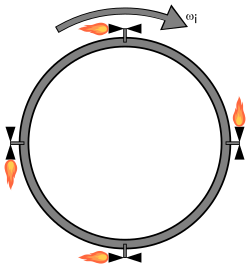
48,000 kg*m^2/s
500
Consider the earth as a sphere of uniform density with mass of 5.852×10^24 kg and radius of 6.693×10^6 m rotating about an axis through the poles. What is the tangential velocity of a point on the surface at the equator?
486.7 m/s