Microbiology
Emergencies/Triage
Clinical Care
Vocabulary
Random
100
What is a nosocomial infection?
an hospital borne infection
100
What are the 3 types of solutions?
Hypertonic, hypotonic, isotonic
100
What is the function of HDL?
To remove excess cholesterol
100
What is herd immunity?
a form of artificially acquired immunity that occurs when the majority of a population, but not all, has been given a vaccine and becomes resistant to infection
100
What color are gram negative and gram positive stains?
Gram Negative: Pink
Gram Positive: Purple
200
What is a prion?
a misfolded protein
200
Which way does water always move towards in an osmotic solution?
Towards the solute
200
What is a negative feedback loop?
A loop that the body uses to maintain homeostasis
200
What is a B cell?
A type of lymphocyte (white blood cell) that matures in bone marrow and produces antibodies.
200
What does transmission mean?
spreading of a disease
300
What shape is cocci, bacillus, and spirillum?
Cocci: Sphere
Bacillus: Rod
Spirillum: Spiral
300
What is the difference between pupillary response and consensual reflex?
Pupillary Response: pupil dilates or constricts when light is shined.
Consensual Reflex: Opposite pupil reacts to light being shined into the other eye.
300
What is a positive feedback loop?
a loop the body uses to push it past homeostasis and achieve a purpose
300
What is a T cell?
A type of white blood cell (lymphocyte) produced by the thymus and involved in the immune response
300
What are the responsibilities of cholesterol in the body?
key component in the structure of cell membranes and is also used to make essential molecules such as hormones and vitamins
400
Which gram stain is typically more dangerous and why?
Gram Negative because it has LPS's and a thicker outside peptidoglycan layer.
400
What are the 4 levels of triage?
Emergent, Urgent, Semi Urgent, Non Urgent
400
What are the components of a CBC panel?
Red Blood Cells (Erythrocytes), White Blood Cells (Leukocytes), Platelets (Thrombocytes), Plasma, Hemoglobin, Hematocrit
400
What are the routes for enteral drugs?
Any medication administered through the digestive system
400
What are the steps to primary assessment?
Form a general impression, determine MOI, determine patient's responsiveness, consider stabilizing the patient's spine, check the ABC's
500
What is the structural difference gram positive and gram negative bacteria?
Gram negative bacteria have a thin peptidoglycan layer. Gram positive bacteria have a thick layer of peptidoglycan.
500
What are the steps to secondary assessment?
Perform physical assessment, take patients vitals, get medical history, provide appropriate emergency care
500
What is systolic blood pressure?
The force exerted by the heart when it is contracting
500
What are the routes of parenteral drugs?
Anything other than the digestive system
(Topical/Dermal, injection, inhalation)
500
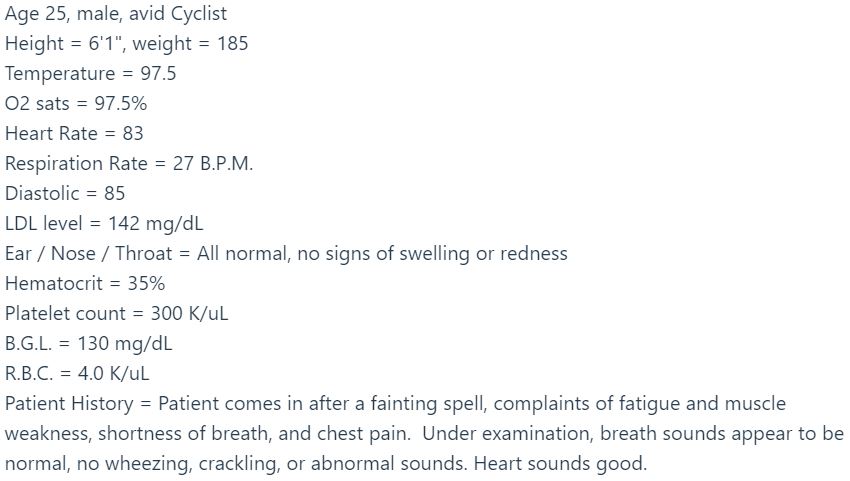
Blood pressure and LDL levels being elevated, coupled with chest pain, fatigue and fainting spells points to arteriosclerosis. Patient is an avid cyclist but numbers suggest a poor diet. Prescribe an angiogram to rule out blood flow issues in the heart and possible source of the chest pain. In addition, a cardiac stress test to rule out cycling as the cause of fainting.