Light & Matter (Eye)
Light & Matter
Thermal Energy (Particles)
Thermal Energy (Concepts)
Weather
100
Labeled as 1 in the diagram.
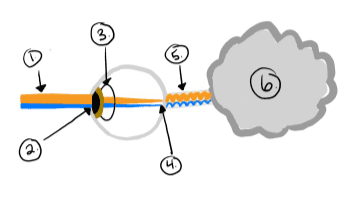
What is light input?
100
When light reaches a regular mirror, this is what happens to all of the light.
What is reflect?
100
This is what happens to particles as they cool down.
What is they slow down?
100
This is the energy of motion.
What is kinetic energy?
100
This is any form of water that falls from clouds and reaches Earth's surface.
What is precipitation?
200
This part of the eye is labeled as (5) in the figure.
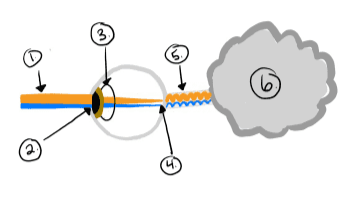
What is optic nerve?
200
This is a piece of glass with a thin, silver film that causes some light to reflect and some to transmit.
What is one-way mirror?
200
This is how heat transfers between particles.
What is they collide?
200
This is the measure of the average kinetic energy of the particles in a substance.
What is temperature?
200
This is the change of state from a liquid to a gas.
What is evaporation?
300
The pupil is the black part that takes in light.
What is 2?
300
This material transmits the most amount of light.
What is glass?
300
Food coloring dropped in a cup of hot water will do this.
What is spread out quickly?
300
When two ice cubes melt in hot water, this is the direction of the thermal energy flow.
What is from the water to ice?
300
This is how the air in a cloud eventually stops rising.
What is it becomes cooler than the surrounding air and more dense?
400
This part of the eye focuses light after it is taken in.
What is the lens?
400
This is what happens to the light when it reaches a one-way mirror.
What is some of the light reflects and some transmits?
400
Particles in a fixed, regular pattern, representing this state of matter.
What is a solid?
400
Water droplets that form on the outside of a cold cup come from this location.
What is the surrounding air?
400
This is the change of state from a gas to a liquid.
What is condensation?
500
This is what the optic nerve does.
Transmit the electrical signal to the brain.
500
This is the condition of light/darkness that would make a building's window act like a mirror from the outside.
What is light outside and dark inside?
500
In the figure showing water at 5 degrees Celsius and air at 20 degrees Celsius, this has the most kinetic energy.
What is the particles in the air?
500
If an object at 25 degrees Celsius is touching an object at 18 degrees Celsius, this is the direction in which heat energy will move.
What is from the 25 degrees Celsius object to the 18 degrees Celsius object (from the warmer object to the cooler object)?
500
Draw a model showing how water in the air gets there.
(Shows process of evaporation/particles gaining energy)