Enzymes/DNA
Meiosis/Mitosis
Genetics
Mutations
Cellular Communication & Differentiation
100
For exergonic or favorable reactions, the energy of the products is (lower/higher) than the energy of the reactants. Bonus question: what is the answer for endergonic or unfavorable reactions?
Exergonic: lower; endergonic; higher
100
Compare and contrast Meosis and Mitosis. List at least 3 differences.
Both lead to new cells. Meiosis: makes 4 haploid cells, that are genetically diverse due to crossing over/independent assortment. Mitotsis: makes 2 identical, diploid cells.
100
Compare two genes on the same chromosome, A and B, that are closer together, and two genes, A and C, which are farther apart from each other. Which is harder to separate?
A and B
100
Insertion or deletion mutations are also known as ______ mutations.
Frameshift, because they shift the reading frame (different from a point mutation).
100
What are the different phases of the cell cycle?
G1 (growth 1), S (synthesis of new DNA), G2 (growth 2), M (mitosis!)
200
What do all reactions need in order to proceed, even favorable ones?
Activation energy! The "hump" on the diagrams.
200
In what stage(s) does crossing over occur? In what stage(s) does independent assortment occur? What is the benefit of these mechanisms?
Crossing over occurs in prometaphase I only (you need to have the homologous pairs together to cross over!). Independent assortment occurs in both Meiosis I and II in the metaphase stage. Both help increase genetic diversity!
200
Predict the percentage of offspring that will have the genotype AaBBCc in a cross between AABbcc x AaBbCc.
1/16 or 4/64
200
What is the difference between genic and intergenic mutations? Which mutation usually has more severe consequences?
Genic is a mutation in a gene, and intergenic is a mutation in a non-coding sequence. Genic mutations usually have more severe consquences, but intergenic mutation can still be consequential (for example, mutating a promoter region).
200
What are multi-potent cells and totipotent cells? What are they used for?
These are cells that divide and differentiate into different cells. Totipotent is a cell that can differentiate into any cell type (aka the zygote!).
300
Describe or draw how telomeres are made and why they are important.
Telomerase extends the end of the DNA by binding an RNA primer to a specific sequence at the end of the strand and then adding DNA to those repeating primers. DNA polymerase can then copy the whole strand starting from the telomere so that DNA doesn't get shorter every times cells replicate.
300
What are defects that can occur from meiosis?
If the incorrect number of chromosomes are separated (so for example 3 in one cell and 1 in the other during meiosis 1) this is called anuploidy and can happen in meiosis 1 or 2.
300
A white rabbit and black rabbit are bred and all of the bunnies are gray! What type of trait is this (dominant, co-dominant, incomplete dominant?) Give examples of what you would see for the other two.
This is incomplete dominance as the phentype is a "blend" of the two alleles. Dominant we would see all the bunnies be black if black is the dominant color. Co-dominant is when both alleles contribute to the phenotype, so the bunnies could be white with black spots.
300
You go to the beach and forget your sunscreen. Oops! The UV radition causes a thymine dimer to form in one of your cell's DNA (oh no!). Describe/draw the steps your cells will take to repair the dimer
1. Detect the damge; 2. Cut out the damaged DNA; 3. Replace the nucleotides; 4. Repair the backbone
300
Draw an example of how the same extracellular signal can produce different outcomes in different cells (draw 3 different pathways!)
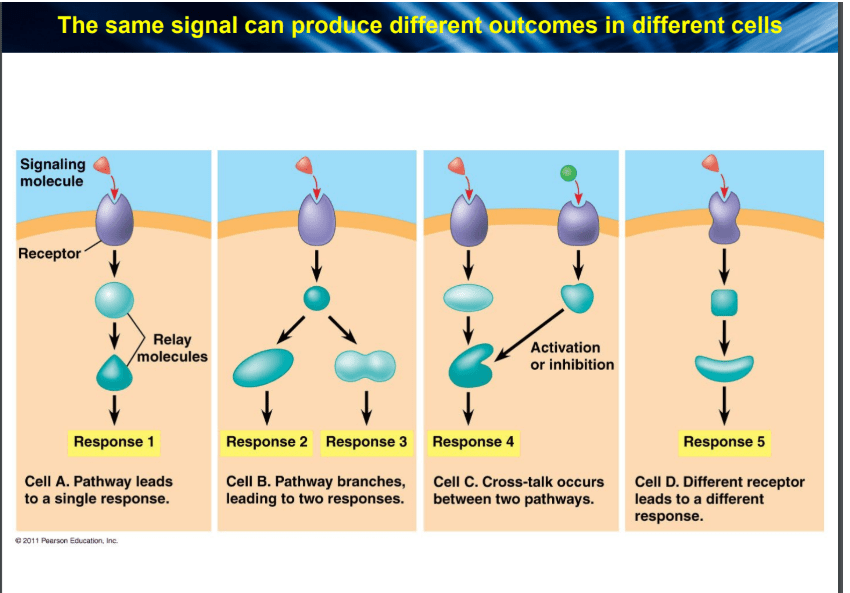
400
A kinase is a protein that adds a phosphate group to another protein. In this case, the kinase phosphorylates an enzyme. The enzyme no longer works. Why?
This is an example of allosteric binding. The addition of the phosphate group changed the shape of the active site so the enzyme could no longer do its job.
400
Draw a holiday junction where a crossover event does not occur. Clearly show which strand (invading or non-invading) gets cut.
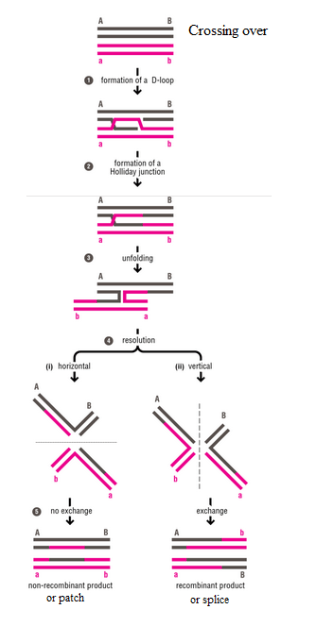
400
Child has Sickle Cell Anemia, caused a homozygous recessive genotype. Mom and Dad do not have Sickle Cell Anemia. Grandpa on dad's side has Sickle Cell, but grandma doesn't. Both Mom's parents don't have sickle cell. List all possible genotypes for child, parents, and the four grandparents.
Child: aa; Mom: Aa; Dad: Aa; Dad's dad: aa; Dad's mom: AA or Aa; Mom's parents: Aa x AA, or Aa x Aa
400
What are some effects of mutations? Think about effects on proteins and organisms.
Proteins: loss of function/gain of function; Organisms: dominant vs. recessive; deleterious vs. non deleterious (whether the organism survives)
400
Draw out the process of phosphorylation and dephosphorylation. What proteins/molecules are involved? What purpose does phosphorylation serve?
To phosphorylate: a protein kinase is an enzyme that helps attach the phosphate group to a protein from ATP. To dephosphorylate: a phosphatase removes the phosphate group. This either turns proteins on or off (depends on the protein!).
500
Define the following terms in bullet points or a drawing: Chromosome, Chromatin, Centromere,
Kinetochore, telomere, homologous chromosome, sister chromatids
Chromosome: One piece of DNA in its condensed form; Chromatin: a less condensed version of DNA; centromere: a protein in the center of the chromosome where microtubles attach during meiosis/mitosis; kinetochore: protein complex that help microtubles bind to centromere; telomere: non-coding ends of the DNA synthesised by telomerase to preventing shortening of DNA; homolougous chromosomes, two different copies of a chromosome containing the same genes but may have different alleles (think maternal and paternal); sister chromatids: two identical pairs of the same chromosome (two maternal pairs after DNA replication)
500
Draw out the steps of Meiosis. What chromosomes are being separated in Meiosis 1 (homologous chromosomes or sister chromatids?) What chromosomes are being separated in Meiosis 2?
Homologous chromosomes are separated in Meiosis 1, and sister chromatids are separated in Meiosis 2.
500
Explain Mendel's law of segregation versus Mendel's law of independent assortment.
Law of segregation is genes are on different chromosomes, so having one gene doesn't impact the likelihood of having another gene (on another chromosome specifically). Law of independent assortment is alleles on the same chromosome separating from each other in meiosis (ignoring crossing over for now).
500
What is a point mutation? What does it mean for a mutation to be missense, nonsense, or silent? What does it mean for it to be transition versus transversion? What does it mean for it to be conservative versus non-conservative?
A point mutation is a mutation of one nucleotide. Missense codes for a different amino acid, nonsense codes for a stop codon, silent codes for the same amino acid. Transition is a purine for purine & pyrimidine for pyrimidine, transversion is purine for pyrimidine etc. Conservative means a missense mutation with a similar amino acid, non-conservative is missense with a non-similar amino acid.
500
How do you know when a signal is being amplified or not?
See if it is a one to one interaction (like a ligand binding to a receptor, a G-protein activating adenyl cyclase, etc) or a reaction that could happen multiple times (like a kinase phosphorylating many proteins).