Geologic Time
Natural Selection and Adaptations
All Things DNA and RNA
Evidence of Evolution
Grab Bag! (Mostly More About DNA/RNA)
100
Explain the principle of inclusions.
According to the principle of inclusions, if one rock contains pieces of another rock, the rock containing the pieces is younger than the pieces.
100
True/False: Adaptations that help an organism survive appear quickly.
False. Adaptations become more common in a population over many generations through natural selection, rather than appearing quickly in individual organisms.
100
What do most genes code for?
Proteins
100
Define vestigial structure.
Vestigial structures are body parts that have lost their original function through evolution.
100
How old is the Earth?
4.6 billion years old
200
What type of unconformity is displayed below?
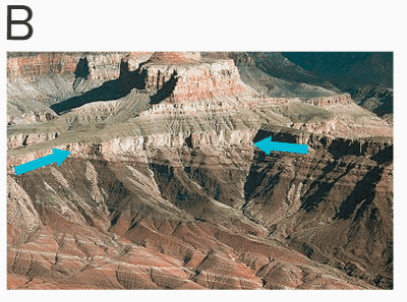
Angular unconformity

200
Who was the scientist that published his theory of evolution by natural selection?
Charles Darwin
200
In the process of translation, what does the process start with, and what does it end with (what is produced)?
DNA --> mRNA
200
According to the diagram below, hippopotamuses and whales/dolphins share a common ancestor that lived how long ago?
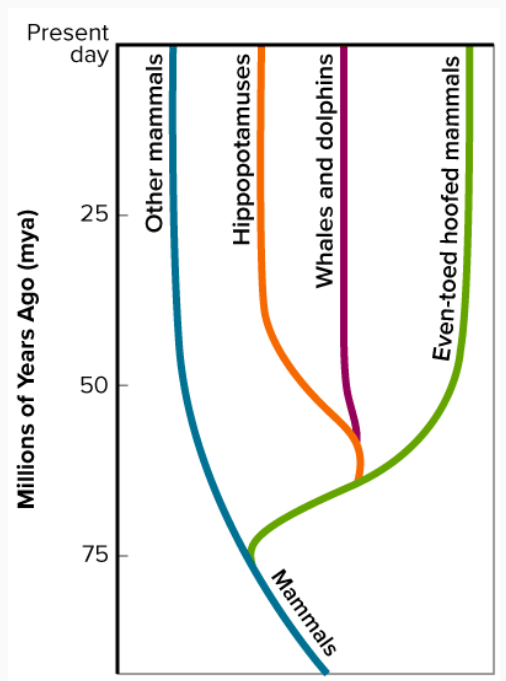
Approximately 50-60 million years ago (MYA)
200
Name the three types of RNA.
mRNA, tRNA and rRNA
300
Explain why the scale and boundaries within the geologic time scale are divided up unequally.
The divisions within the geologic time scale are not all the same length/amount of time because they mark places in the rock record where there are significant changes in the types of fossils present in the rocks, like mass extinctions. Mass extinctions do not occur at regular intervals.
300
What CAUSES the small changes in traits that cause variation? (One-Word Answer)
Mutations
300
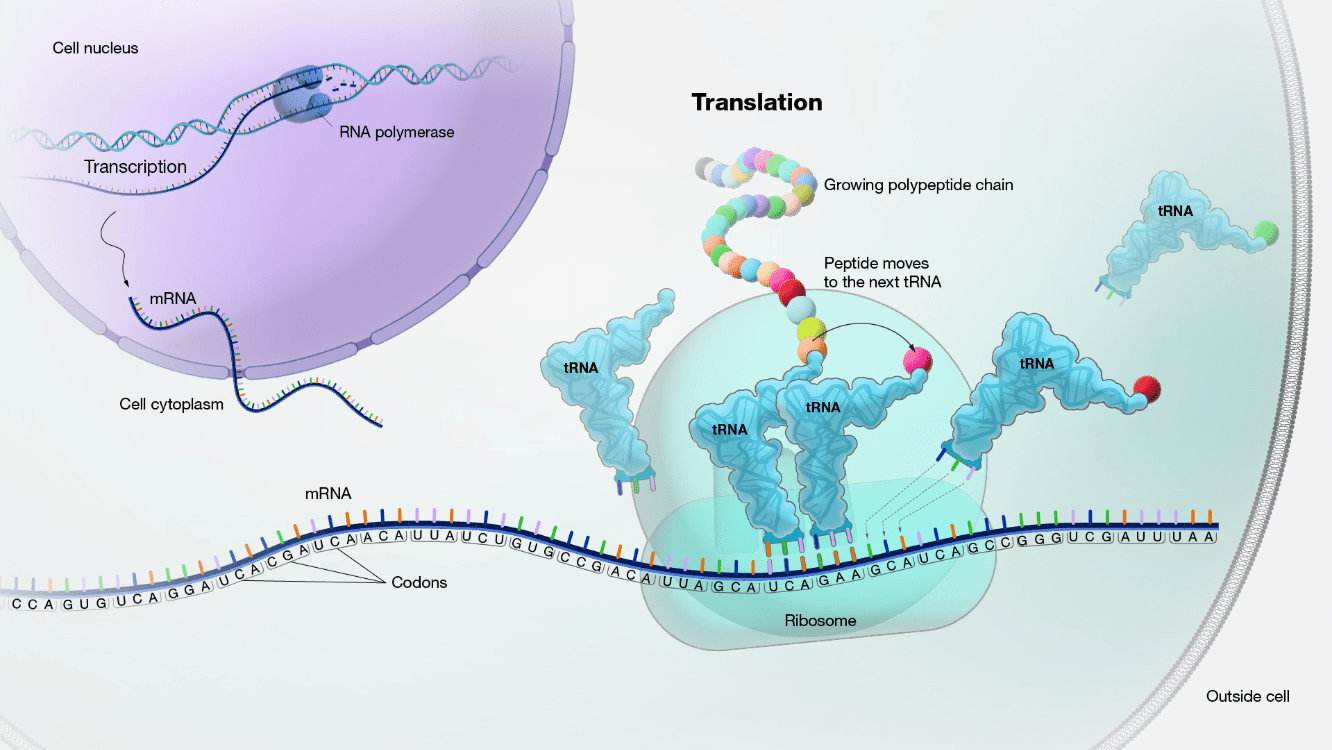
Where does the process of translation occur, and at which organelle of the cell?
Outside the nucleus in the cytoplasm, at organelles called ribosomes.
300
Fill-In-The-Blank: Butterflies taste with their legs, while humans taste with their tongues. In this way, butterflies' legs and humans' tongues are __________ structures.
Analogous
300
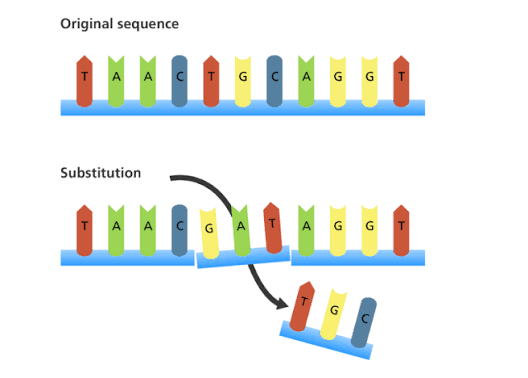
What type of mutation is pictured below?
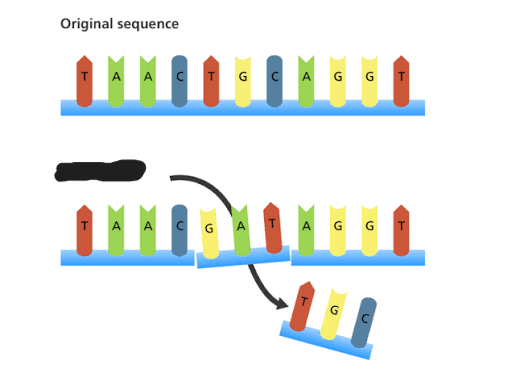
Substitution
400
What are index fossils used for?
Describe one feature of a fossil species that could implicate it as an index fossil.
Geologists use index fossils to correlate rock layers over large geographic areas or to date a particular rock layer.
To be useful, an index fossil must be abundant and widely distributed geographically. It must also have lived over a short period of time.
400
Give one example of natural selection and one example of artificial selection.
Answer Vary
400
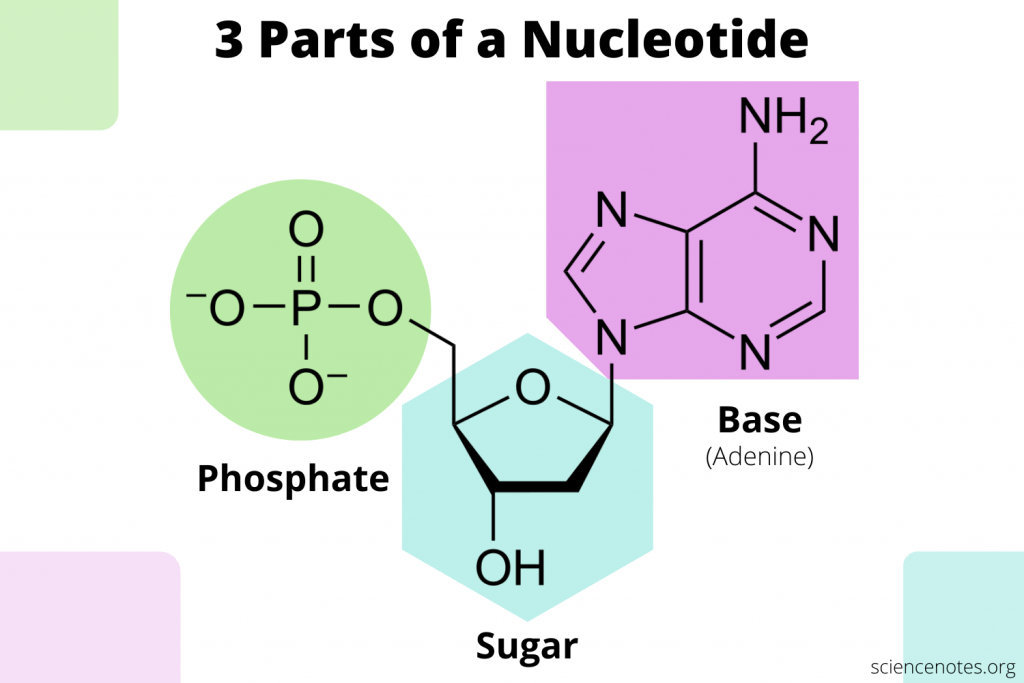
Name the three parts of a nucleotide.
Nitrogen base
A sugar
A phosphate group (A, T, C, G, and U)
400
Scientists compare the DNA sequences of three organisms and discover that Species A and B share 98% of their DNA, while Species A and C share only 75%. What can scientists conclude about their evolutionary relationships? Explain your reasoning.
Species A and B likely share a more recent common ancestor because their DNA sequences are more similar.
400
Analysis of a DNA sequence reveals that the amount of adenine in an organism genetic sequence is 28%. How much of the other nitrogenous bases are there?
Thymine: 28%
Cytosine: 22%
Guanine: 22%
500
DOUBLE JEOPARDY!
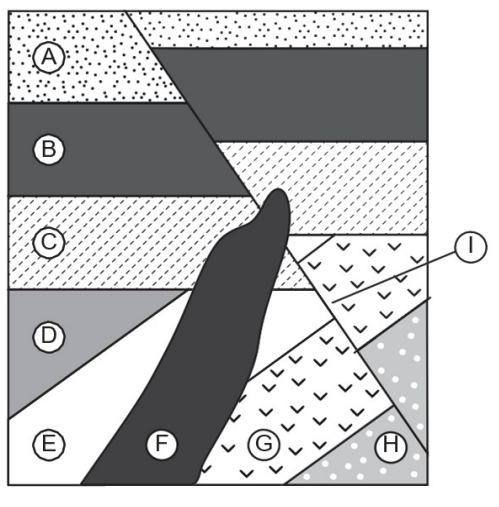
List the sequence of events that occurred in the area represented by the diagram below.
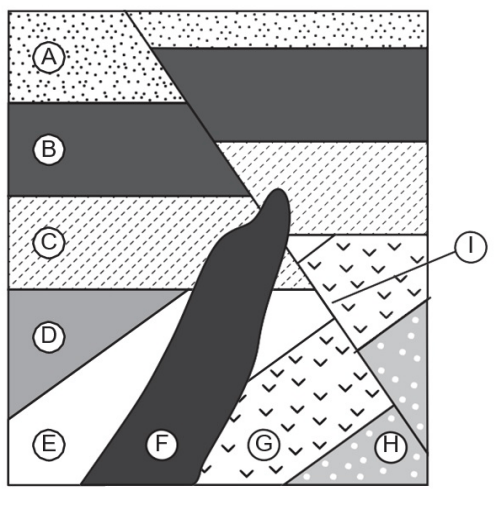
H (oldest), G, E, D, C, B, A, I, F (youngest)
500
Kangaroo rats and desert rodents produce highly concentrated urine and very little sweat to lose almost no moisture, and some can derive all the water they need purely from metabolizing dry seeds. What kind of adaptation is this considered?
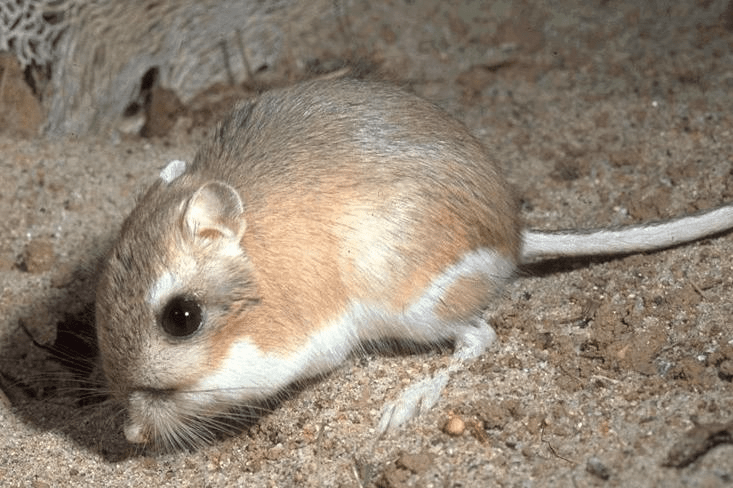
Functional
500
List two differences between DNA and RNA.
DNA is double-stranded, RNA is single-stranded
DNA contains the sugar deoxyribose, while RNA contains the sugar ribose
DNA contains thymine, while RNA contains uracil
500
DOUBLE JEOPARDY!
Scientists discovered fossils of an ancient organism called Tiktaalik. It had fish-like features, including scales and fins, but also features similar to early land vertebrates, such as a neck and sturdy bones inside its fins.
Using this evidence, explain how Tiktaalik supports the theory of evolution.
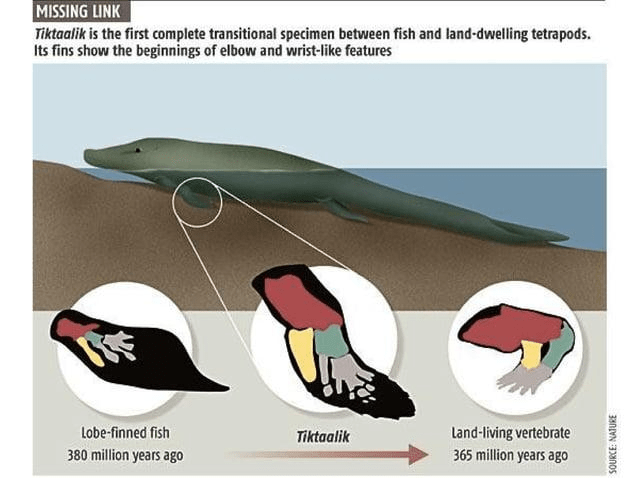
Tiktaalik has a combination of features associated with fish and early land vertebrates, suggesting that major evolutionary changes occurred gradually over many generations. It provides fossil evidence of the evolutionary transition toward four-limbed vertebrates and supports common ancestry.
500
What does the acronym DNA stand for?
Deoxyribonucleic Acid