Living Things & Cells
Disease & Medicine
Math & Graphs
Physical & Chemical
Properties
Properties
Physical & Chemical
Changes
Changes
100
Give an example of a horse's reaction to a stimulus.
Answers vary. Example: the horse turns its head when it hears a sound.
100
How are vaccines and antibiotics different?
Vaccines prevent disease, while antibiotics treat infection.
100
How many milliliters (mL) of liquid are in the graduated cylinder?
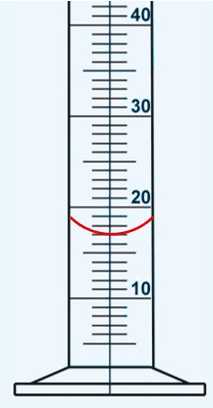
17 mL
100
Describe a object in the room in terms of its physical properties
Answers vary.
100
Is boiling water a physical or chemical change?
Physical change
200
Name one organelle that is only found in plant cells, but not in animals cells.
Possible answers: cell wall, chloroplasts
200
If 32 people in Valemount get food poisoning from a community event, this is an example of an:
a) pandemic
b) outbreak
c) epidemic
b) outbreak
200
Suppose you score 18/20 on a test. What is your score as a percentage?
90%
200
Explain what combustibility is.
Ability of a material to catch fire and burn in the air.
200
Is rust a physical or chemical change?
Chemical
300
Give 2 examples of positive interactions we have with microbes.
Possible answers: food production, antibiotics, waste water treatment, etc.
300
What parts of the human body are the 1st line of defense against pathogens? (select all that apply)
a) white blood cells
b) skin
c) heart
d) stomach
e) nose/ throat
b) skin
d) stomach
e) nose/ throat
300
Suppose that students in a class voted on their favourite type of movie. Here are the results:
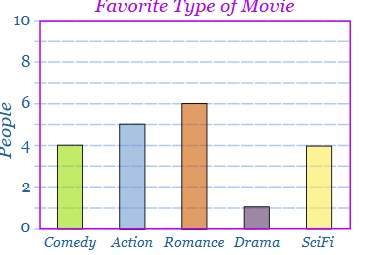
How many people voted for Action?
300
Which of the following is a chemical property:
a) Steel is resistant to corrosion
b) Steel has a melting point of 1400 C°
a) Steel is resistant to corrosion
300
After mixing two liquid substances together, you notice some solids quickly forming. Is this a physical or chemical change?
Chemical change (precipitate)
400
Name one difference between prokaryotic and eukaryotic cells.
Possible answers - prokaryotic cells are more simple and lack a nucleus. Eukaryotic cells are more complex and have a nucleus.
400
Explain what the immune system's 2nd and 3rd lines of defense are responsible for.
2nd - White blood cells fight pathogens that have entered the body and cause inflammation
3rd - Specialized white blood cells (T cells and B cells) remember how to fight the infection
400
A substance has a mass of 5 g and a volume of 20 mL. What is its density?
0.25 g/mL
400
Give an example of a quantitative property and a qualitative property.
Answers vary.
400
When salt is separated from seawater, is this a physical or chemical change?
Physical change
500
Give 2 reasons why a virus is not a living thing.
Possible answers - a virus is not made of cells, does not take in nutrients, grow, or produce waste. It can only reproduce and use energy when it binds to a host cell.
500
Explain how some pathogens become resistant to antibiotics.
Random mutations occur in pathogens as they multiply. Sometimes, they mutate in a way that makes them resistant to an antibiotic. When the antibiotic is used, it kills the weak pathogens, but the resistant pathogens survive and continue to multiply.
500
Which substances have a higher density than water?
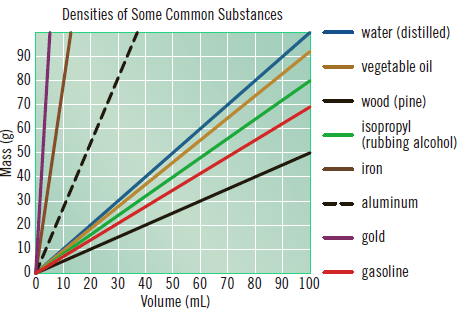
Gold, vegetable oil, and aluminum
500
Which of the following are physical properties (select all that apply):
a) Reactivity
b) Density
c) Odour
d) Flammability
e) Electrical conductivity
b) Density
c) Odour
e) Electrical conductivity
500
Describe 3 physical or chemical changes that occur while cooking a meal.
Answer vary.