Forces
Energy
Physical Properties
Matter
Bonus
100
A student conducted an investigation to find out the effects of force on objects. They concluded that a push or a pull is required for all of the following situations. Which of the following situations does not require a push or a pull?
A. A ball at rest to remain at rest.
B. A ball that is moving to change its direction of motion.
C. A ball at rest to start moving.
D. A ball that is moving to stop.
A
100
When you place a pot on the stove, what type of energy causes the water in the pot to boil?
Light
Sound
Thermal
Solar
3
100
A baseball and a wooden block are placed on a balance scale. Although the two objects have different volumes, the scale is balanced. What does this tell us about the ball and the wooden block?
A. The two objects have the same mass.
B. The two objects are both solids.
C. The two objects are made from the same material.
D. The block has more matter than the ball.
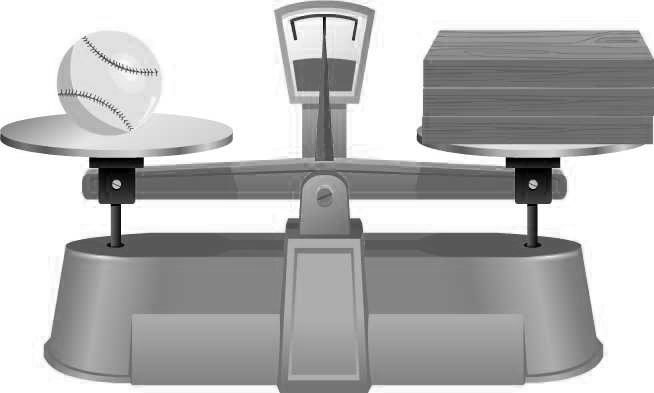
The two objects have the same mass.
100
A group of students was given an unknown substance. Their job was to classify it as a solid, a liquid, or a gas. The substance was clear and colorless. It gave off no odor. When poured into a glass container, it filled the bottom half and took the shape of the container. This unknown substance can most likely be classified as _______.
Solid
Liquid
Gas
A Liquid
100
Which of the objects shown below will float
when placed in a bucket of water?
F Paperclip
G Penny
H Pencil
J Marble
H
200
When the batter hits the ball, the ball changes its -
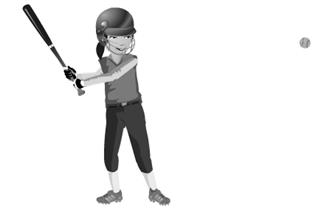
Mass
Color
Direction
Size
C
200
When the strings of a guitar are plucked, they vibrate rapidly. What type of energy is produced by the vibrating strings?
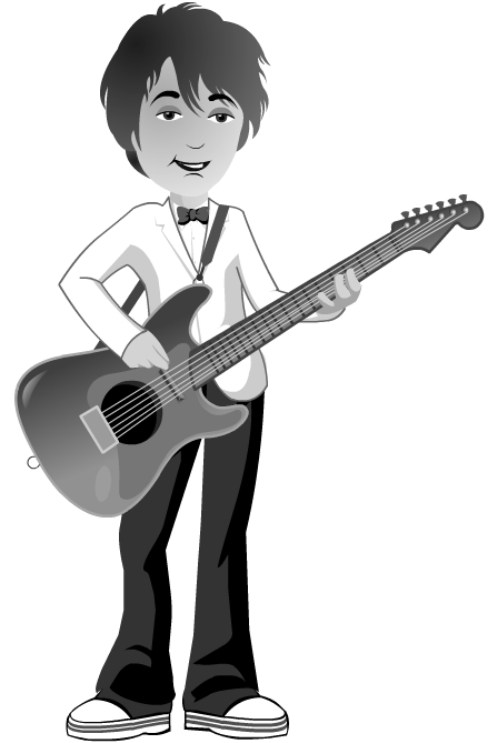
A. Sound
B. Light
C. Thermal
D. Mechanical
Sound
200
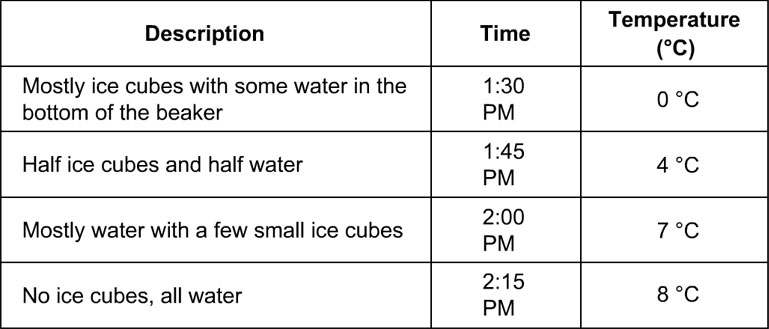
A. The temperature decreased by 8 °C
B. The temperature increased by 2 °C
C. The temperature decreased by 4 °C
D. The temperature increased by 4 °C
The temperature increased by 4 °C
200
During an investigation, materials in different states of matter were put into different types of containers. Students observed to see if the substances would take the shape of their containers. Their observations are recorded in the table. What can students conclude from this investigation?
A. Only liquids take the shape of their containers.
B. Both liquids and gases take the shape of their containers.
C. Gases and solids keep their shape and do not take the shape of their containers.
D. Liquids and gases spread out to fill their containers completely.
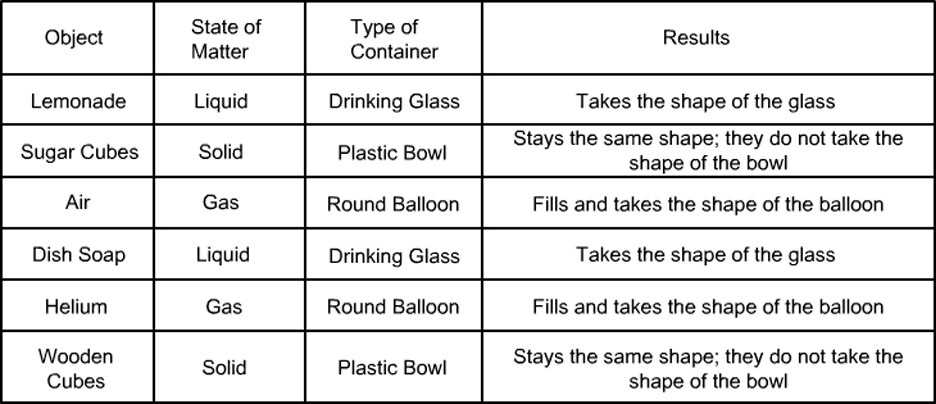
Both liquids and gases take the shape of their containers.
200
When water goes from the gas state to the
liquid state it is called –
A sublimation
B condensation
C evaporation
D deposition
B
300
Moving a chair away from you is an example of -
A. A push force that acts on an object in contact
B. A pull force that acts on an object in contact
C. The force of gravity that acts at a distance
D. Magnetic force that acts at a distance
A
300
While exploring different types of energy, a student uses a drinking straw to blow air on a ball. The air pushes the ball, causing it to roll. The rolling ball strikes a stack of cups knocking them over. What types of energy did the student use to knock over the cups?
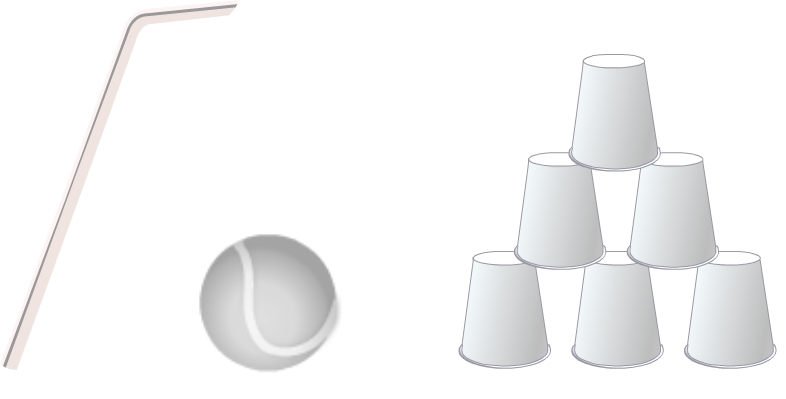
A. Sound
B. Thermal
C. Light
D. Mechanical
Mechanical
300
A small hollow metal ball and a large hollow metal ball both float when placed in water. What does this tell us about their densities as compared to the density of water?
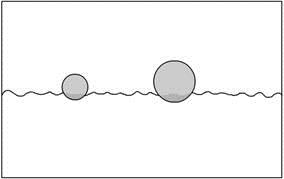
The small hollow metal ball is denser than water.
The large hollow metal ball is denser than water.
It’s impossible to determine their densities compared to water.
Since both balls float, they are both less dense than water.
1
300
Marisol has placed a solid glass marble in this graduated cylinder to find its volume.
What is the volume of the marble shown?
_Marisol_has_placed_a_solid_glass_marble20180613051250.jpg)
1 ml
10 ml
50 ml
60 ml
2
300
Which two types of energy are produced by the
Sun?
F Mechanical and light energy
G Thermal and sound energy
H Sound and electrical energy
J Light and thermal energy
J Light and thermal energy
400
Gravity is a force exerted by Earth and acts on all objects even from a distance. Which picture correctly shows the direction in which gravity acts on the apple?
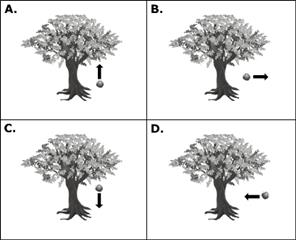
Picture A
Picture B
Picture C
Picture D
3
400
There are different forms of energy, but all forms of energy can cause matter to move or to change.
The following are all examples of using heat energy to make matter move or change EXCEPT
A. Using a campfire to boil water in a metal pan
B. Using a battery to power a flashlight
C. Metal spoon becoming hot while using it to stir a mixture of boiling water and spaghetti
D. Chocolate candy melting when left inside of a car on a summer day
B
400
Using a magnet, students tested objects made of different types of metal to see if the metals have magnetic properties. To test this, the students placed the magnet close to each object and observed whether the object was attracted to the magnet or not. Their observations are recorded in the table. From this investigation, what can students conclude about the magnetic properties of metals?
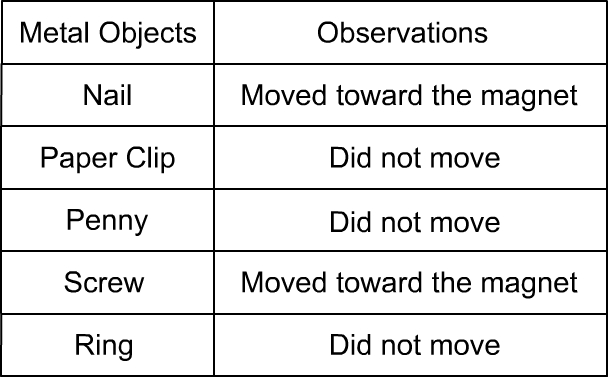
A. Round metal objects are made of metals with magnetic properties.
B. Not all metals have magnetic properties.
C. The paper clip, the penny, and the ring are all made of the same type of metal.
D. Objects that are used as tools are made of metals with magnetic properties.
Not all metals have magnetic properties.
400
When you hold an ice cube in your hand for a few minutes, it will begin to melt. When ice melts how does its state change?
Its state changes from a liquid to a solid.
Its state changes from a solid to a liquid
Its state changes from a solid to a gas.
Its state changes from a gas to a liquid
2
400
Which of the following statements about a
toaster is correct?
A The energy source is electrical energy and
it produces thermal energy.
B The energy source is electrical energy and
it produces mechanical energy.
C The energy source is thermal energy and it
produces electrical energy.
D The energy source is light energy and it
produces electrical energy.
A The energy source is electrical energy and
it produces thermal energy.
500
During an investigation to study the effects of force, a girl pushed a table as shown in the picture A. Which of these is MOST likely to change because of the push?
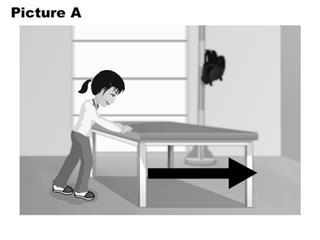
The position of the table
The height of the table
The mass of the table
The shape of the table
1
500
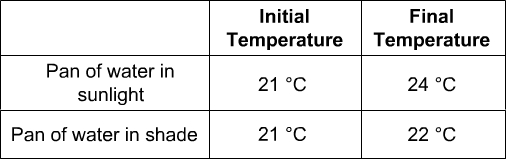
Students followed the steps of the following investigation while exploring heat energy. The data they collected is recorded in the table. STEPS:
1) Fill two aluminum pans with the same amount of water.
2) Measure and record the temperature of the water in both pans using a thermometer.
3) Place one of the pans in the sun and the other in the shade.
4) After one hour, measure and record the final temperature of the water in each pan.
5) Compare the temperatures of the water in the two pans.
After comparing the temperatures of the water in the two pans, what did the students most likely infer about heat energy from the Sun? DATA:
A. Objects will absorb the same amount of heat energy from the Sun whether placed in direct sunlight or in the shade.
B. Objects placed in the shade will absorb more heat energy from the Sun than objects placed in direct sunlight.
C. Objects placed in direct sunlight will absorb more heat energy from the Sun than objects placed in the shade.
D. You should never place objects in direct sunlight.
C
500
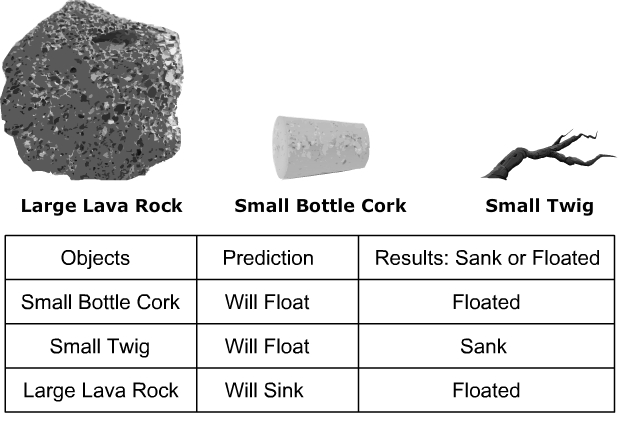
Students conducted an investigation where they tested different objects to see if they would sink or float when placed in a tub of water. The students first predicted what they thought would happen when each object was placed in the water. Then they tested each object and recorded what happened in the table. Based on what students predicted and what they observed, what must the students conclude?
A. Objects such as the rock that weigh more will sink in water, while objects that weigh less will float.
B. Solid objects with no holes will sink in water, but solid objects with holes will float.
C. The size of an object does not determine whether it will sink or float when put in water.
D. Round objects sink when placed in water, but objects that are flat will float.
The size of an object does not determine whether it will sink or float when put in water.
500
When liquid water is heated, it changes state from a liquid to water vapor. This change in state is called:
Melting
Freezing
Clouding
Evaporation
4
500
Which of the examples below is a pushing
force?
A Lifting a heavy bag of groceries
B Throwing a football
C Dropping a ball
D Opening a door
B Throwing a football