Plants and Energy
Matter and Energy
Organism Interaction
100
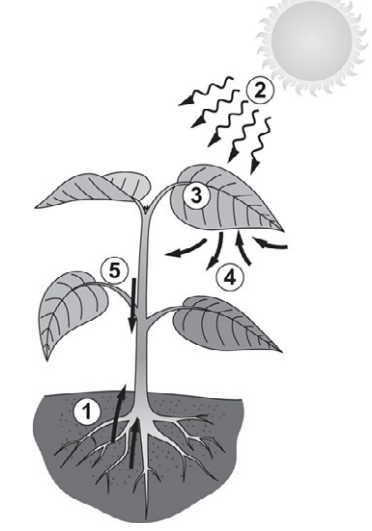 What is happening at Step 4 in the picture?
A. Sugar is entering the leaf, and water vapor is exiting.
B. Carbon dioxide is entering the leaf, and sugar and oxygen are exiting.
C. Carbon dioxide is entering the leaf, and water vapor and oxygen are exiting.
D. Water vapor and oxygen are entering the leaf, and carbon dioxide is exiting.
D. Water vapor and oxygen are entering the leaf, and carbon dioxide is exiting.
100
This picture shows a food chain that can be found in a prairie. 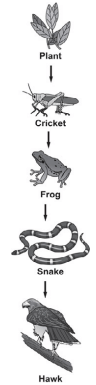
How is the plant different from the snake?
A. The plant is a consumer and the snake is a producer.
B. The plant is an herbivore and the snake is a carnivore.
C. The plant is a producer and the snake is a consumer.
D. The plant is a carnivore and the snake is an herbivore.
C. The plant is a producer and the snake is a consumer.
100
Which graph shows what can happen to a population when a competitor population moves into its environment?
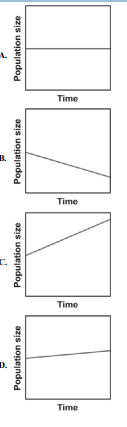
B
200
What can plants do that animals cannot do?
A. Plants can grow and change.
B. Plants can move to find food.
C. Plants can make their own food.
D. Plants can use air to help them survive.
C. Plants can make their own food.
200
This picture shows a food chain in the ocean.
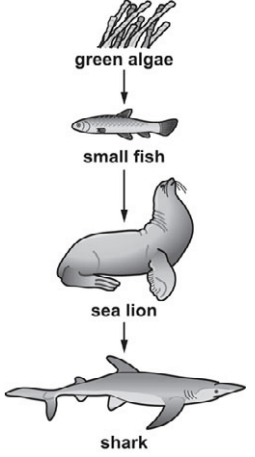
How does the small fish get energy?
A. by eating algae
B. by eating the shark
C. by eating a consumer
D. by eating the sea lion
A. by eating algae
200
Earthworms live in soil. They eat rotting leaves and the remains of dead insects. Wastes from earthworms add nutrients to the soil. Earthworms are food for some birds. Which statement best describes the niche of an earthworm?
A. Earthworms live in soil.
B. Soil contains nutrients for plants.
C. Earthworms use remains of insects found in soil as food.
D. Rotting plants and remains of insects can be found in soil.
C. Earthworms use remains of insects found in soil as food.
300
A student set up an investigation with four plants of the same kind. Plant 1 gets light and water. Plant 2 gets light but no water. Plant 3 gets water but no light. Plant 4 gets no water and no light. What will happen to the plants?
A. Plant 1 will grow well.
B. All plants will grow well.
C. Plants 1 and 3 will grow well.
D. Plants 2 and 4 will grow well.
A. Plant 1 will grow well.
300
How are decomposers like consumers?
A. They provide energy to producers.
B. They must capture prey in order to survive.
C. They can make their own energy from sunlight.
D. They get their energy from producers or other consumers.
D. They get their energy from producers or other consumers.
300
The picture shows a food web. Which organisms does the penguin compete with?
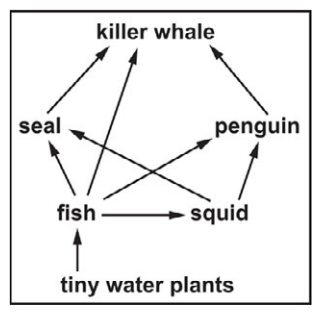
A. fish and seals
B. fish and squid
C. killer whales and squid
D. tiny water plants and seals
C. killer whales and squid
400
Russ puts three bean plants on a windowsill. He waters the plants daily, measuring in milliliters (mL). The plants are watered the following amounts daily: plant A – 0 mL, plant B – 10 mL, plant C – 25 mL, plant D – 50 mL. Russ measures the height of the plants every week. This table shows his results in centimeters (cm). 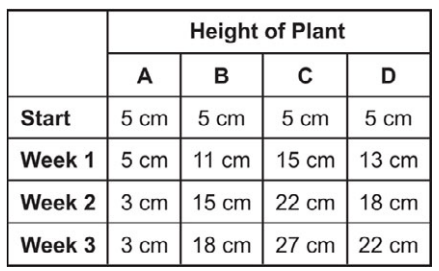
Which best describes how much water young bean plants need every day?
A. 0 mL
B. 10 mL
C. 25 mL
D. 50 mL
C. 25 mL
400
What do all animals need for growth?
A. oxygen, water, and food
B. oxygen, sunlight, and food
C. carbon dioxide, food, and water
D. carbon dioxide, nutrients, and sunlight
A. oxygen, water, and food
400
This picture shows the life cycle of a frog. Which statement describes the environment the frog needs throughout its life?
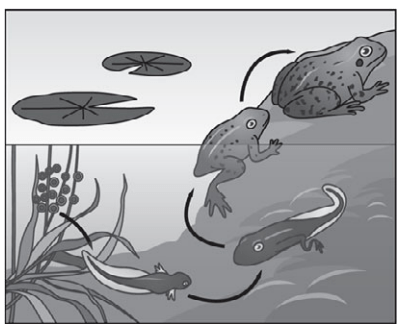
A. A frog lives on land all its life.
B. A frog lives in water all its life.
C. A frog hatches on land, and lives in water when it is an adult.
D. A frog hatches in the water, and lives on land when it is an adult.
D. A frog hatches in the water, and lives on land when it is an adult.
500
Carlos says that plants do not need soil to grow. Describe an experiment Carlos could do to provide evidence to support his statement.
Plants only need sunlight, water, and carbon dioxide. Therefore, plants do not need soil
500
This picture shows a forest food chain.
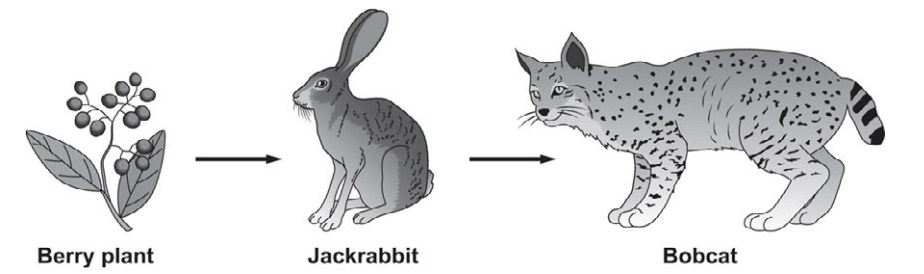
Explain how energy moves through the food chain.
Describe how each organism in this chain gets energy.
Explination:
The mouse has eaten plants. The plant got energy from the sun. When the owl eats the mouse, it gets the energy from the sunlight.
Description:
The berry plant is a producer. The jackrabbit is a consumer. It eats the berries to get energy. The bobcat is also a consumer. It eats the jackrabbit to get energy.
500
Explain why it is important to know the nonliving things as well as the living things in an ecosystem.
Nonliving things provide some of the needs of living things in an ecosystem. Living things can interact with the nonliving things in the ecosystem.