Steps & Definitions
The 3 Variables
Validity & Reliability
Bias & Ethics
Scenario Challenge
100
A testable prediction is often written as an "If... then..." statement.
What is the hypothesis?
100
The factor in an experiment that is intentionally changed by the scientist.
What is the manipulated or independent variable?
100
The measure of whether an experiment gives consistent results when repeated.
What is reliability?
100
A fact or event that can be observed in nature.
What is a phenomenon?
100
A psychology student wants to determine if listening to classical music while studying affects test performance. They select two groups of students with similar grades. Group A studies for one hour while listening to Mozart. Group B studies for one hour in silence. Both groups take the exact same 20-question quiz immediately afterward, and their scores are recorded.
Manipulated (Independent): Presence or absence of classical music during studying. Responding (Dependent): The score achieved on the 20-question quiz. Controlled: Studying time (1 hour), the quiz itself (same 20 questions), initial grades/academic level of students, the room temperature/lighting.
200
The step where a scientist uses graphs and charts to look for patterns in their measurements.
What is analyzing data?
200
The variable that is measured or observed as the result of the experiment.
What is the responding or dependent variable?
200
The measure of whether an experiment is truly testing what it is supposed to test.
What is validity?
200
A scientist allowing their personal expectation to influence the outcome of a test.
What is bias?
200
A gardener is testing three different commercial fertilizers (Brand X, Brand Y, and Brand Z) to see which one produces the largest flowers on rose bushes. They plant 15 identical rose bushes in the same type of soil, giving 5 bushes Brand X, 5 bushes Brand Y, and 5 bushes Brand Z. All bushes receive the same amount of water and sunlight. After one month, the diameter of the largest flower on each bush is measured.
Manipulated (Independent): The type of commercial fertilizer used (Brand X, Y, or Z). Responding (Dependent): The diameter of the largest flower on the rose bush. ControlledType of rose bush (identical), type of soil, amount of water, amount of sunlight, time period (one month).
300
The step that follows "Analyzing Data" determines if the hypothesis was supported.
What is the conclusion?
300
Any factor in an experiment that is kept exactly the same across all groups.
What are controlled or constant variables?
300
The ability of a study to be verified by a different research group repeating the exact same procedure.
What is reliability?
300
The guidelines that scientists must follow when conducting an experiment to ensure safety, fairness and minimal disturbance.
What is scientific ethics?
300
An automotive engineer is investigating how different road surfaces affect a car's braking distance. They test a new car on three identical stretches of road: dry asphalt, wet asphalt, and gravel. For each test, the car is driven at exactly 60km/h and the brakes are applied forcefully at the same marker. The distance the car travels before coming to a complete stop is measured in meters.
Manipulated (Independent): The type of road surface (dry asphalt, wet asphalt, gravel).Responding (Dependent):The braking distance (measured in meters).Controlled: Initial speed of the car 60 km/h the car model/type, the force applied to the brakes, the tires used.
400
A systematic and logical process used to solve a problem or investigate an observation.
What is the Scientific Method?
400
The type of variable that represents the effect in a cause-and-effect relationship.
What is the dependent variable (or responding variable)?
400
What an experiment lacks if the measuring tool is faulty or improperly calibrated.
What is validity?
400
The reason scientists must strive for objectivity when collecting data and writing conclusions.
What is to elimate bias (or to ensure accuracy/fairness)?
400
A nutritionist wants to see if a high-protein diet causes faster weight gain in laboratory mice than a standard diet. They divide 20 identical mice into two groups (10 per group). Group A receives the high-protein diet, and Group B receives the standard diet. Both groups are kept in the same size cages with the same temperature and lighting. The mice are weighed every week for six weeks.
Manipulated (Independent): The type of diet (high-protein vs. standard).Responding (Dependent): The weight gain of the mice (measured weekly).Controlled:Type of mouse (identical), number of mice per group, cage size, temperature, lighting, time period (six weeks).
500
The four steps of the Scientific Method that occur after the hypothesis is created.
What is 1) gather materials, 2) procedure, 3) collect results, 4) analyze data?
500
The only type of variable that can be used to establish a cause-and-effect relationship.
What is the independent variable or manipulated variable?
500
Briefly describe validity and reliability using the target metaphor
What is Target 1 (reliable and valid) all shots are in the middle. Target 2 (not valid but reliable) shots are not in the center but all together on another spot on the dart board. Target 4 (not reliable and not valid) the shots are not on the target and no where near each other.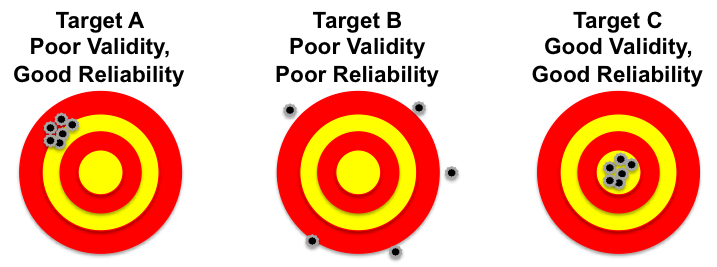
500
Name 1 type of bias presented in class
What is publication, participation/selection, confirmation, observation, or design bias?
500
A physical science student is investigating how the concentration of salt in water affects its boiling point. They measure out four beakers, each containing exactly 500ml of distilled water. Beaker 1 has 0gof salt, Beaker 2 has 5g of salt, Beaker 3 has 10g of salt, and Beaker 4 has 15g of salt. The water in each beaker is heated on the same stove burner, and the temperature at which the water begins to boil is recorded.
Manipulated (Independent): The concentration/amount of salt added to the water. Responding (Dependent): The boiling point temperature of the water. Controlled: Volume of water 500ml, type of water (distilled), type of beaker, stove burner used.