Scientific Thinking
Ecology Foundations
Weather, Climate & Seasons
GHGs
Biomes & Data
100
What is the variable that the scientist changes?
Independent variable (manipulated variable)
100
What is the study of relationships between organisms and their environment called?
Ecology
100
Name the three major climate zones.
tropical
temperate
polar
100
Name one greenhouse gas.
CO2, Nitrous oxide, Water vapor, methane, CFCs
100
What two climate factors strongly influence biomes?
Temperature and precipitation
200
What is the variable that is measured or observed?
Dependent variable
200
What is the difference between a biotic and an abiotic factor?
Abiotic = things that are not alive but interact with the environment
Biotic = living or once living things that interact with the environment
200
What describes the long-term conditions of a region?
Climate
200
What type of radiation does Earth emit after absorbing solar energy?
Infrared/long-wavelength radiation
200
Which biome is warm and very wet?
Tropical rainforest
300
Why do scientists keep some conditions the same during an experiment?
To help isolate the factor being tested
300
Put these in order from smallest to largest: population, organism, biosphere, ecosystem, community, biome.
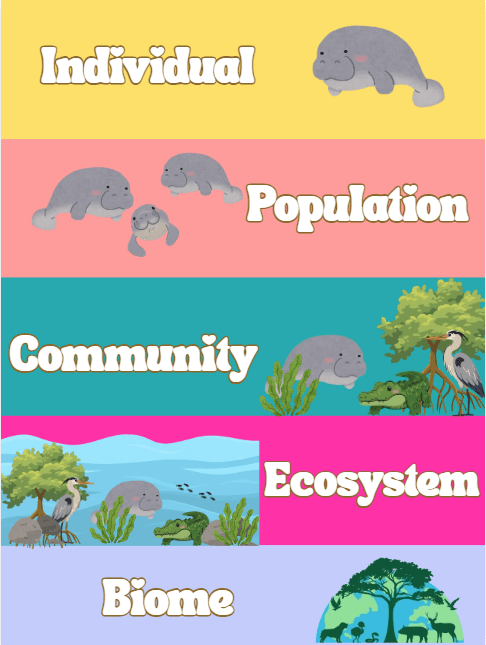
300
Water evaporates from the ocean into the air. Which two Earth systems are interacting?
Hydrosphere and atmosphere
300
What human activity discussed in class increases atmospheric CO₂?
Burning fossil fuels
300
Which biome has very low precipitation?
Desert
400
A student says, “The plants grew poorly because the soil lacked nutrients.” Is this an observation or an inference? Explain.
Inference
400
A pond contains fish, algae, bacteria, water, rocks, and sunlight. What level of ecological organization is being described?
Ecosystem
400
What causes Earth's seasons?
Earth's tilt as it revolves around the Sun
400
What happens to outgoing infrared (radiation) energy when it encounters greenhouse gases?
It is absorbed and re-radiated
500
A student tests whether salt concentration affects seed germination. Identify the independent variable, dependent variable, and one controlled variable.
IV: salt concentration
DV: seed germination
Control: light, temperature, seed type
500
A researcher studies how rainfall affects the growth of grasses in a savanna. Identify the biotic factor and the abiotic factor.
Biotic = grasses; Abiotic = rainfall
500
What describes day-to-day atmospheric conditions?
Weather
500
What generally happens to Earth's temperature when more heat is retained by increased greenhouse gases?
Global warming (temperature increases)