Period 1 (1491-1607) Before the British
Period 2 (1607-1754) Colonial Times
Period 3 (1754-1800) Colonies to Constitution
Period 3(1754-1800)
The Early Republic
The Early Republic
Period 4 (1800-1848) Growing Pains
Period 4 (1800-1848) You Don't Know Jackson
100
This Spanish labor system was justified as a way to Christianize Native Americans but in practice functioned as forced labor and exploitation.
Encomienda system
100
Unlike the plantation-based South, this colonial region was known for small farms, shipbuilding, and an economy built around trade in the Atlantic Ocean.
New England
100
This war between Britain and France led to increased British debt and ultimately prompted new taxation policies in the American colonies.
French and Indian War
100
The establishment of a presidential cabinet and the tradition of a two-term limit are examples of these set during Washington’s presidency.
Precedents
100
The election of Thomas Jefferson in 1800 marked the first peaceful transfer of power between political parties and is often referred to by this term.
Revolution of 1800
100
The decline of property requirements for voting in the early 19th century helped shift political power toward the common man, contributing to the election of this president in 1828.
Andrew Jackson
200
This process explains how the introduction of Old World animals, crops, and diseases fundamentally reshaped ecosystems, diets, and population patterns in both hemispheres.
Columbian Exchange
200
This set of laws required colonial goods to be transported on British ships and limited trade with other nations.
Navigation Acts (mercantilism)
200
Britain’s attempt to raise revenue and assert authority in the colonies after 1763 is best illustrated by this broader policy shift.
End of salutary neglect
200
Washington’s decision to remain neutral in the conflict between Britain and France was formalized in this 1793 policy.
Proclamation of Neutrality
200
This 1803 acquisition doubled the size of the United States and raised constitutional questions about presidential power.
Louisiana Purchase
200
This 1830 law led to the forced relocation of Native Americans, culminating in the Trail of Tears.
Indian Removal Act
300
These Spanish explorers toppled large empires like the Aztec and Inca using superior weaponry, Native alliances, and the unintended impact of disease.
Conquistadors
300
The transition from indentured servitude to racial slavery in the Chesapeake was accelerated by this 1676 uprising.
Bacon’s Rebellion
300
Colonial opposition to the Stamp Act and Townshend Acts was grounded in the belief that taxation without direct representation violated this broader principle of political legitimacy.
Consent of the governed
300
This 1794 agreement with Britain angered many Americans who believed it favored British interests and led to protests and the burning of John Jay in effigy.
Jay’s Treaty
300
SCOTUS decisions such as Marbury v. Madison, McCulloch v. Maryland, and Gibbons v. Ogden expanded federal power under this chief justice.
John Marshall (The Marshall Court)
300
South Carolina’s attempt to declare federal tariffs invalid led to this major confrontation over states’ rights during Jackson’s presidency.
Nullification Crisis (1828-33)
400
Differences between societies like the Iroquois and Pueblo peoples largely developed as a result of this factor.
Adaptation to geography
400
This religious movement of the 1730s–1740s emphasized emotional preaching and challenged established colonial authority.
First Great Awakening
400
The inability of the national government to respond effectively to Shays’ Rebellion exposed key weaknesses in this governing document.
Articles of Confederation
400
Passed during John Adams’s presidency, these laws targeted immigrants and political dissent, raising concerns about civil liberties.
Alien and Sedition Acts
400
The shift from subsistence farming to a market-based economy, supported by innovations in transportation and industry, is known as this.
The Market Revolution
400
This institution became the target of Andrew Jackson’s veto because he argued it concentrated economic power in the hands of wealthy elites.
Second Bank of the United States
500
European expansion was also driven by this combination of religious zeal, wealth-seeking, and national competition.
God, Gold, and Glory (3 G’s)
500
The long period during which Britain loosely enforced colonial regulations, allowing for significant colonial self-government, is known as this.
Salutary neglect
500
Debates at the Constitutional Convention in 1787 over representation, federal power, and slavery ultimately led to the ratification of the Constitution in this year.
1789
500
Debates over the national bank, foreign policy, and the power of the federal government led to the formation of these two early political groups.
Federalists and Democratic-Republicans
500
Movements such as abolition, temperance, and women’s rights were influenced by this religious revival that emphasized individual moral responsibility.
Second Great Awakening
500
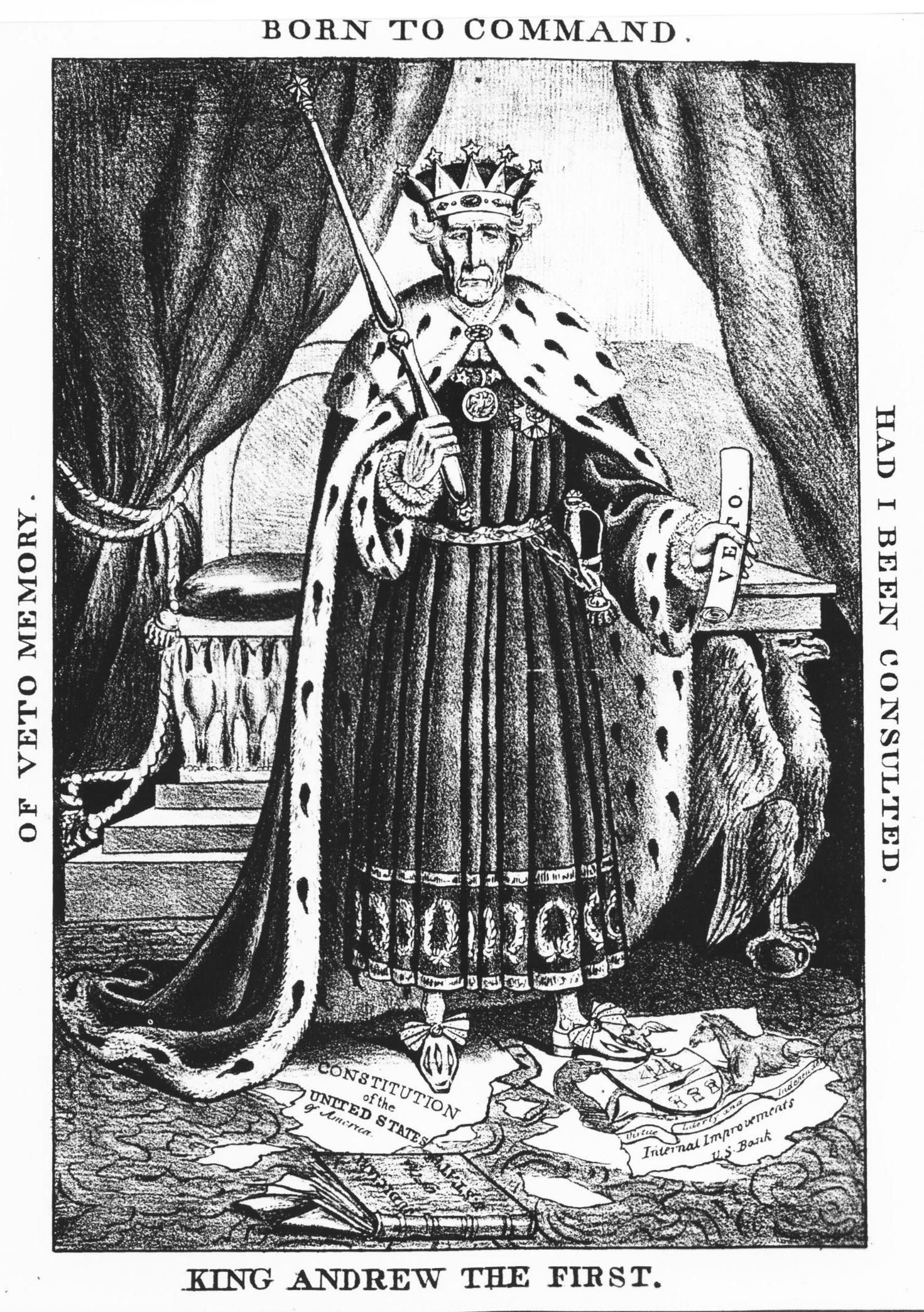
According to the artist, Andrew Jackson's frequent use of this power threatened republican government.
Veto