Vocabulary Terms
Plate Tectonics
Weathering & Erosion
Rocks Rock
The Scientific Method
Work of Waves
100
This is the principle that the processes we observe today occurred throughout Earth's history.
What is "Uniformitarianism?"
100
These are the three types of plate boundaries.
What are "Divergent, Convergent, & Transform?"
100
This process occurs when rocks are moved from one location to another.
What is "Erosion?"
100
These are the three types of rocks.
What are "Igneous, Sedimentary, & Metamorphic?"
100
This type of variable should be kept the same for every test in the experiment.
What is a "Constant Variable?"
100
This type(s) of waves have a "Crest & a Trough."
What is a Transverse Wave?
200
This is a set of steps that explains how to carry out an experiment.
What is a "Procedure?"
200
These types of plate boundaries are associated with volcanoes.
What are "Divergent & Convergent" plate boundaries?
200
This process puts materials down.
What is "Deposition?"
200
These rocks form directly from liquid magma.
What are "Igneous Rocks?"
200
This part of the scientific method must be testable, specific, and include the words "IF, THEN, & BECAUSE" to receive full credit.
What is a "Hypothesis?"
200
This type(s) of waves cause the particles to move perpendicular to the direction of the wave.
What is a "Transverse Wave?"
300
This is a break in Earth's lithosphere where one block of rock moves toward, away from, or past another.
What is a "Fault?"
300
These are the two types of plates found on Earth.
What are "Oceanic & Continental?"
300
This type of weathering physically breaks a rock down into smaller pieces without changing its composition.
What is "Mechanical Weathering?"
300
These are the two types of Metamorphic Rocks.
What are "Contact Metamorphism" and "Regional Metamorphism."
300
What type of information is used as evidence for Parts 1 and 2 of the four part conclusion?
What are "Examples from the data table?"
300
This wave property is shown in the diagram below as the Dotted Red Line from the "Rest Line" to Point A or the "Rest Line" to Point C.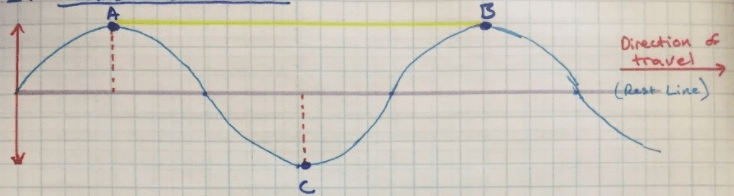
What is the "Amplitude?"
400
This process breaks down rocks into smaller pieces.
What is "Weathering?"
400
This type of fault is associated with a transform plate boundary.
What is a "Strike Slip Fault?"
400
This type of weathering breaks down rocks by dissolving minerals or otherwise changing their composition.
What is "Chemical Weathering?"
400
These are the two types of igneous rocks.
What are "Intrusive Igneous Rocks" (Plutonic) and "Extrusive Igneous Rocks" (Volcanic).
400
In a scientific graph, this variable is found along the X-axis.
What is the "Independent Variable?"
400
This wave interaction is shown below. 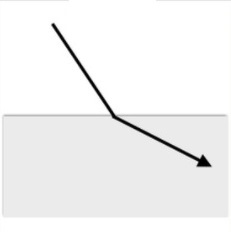
What is Refraction?
500
This variable is what is measured in the experiment.
What is the "Dependent Variable?"
500
This type of volcano is associated with a Convergent Plate boundary that contains an Oceanic & Continental Plate.
What is a "Composite (or Strato) Volcano?"
500
This surface feature is formed when flowing water quickly comes to a stop and deposits the sediment it was carrying.
What is a "Alluvial Fan" or "Delta?"
500
This type of Igneous Rocks have very large crystals because the rocks cooled very slowly.
What are "Intrusive Igneous Rocks" (Plutonic)?
500
Why is the reliability of the data an important thing to discuss in your conclusion?
Answers will vary, but may include things like "It explains why your conclusions should be trusted," or "It informs the reader of any issues that may have affected the outcome of the experiment."
500
This type(s) of waves transfer energy without transferring the matter.
What is "Both Transverse & Longitudinal Waves?"