Human Body
Ecology
Evolution
Plants
Other
100
To distribute nutrients and oxygen effectively, the circulatory system must have close contact with all the cells of the body. This close contact is accomplished by millions of microscopic blood vessels called ___________ Some are so narrow that blood cells must travel through them one at a time.

capillaries
100
What are the levels of ecological organization starting with the individual?
Individual, Population, Community, Ecosystem, (Biome) Biosphere
100
Organisms that have a more recent common ancestor have more similarities in this nucleic acid _______
DNA!
DNA --> RNA --> Protein --> Trait
This is also why organisms that are more closely related look similar
*central dogma*
100
Similar to plants and different from animals, bacteria and fungi also have __________ (think organelle!)
cell walls
100
What does this diagram show?

A trophic cascade
200
Arterties carry __________ blood _______ the heart. Veins carry ___________ blood _______ to the heart.
The exception to this rule are the _____________ arteries and veins. They move in the same pathways towards/away from the heart but the ________ changes.
oxygenated from
deoxygenated towards
pulmonary
oxygenation
200
The competitive exclusion principle is closely related to the idea of ______________?
niche/ resource partitioning
200
What evidence of evolution fall under the umbrella of comparative anatomy (there are 4!)
analogous structures,
homologous structures
vestigial structures
embryology
200
What is the equation for photosynthesis?
Water + CO2 ---(sunlight)-> O2 and Glucose
200
Put the number and name of each of the 4 chambers of the heart

3 - Right Atrium
5 - Right Ventricle
10 - Left Atrium
12 - Left Ventricle
300
This diagram shows the connection between the __________ system and the ___________ system. ___________ brings blood to the lungs to become oxygenated and is returned via the ________. Then it enters the _________.
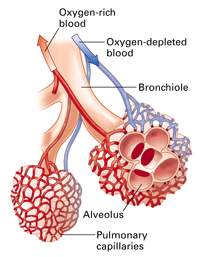
circulatory, respiratory, pulmonary arteries, pulmonary veins, left atrium.
300
Look at the picture below and explain how it shows the competitive exclusion principle:

1: A smaller (yellow) species of bird forages across the whole tree.
2: A larger (red) species competes for resources.
3: Red dominates in the middle for the more abundant resources. Yellow adapts to a new niche restricted to the top and bottom and avoiding competition.
300
Explain how intraspecific competition is good for the health of a population. Answer in terms of natural selection!
Intraspecific - competition between members of the same species
Those who get the best resources will survive, reproduce and be more likely to pass those traits down to their offspring.
300
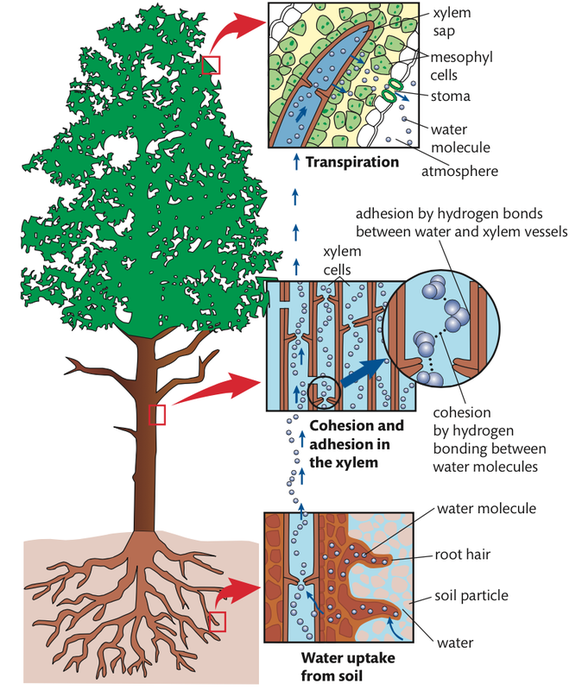
What are the different ways that water moves through a plant? (there are 4)
TACT - transpiration - evaporation of water through stomata Adhesion (water to other), Cohesion (water to water) Tension
300
People can survive without gallbladders but need to pay special attention to their diet. What might they need to consider/ explain why this is.
Gallbladders store bile which is made by the liver. It's released into the SI and is used to break down fats. Without the gallbladder, fat digestion is limited so they will need to be careful of their fat intake.
400
Lymphocytes are involved in the 3rd line of defense - describe the two types of cells we covered, where they are made and what they do.
B cells - bone marrow - make antibodies, humoral response (outside of cells)
T cells - thymus - cell mediated response - take down infected cells
400
The big difference between primary and secondary _________ is that in secondary succession the _________ is intact. The first species to colonize the area is known as a ______________
succession, soil, pioneer species
400
Describe the contributions of the following scientists to our understanding of evolution - Darwin, Wallace, Lamarck
*I'm looking for you to mention specific theories*
Darwin - natural selection
Wallace - came to similar conclusion as Darwin (was younger, less prominent)
Lamarck - inheritance of acquired characteristics and use and disuse.
400
What challenges did plants have to overcome coming to life on land?
Staying hydrated.
Resisting gravity to provide structure.
Obtaining resources from the earth and the air.
Reproducing without the aid of water.
400
Bacteria reproduce through a method called binary fission. Explain how bacteria can evolve if this is the case. (you should have more than one answer)
Mutations and conjugation/sharing of plasmids
500
Arguably the most important part of the the small intestine, the ___________ is where which accessory glands _______ and _________ release digestive enzymes and chemicals to further digest macromolecules
duodenum
gallbladder (bile) and the pancreas (enzymes and buffers)
500
The cane toad is an __________. The cane toad eats _________ different organisms. Based on the food web the cane toad is a ____________. What would happen if the cane toad depleted the mouse population?

invasive species, 5 different organisms, tertiary consumer (carnivore), grasshoppers and beetles would increase, wildflowers could potentially decrease
500
Connect the central dogma to natural selection!
Central Dogma - DNA to RNA to Protein
Proteins determine traits
Variations in traits allow organisms to be more or less adapted to their environment. Those with less favorable adaptations are less likely to survive, reproduce and pass down to their offpsring
500
Over thousands of years, farmers used ___________ to create the best crops. What are some modern ways to influence the traits of crops (such as being pest resistant)
selective/ artifical breeding
GMOs, recombinant DNA, CRISPR
500
After an unusually rainy spring, a population of deer have more food due to large growth of grass. The following years will have normal rain conditions. What will happen to it's population? Will it's carrying capacity change?
Population increase, but not indefinitely
Grass due to unusual weather patterns - carrying capacity won't change. Population may overshoot that one year but should return to under limit due to limited resources