Consciousness
Sleep Stages and Theories
Sleep disorders and Dreams
Sensation Basic Concepts
100
Provide the term: Processing multiple aspects of a stimulus at the same time.
Parallel Processing 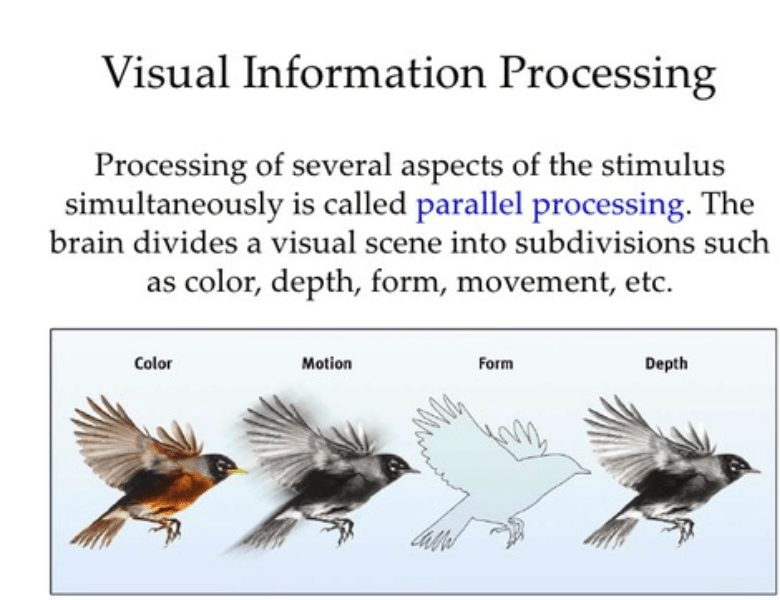
100
What are the four stages of sleep?
Non-REM 1
Non-REM 2
Non-REM 3
REM- RAPID EYE MOVEMENT
100
Provide two ways that sleep loss affects us
Possible Answers:
-Irritability
-Poor concentration
-Poor memory
-Depression
-Obesity
-Suppressed immune system
-Slowed reaction time
100
Provide the terms for the following examples: You may not notice a fan's noice until it is turned off. You put on a watch in the morning and immediately feel it against your wrist. After wearing it for several hours, you completely forget it's there. You jump into a swimming pool, and the water initially feels extremely cold. After remaining in the water for several minutes, it doesn't feel quite as cold anymore.
Sensory Adaptation
200
Provide the term: Processing one spect of a problem at a time, requiring your conscious attention and working memory. For example, when you first learn how to ride a bike, focusing on peddling each foot or learning a language and thinking carefully about grammar rules before speaking, or learning an instrument and consciously remembering what to do with your fingers.
sequential processing
200
Provide the term: Our natural biological 24 hour cycle of wake and sleep. This natural cycle can be affected by our work schedule, mental health, and other variables.
Circadian Rhythm
200
Provide and define two sleep disorders
Insomnia: Recurring problems in falling or staying asleep
Narcolepsy: Sudden uncontrollable sleep
Sleep Apnea: Repeated stopping of breathing while asleep
200
Compare absolute threshold to difference threshold
Absolute threshold is the minimum sensory stimulation possible to be detected 50% of the time
Difference threshold is the minimum difference in two stimuli that we can detect 50% of the time. (Just noticeable difference) 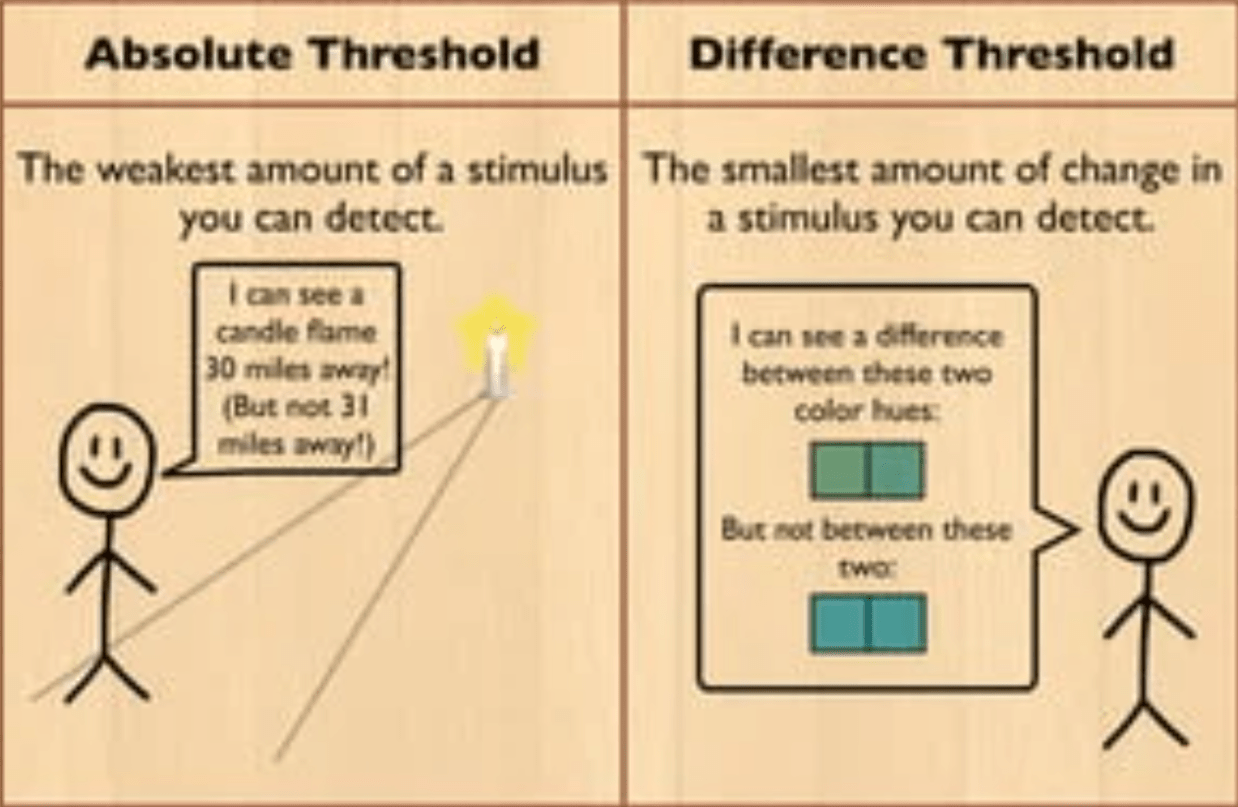
300
Provide the term: The mind processes information on two tracks- one conscious, and the other unconscious
Dual Processing
300
Provide two important functions of sleep
Possible answers:
Restoration: allows for neural connections to repair themselves, cleans the brain of waste
Memory Consolidation: Sleep reactivates recent experiences and helps to retain those memories
Protection: Keeps us hidden and safe
Creativity: Helps with making creative insights and connections- Dreams can be a source of inspiration
Growth- During sleep, the pituitary glad releases human growth hormone
Conserve Energy- Slows down metabolism to preserve energy for waking hours
300
Provide and define one of the theories of dreaming
Information Processing/Consolidation: Dreams help us consolidate our memories by sorting through the day's events
Physiological function: Dreams help develop and preserve neural pathways
Activation synthesis: REM sleep triggers neural activity that produce random visual memories
Cognitive development: Dreams illustrate a persons knowledge and understanding, simulating our lives.
300
Transduction is the transformation of one form of energy into another. Provide an example of how transduction works in one of the senses that we learned about.
Possible answers
Hearing: Sound waves cause tiny hair cells in the cochlea to bend, converting vibrations into neural signals that send sensory neurons through the auditory nerve to the temporal lobes of the brain
Sight: Light waves enters the eye and reach the retina, where rods and cones convert light energy into sensory neurons that travel through the optic nerve to the occipital lobes of the brain.
Touch: Pressure, temperature, and pain stimulate sensory receptors in the skin, which convert these sensations into sensory neurons that travel to the parietal lobes
Taste: Chemicals from food dissolve in saliva and stimulate taste receptor cells in taste buds, which convert the chemical stimulation into sensory neurons that travel to the frontal lobes/parietal lobes.
Smell: Odor molecules enter the nose and stimulate olfactory receptor cells, which convert the chemical stimulation into sensory neurons that travel to the olfactory bulb in the brain through the olfactory nerve.
Balance: Movement of fluid inside the semicircular canals of the inner ear bends tiny hair cells, converting movement into sensory neurons that travel to the cerebellum in the brain and help us maintain balance.