People
Villages
Food and Tools
Transportation
Family Life
100
Which clan lived in between Lake Huron and Lake Erie? (Page 11)
The clan that lived in between Lake Huron and Lake Erie were the Wendats.
100
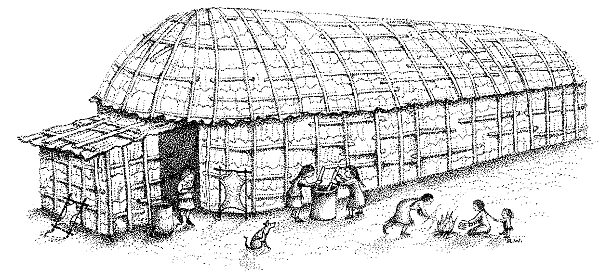
What did the Wendat people call their homes? (Page 13)
They called their homes longhouses.
100
How did the Wendat people make fields for their food? (Page 14)
They made fields by clearing land. They cut down trees or burned them to make open areas in the forest.
100
What material did the Wendat people cover their canoes with? (Page 15)
The canoes were covered with elm bark.

100
In the Wendat family, who were the leaders of the clan? (Page 20)
Women were the leaders of the clans. When a man married a woman, he went to live with her clan.
200
What language did the Wendat people speak? (Page 11)
The Wendat people spoke Iroquoian languages.
200
What did the Anishinabe people call their homes? (Page 23)
They called their homes wigwams. Many were shaped like domes and others were in the shape of cones.

200
How did the Anishinabe harvest wild rice? (Page 24)
The Anishinabe people harvested wild rice from a canoe. They always let some seeds fall in the water to grow into plants the next year.

200
What material did the Anishinabe people cover their canoes with? (Page 25)
The canoes were covered with birchbark.

200
What did the men do in the Anishinabe clan when they moved camps? (Page 28)
The men hunted along the way, and they also guarded the family from danger.
300
What language did the Anishinabe people speak? (Page 11)
The Anishinabe people spoke Algonquian languages.
300
Why were the Wendat villages often built along the shores of rivers? (Page 12)
The rivers gave the Wendat a good supply of water and made travel easier.
300
Why did the Anishinabe people not grow crops? (Page 24)
The Anishinabe people lived in rocky land. The soil did not have the right nutrients to grow crops well.
300
How did the Anishinabe carry their belongings in the winter? (Page 25)
They pulled their belongings in toboggans.

300
In the Wendat family, the children did not go to school. How did they learn? (Page 18)
The children learned by watching and copying adults as they worked. They also listened to the elders.
400
What is another name for the Wendat people? (Page 10)
Another name for the Wendat people is the Huron.
400
How long and wide are the Wendat peoples homes? (Page 13)
Their homes were between 20 and 40 metres long. They were 7 to 10 metres wide.
400
How did the Anishinabe cook food using pots made of bark or wood? (Page 27)
They put water and meat into the pot. Then they put stones into the fire to get very hot. They picked up the stones with sticks and put them into the pot. The stones heated the water and cooked the meat.
400
How did the Wendat travel during the winter? (Page 15)
The Wendat people travelled on foot, while wearing snowshoes. The snowshoes stopped their feet from sinking into the snow.

400
Why did the Aboriginal people tell stories? (Page 29)
Storytelling was an important part of life for the Aboriginal people. It was a way they learned about their past, and a way they shared their beliefs.
500
What is another name for the Anishinabe people? (Page 11)
Another name for the Anishinabe people is Ojibwa.
500
Were the Anishinabe camps big or small? Tell us one reason. (Page 23)
The Anishinabe lived in small camps. Each camp had only a few homes. One family lived in each home.
500
What are the three techniques the Wendat people used to preserve their food? (Page 14)
Corn and beans were dried and stored in bark containers. Squash and pumpkins were stored in holes dug in the longhouse floor. Fish and meat were smoked on racks above a fire.
500
The Wendat did not have horses or wagons. How did they travel to deliver their goods? (Page 15)
The Wendat travelled and moved their goods by canoe, on the lakes and rivers.
500
Who is Nanabush? (Page 29)
The Anishinabe showed respect to this spirit. Nanabush was a trickster. Sometimes he helped the animals and people. Sometimes he tricked them.