6.01-6.04
6.05-6.08
6.09-6.12
6.13-6.15
6.16-6.19
100
A civilization existed from around about 1900 BCE until about 1600 BCE. Which statement about these dates is correct? How long did the civilization last? Which year came first?
The civilization lasted about 300 years, and 1900 BCE came first.
100
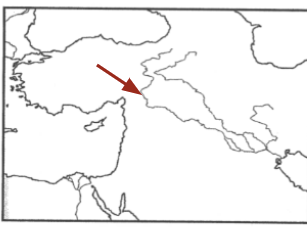
The red arrow is pointing to the ___________ River.
Euphrates.
100
What is the difference between an empire and a monarchy?
Empire is a territory taken over by a single ruler a monarchy is like a king or queen who acts as head of state.
100
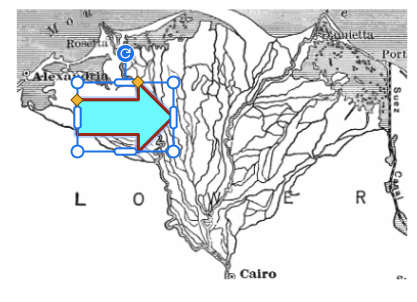
The arrow is pointing to what area in Ancient Eqypt?
Nile Delta
100
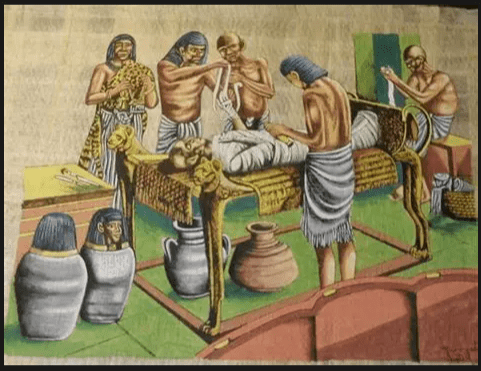
This process was called _________________ in ancient Egypt.
Mummification
200
Sharpened stone points, scrapers made from flint, charred animal bones, remains of a windbreak built from hides: what do these findings best show about the people who lived at this site?
They hunted animals, used fire, and built shelter as they moved with their food supply.
200
Why was the area between the Tigris and Euphrates river called the Fertile Crescent?
The rivers flooded and left behind silt that made the soil rich.
200
Who was the first ruler in early civilization?
Sargon
200
What can we say about the flooding of the Nile River each year?
It was predictable and left rich soil on the fields for farming.
200
Why was mummification done?
To preserve the body for the afterlife.
300
These two statements describe nomadic hunter-gatherer societies? They moved as the animals and plants they depended on moved; They built permanent walled cities. Is this TRUE or FALSE
False
BONUS: Which makes it false?
300
Small ditches branched from the Euphrates and carried water into fields was called
Irrigation allowed farmers to water fields far from the river.
300
What did people believe about deities (gods)
They believed deities controlled the natural forces of which their survival depended.
300
Egyptians developed a calendar to predict the
Flooding cycle.
300
Hieroglyphics are the
recording of religious text and the deeds of rulers
400
What did domesticating plants, animals, and extra surplus food make possible for ancient civilization?
People were able to work in specialized trades other than producing food.
400
City-states were formed because of what chain of effects?
surplus meant fewer people were needed to farm, more became traders and craft workers, and they became more settled.
400
Ziggurates were built in the center of cities for what purpose?
religion
400
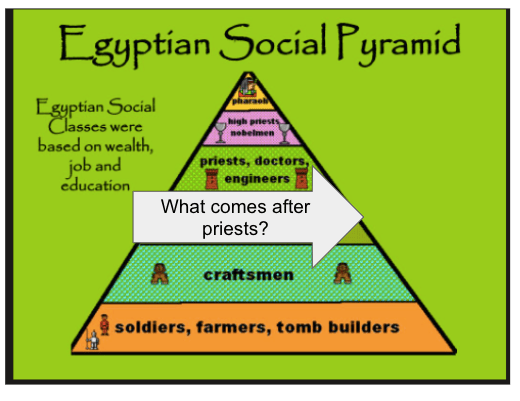
What comes after priests on this social pyramid?
Scribes
400
Papyrus was
Lightweight writing was an achievement of the ancient Egyptians.
500
A historian writes that a temple was built "c. 2500 BCE. What does the abbreviation stand for?
Before the Common Era.
500
Why did the earliest Mesopotamian settlements develop close to the Tigris and Euphrates rather than farther inland?
The river supplies water for crops and a route for moving goods.
500
Which Mesopotamian achievement is identified as the oldest written epic?
The Epic of Gilgamesh
500
What made scribes unique in the social pyramid?
They were the only ones who could read and write.
500
Pyramids were important because of
Built to protect a ruler's body and goods for the afterlife.
600
How did labor specialization change life in early farming villages?
people could work as potters, weavers, or toolmakers instead of farming.
600
Which two developments most directly increase the amount of food Mesopotamian farmers could produce?
The plow and irrigation canals.
600
What did the Code of Hammurabi state?
"An eye for an eye," what someone does to you, you can do it back to them.
600
Pharaohs was honored as
gods
600
What are two true statements about Queen Hatshepsut?
She increased Egypt's wealth by trading with other countries, and she ruled as a pharaoh, a position usually held by a man.
700
What characteristics of civilization made it possible to record laws and pass them to later generations?
Writing
700
The Tigris and Euphrates rivers flow into the
Persian Gulf
700
Hammurabi's laws were carved on a stone pillar set up in public. Why did they do this?
So people could know the rules and penalties.
700
The Nile Delta emptied into the
Mediterranean Sea
700
Egypt and the Nubian civilization was connected by the
Nile River, which made both trade and conflict likely.
1000
What are the characteristics of civilization? List three of them.
Stable food supply, government, social structure, religion, technology, art, and writing
1000
The mountains north of the Tigris River is the ___________ and how did it impact the river?
Zagros Mountains: When the snow melted, the rivers flooded.
1000
Some of the punishments of Hammurabi's code were based on _________________.
Social class; this means the punishment depended on the social class of both the people harmed and the person who caused the harm.
1000
Complete the social pyramid starting at the top.
Pharaoh, vizier, government officials, nobles, priests, scribes, soldiers, craftsmen, merchants, artisans, farmers, laborers, and slaves.
1000
Why was finding King Tutankhamun's tomb important?
The objects and writing inside revealed how Egyptians lived and what they believed.