Measurement
Rigor
Methodology & Research Design
Methods
Interpretation
100
The process through which a concept is turned into a measurable variable
Operationalization
100
A phrase used to describe how applicable the findings of a study are to other unobserved populations at other times, in other places in a quantitative study
External Validity
100
A longitudinal research design in which a group of people who enter and/or exit institutions together are followed over time.
A Cohort Study
100
A specific technique used to generate further information from participants after asking an initial interview question
Probing
100
Covariance, Temporal Precedence, and Internal Validity need to established before making this type of claim
Causality
200
A comprehensive guide that indicates information about a dataset such as names of variables, a description of what they measure, information on how they were coded, and how missing values are dealt with
A Codebook
200
The extent to which X→ Y rather than another variable
Internal Validity
200
Uses prolonged engagement and several methods (i.e. interviews, field observation, archives) to understand the norms and practices of a particular bounded context
Ethnography
200
A method that prefers mutually exclusive, closed-ended responses
Surveys
200
Erroneously drawing conclusions about individuals based solely on observations of groups. An interpretation with a mismatch unit of analysis.
Ecological Fallacy
300
A level of measurement that describes a variable whose attributes are rank order but do NOT have equal distance between attributes
Ordinal
300
This concept describes the trade-off between strong causal control in laboratory experiments and their limited applicability to real-world settings—and vice versa
Mutual-Internal-Validity Problem
300
This design starts with quantitative analysis and follows with qualitative inquiry to explain and interpret those results
Explanatory Mixed Methods Design
300
The study of recorded communication such as books, websites, images, mass media, and police reports
Content Analysis
300
A measure that tells us how our sample might differ from the population we are studying solely by chance not sampling bias
Standard Error
400
The extent to which a test, tool, or measure accurately assesses a theoretical construct
Construct Validity
400
This concept refers to the extent to which qualitative findings can extend beyond the original context, emphasizing shared processes and meaningful overlap across people and settings rather than generalizing to an entire population.
Transferability
400
A type of quasi-experimental design in which changes in a dependent variable are monitored before and an interruption of a real-world intervention such as a change in law or policy
Interrupted Time Series Design
400
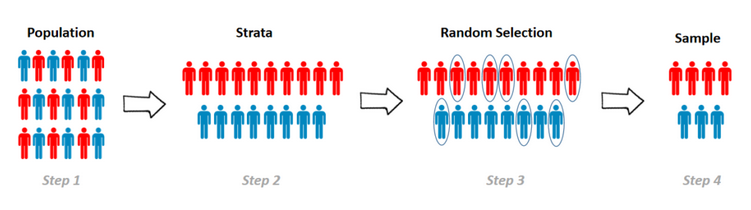
Stratified Sampling
400
Higher order concepts that are derived from examining the relationship between inductive and deductive codes. They don’t ‘emerge’ but rather come about through the active process of analysis and interpretation
Themes
500
An aggregated score or index created by combining two or more individual indicators, like Beck’s Depression Inventory
Composite Measure
500
Describes the truth value in qualitative research and can be established through prolonged engagement, member checks, memoing, triangulation, reflexivity, and other processes which determine the extent to which the findings are true.
Credibility
500
If methodology is part of an iceberg, these two concepts lie beneath it:
The first refers to a set of ideas that explain phenomena. The second refers to a broader worldview that shapes how we understand the world.
Theory & Philosophical Assumptions
500
A bottom-up qualitative analysis approach where codes are derived directly from the words of participants rather than pre-determined concepts or theory
Inductive Coding
500
Describe the moment in which qual and quant components are integrated together. It can occur during design, data collection, data analysis, IN ADDITION to the interpretation phase. Without this, the study cannot be considered mixed methods.
Point of Interface