Solubility
Concentration
Acids & Bases
Nomenclature
Titrations
100
The type of solvent that would dissolve a polar solute.
What is a polar solvent?
100
Which solution is most concentrated? Which is the most dilute?
a. 3.0 M
b. 2.4 M
c. 1.0 M
d. 8.2 M
Concentrated: What is d. 8.2 M?
Dilute: What is c. 1.0 M?
100
The pH of a solution that has a pOH of 9.50?
What is 4.50?
100
Write the name of Co(OH)3
What is Cobalt (III) hydroxide?
100
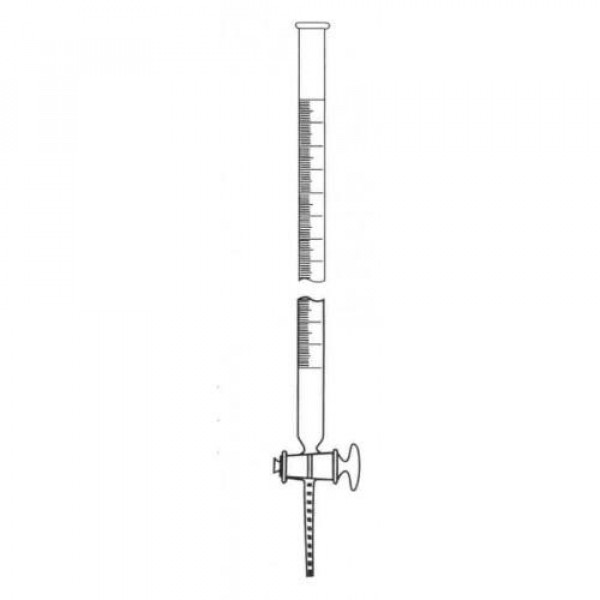
Name the part of this piece of equipment that controls the rate of dispensing.
What is the stopcock?
200
The change in solubility if pressure is increased on a solid solute in a liquid solvent.
What is no change?
200
A 0.07 L solution of Sr(CN)2 is diluted from its original concentration of 2 M to a new concentration of 1.27 M. What is the resulting volume?
What is 0.11 L?
Explanation: (2 M)(0.07 L)/(1.27 M) = ???
M1 = 2 M
V1 = 0.07 L
M2 = 1.27 M
V2 = ???
200
The identity of the following substance.
- Sour
- Sticky
- Turns litmus paper red
What is an acid?
200
Write the name of H2CO3
What is Carbonic Acid?
200

In a titration, the type of solution present in this piece of equipment.
What is the analyte?
300
The substances dissolved in water in the chemical equation shown below.
AgNO3(aq) + KCl(aq) --> AgCl(s) + KNO3(aq)
What is: AgNO3, KCl, and KNO3
300
0.191 mol of CuBr2 is dissolved in water to produce a solution with a concentration of 0.22 M. What is the volume of this solutions in liters?
What is 0.87 L?
Explanation:
(0.191 mol)/(0.22 M) = 0.868 L
300
The pOH of a solution with a H3O+ concentration of 7.23 x 10⁻⁴ M.
What is 10.86?
Explanation:
Calculate pH: -log(7.23 x 10⁻⁴) = 3.14
Solve for pOH: 14 - 3.14 = 10.86
300
Write the products for the neutralization reaction shown below:
HBr + Sr(OH)2 --> ???
What is SrBr2 + H2O?
300
The name of an indicator that is clear in acid but pink in base.
What is phenolphthalein?
400
Which of the following would dissolve in liquid methane (CH4)?
a. H2O
b. PBr3
c. C2H6
d. OF2
What is c. C2H6
Explanation: C2H6 is a nonpolar molecule, meaning it would dissolve in CH4 another nonpolar molecule. (Like dissolves like)
400
50 g of Ba(ClO4)2 is dissolved in water to produce a solution with a concentration of 3 M. What is the volume of this solution in liters?
What is 0.05 L?
Explanation:
Find mol of Ba(ClO4)2: 50 g * (1 mol Ba(ClO4)2 / 336.2312 g) = 0.148 mol
Find L of Ba(ClO4)2: 0.148 mol / 3 M = 0.04956 L --> 0.05 L
400
Using the reaction below, determine the identity of the water molecule.
NH3 + H2O --> NH4+ + OH-
What is an acid?
400
Write and balance the neutralization reaction between H2SO3 and NaOH.
What is:
1 H2SO3 + 2 NaOH --> Na2SO3 + 2 H2O
Sulfurous acid + sodium hydroxide --> Sodium sulfite + Dihydrogen monoxide.
400
How many mL of 0.459 M barium hydroxide (Ba(OH)2) would be necessary to neutralize 140.0 mL of 0.440 M chloric acid (HClO3)?
What is 67.1 mL?
Explanation:
Step 1. Determine moles HClO3
0.1400 L * 0.440 M = 0.0616 mol
Step 2. Write and balance the neutralization reaction.
2 HClO3 + Ba(OH)2 --> Ba(ClO3)2 + 2 H2O
Step 3. Determine the moles of Analyte using Stoichiometry
0.0616 mol HClO3 * (1 mol Ba(OH)2 / 2 mol HClO3) = 0.0308 mol Ba(OH)2
Step 4. Determine the volume of Ba(OH)2
0.0308 mol Ba(OH)2 / 0.459 M Ba(OH)2 = 0.0671 L
Step 4.5. Convert to mL
0.0671 L * 1000 mL = 67.1 mL
500
Which solute will dissolve in solution the fastest?
A. Solid, 50 degrees Celsius, being stirred, 1 atm
B. Gas, 50 degrees Celsius, being stirred
What is A. Solid, 50 degrees Celsius, being stirred, 1 atm.
Explanation: Solids experience an increase in dissolution if temperature is increased and stirring is added. Gases experience the same increase based on temperature, but leave a solution when stirred.
500
A solution of calcium nitrate is diluted from its volume of 970. mL to its new volume of 1.23 L. If its new concentration is 5.30 x 10⁻²⁰ particles, what was the original concentration of this solution?
What is 6.72 x 10⁻²⁰ particles?
Explanation:
Convert all volume units to the same unit (L):
970. mL / 1000 mL = 0.97 L
Solve: (5.30 x 10⁻²⁰ particles * 1.23 L)/(0.97 L) = ???
M1 = ???
V1 = 0.97 L
M2 = 5.30 x 10⁻²⁰ particles
V2 = 1.23 L
500
Using the reaction below, determine the identity of the water molecule.
HF + H2O --> F- + H3O+
What is a base?
500
Write and balance the neutralization reaction between Phosphoric acid and Copper (II) hydroxide.
What is...
2 H3PO4 + 3 Cu(OH)2 --> 1 Cu3(PO4)2 + 6 H2O?
500
What is the concentration (M) of a nitric acid (HNO3) solution if 346.6 mL of 0.197 M sodium hydroxide (NaOH) is required to neutralize a 160.0 mL sample?
What is 0.427 M?
Explanation:
Step 1: Calculate moles of titrant
0.3466 L * 0.197 M = 0.0682802 mol NaOH
Step 2: Balanced Neutralization reaction
HNO3 + NaOH --> NaNO3 + H2O
Step 3: Convert moles of titrant to moles of analyte
0.0682802 mol NaOH * (1 mol HNO3 / 1 mol NaOH) = 0.0682802 mol HNO3
Step 4: Calculate molarity of the analyte
0.0682802 mol HNO3 / 0.1600 L HNO3 = 0.427 M HNO3