Neuroscience Review
Sensation and Perception Methods
Transduction and Neuronal Function
Vision
The retina
100
What part of the cerebral cortex is #1?
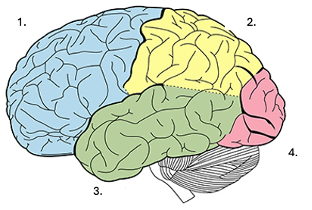
Frontal lobe
100
Magnitude estimation yields a measure of _____ magnitude of a stimulus.
a. absolute
b. difference
c. perceived
d. objective
percieved
100
What is transduction?
Converting environmental energy into electrical impulses that can be interpreted by the brain.
100
The area where the optic nerve passes out through the back of the eye is called the _____. No visual processing happens at this location.
Blind spot
100
Compared with cones, rods are _____.
- More sensitive to differences in color
- Better able to determine shapes
- More numerous in the fovea
- More sensitive to light
More sensitive to light
200
What part of the cerebral cortex is #4?
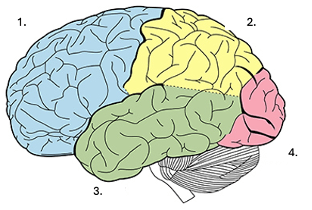
Occipital lobe
200
What is the absolute threshold for a stimulus?
The smallest amount of stimulus necessary for detection.
200
Which cells are responsible for visual transduction?
Rods and cones
200
The _______ of a light wave is perceived by the visual system as color.
Frequency
200
What part of the retina has the most acute vision?
Fovea
300
What part of the cerebral cortex is #2?
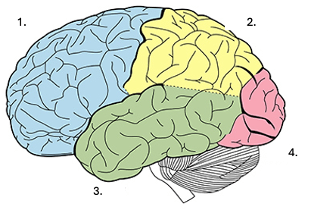
Parietal lobe
300
What is a difference threshold?
The smallest difference between two stimuli that can be detected.
300
The signal sent within a neuron is called _______.
Action potential
300
As light in the environment increases, the pupil _____.
constricts
300
The brain uses retinal disparity to perceive _____.
depth
400
What part of the cerebral cortex is #3?
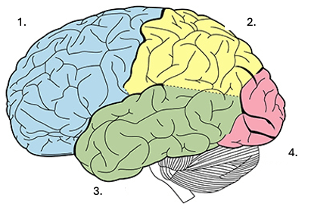
Temporal lobe
400
According to signal detection theory, what is a miss?
The target stimulus was present but not detected by the participant.
400
Communication between neurons takes place at the ______.
synapse
400
The ______ of a light wave is perceived by the visual system as brightness.
amplitude
400
The axons of _____ come together to form the optic nerve.
ganglion cells
500
Which neuroscience technique would you want to use if you wanted to pin point precisely WHEN a response in the brain is occurring?
EEG
500
Used to measure the absolute threshold, what is the method of adjustment?
Participant controls the stimulus level and adjusts to absolute threshold.
500
Communication between neurons is in the form of _____.
neurotransmitters
500
The structure that provides 20% of the eyes focusing ability and can change shape is the _____.
lens
500
Lateral inhibition in the visual system is likely the reason why we have an enhanced ability to perceive _____.
edges