Ch. 1+4 - What's Psych? + Sensation and Perception
Ch. 2-Psyc's Scientific Method
Ch. 3-Biological Foundations
Ch. 5+7 - States of Consciousness + Memory
Ch.6-Learning
100
30 sec
Who founded the First Psychology lab in Germany?
Wilhelm Wundt
100
2 min
What is an operational definition, and what is its value in a study?
An objective description of how a variable is measured and observed (in a particular study).
Value - Eliminates any misconfusion or "fuzziness." Ensures everyone agrees on what a variable means.
-Concepts need definitions!
100
1 min
What is the difference between genotype and phenotype?Genotype - "Your blueprint." One's genetic material.
Phenotype - An individual's observable characteristics.
100
30 sec
What is consciousness?
An individual's awareness of external events and internal sensations under a condition of arousal. Awareness of the self and thoughts about one's experience.
100
1 min
What is the definition of learning?
Relatively permanent change, acquired through experience.
200
20 sec
What's the definition of Psychology?
The scientific study of behavior and mental processes.
1. It's scientific
2. Behavior - Observable and repeatable behavior, external factor
3. Mental processes - Why we do the things we do, internal factor
200
3 min
You're the experimenter here; you also need 2 answers here:
1. According to the scientific methods, after you make an observation, what do you do next?
2. What is the last step in the scientific method?
1. Create a testable hypothesis.
2. Replication
200
2 min
What is the difference between afferent and efferent nerves?Afferent - Nerves that carry information from our external environment to the brain and spinal cord, via sensory receptors. "Afferent nerves arrive."
Efferent - Nerves that carry information out of the brain and spinal cord to other areas of the body. "Efferent nerves exit."
200
30 sec
IN ORDER: What 3 processes play key roles in memory?
Encoding -> storage -> Retrieval
200
30 sec
Give an example for:
Primary reinforcer AND secondary reinforcer.
Primary - Primal, primary, internal, not learned.
Secondary - External, learned.
300
2 min
What is the difference between structuralism and functionalism?
Structuralism focuses on identifying the structures of the human mind. - W.W.
Functionalism focuses on the functions and purposes of the mind and behavior in the person's adaptation to their environment. - William James
300
3 min
Needs: 2 correct answers!
1. Do we prove? If not, then what do we do instead?
2. What is a meta-analysis?
1. We never prove! We either support or fail to support
2. "study of studies." A summary of a large body of evidence from the research literature on a particular topic.
300
30 sec
How do neurons communicate, and what is the advantage of this type of communication?
Neurons communicate electrochemically, and the advantage is neuroplasticity.
300
30 sec
What are the unique features of REM sleep?
Vivid dreams or apex dreams and rapid eye movement (REM).
300
3 min
What is: Negative reinforcement AND positive punishment?
Provide your own definition and examples.
Negative reinforcement - Removing a stimulus in order to increase a behavior.
Ex: Taking away chores when a child presents a good report card.
Skinner box - A rat having to hold the lever down to stop getting shocked.
Positive punishment - Adding a stimulus in order to decrease a behavior.
Ex: Spanking a kid for getting a bad report card.
Skinner box - A rat gets shocked every time it presses down the lever.
400
2 min
What is the difference between sensation and perception?
Sensation (objective/biological) is the process of receiving raw external stimuli from your environment.
Perception (subjective/personal) is the process of organizing and interpreting sensory information so that it makes sense to you!
400
3 min
What are the 3 different types of research methods? AND What is the key word assosiated with each one?
1. Descriptive - describe
2. Correlational - relationship
3. Experimental - causation
400
3 min
DRAW and IDENTIFY the basic anatomy of a neuron.
Remember: "To receive or not to receive."
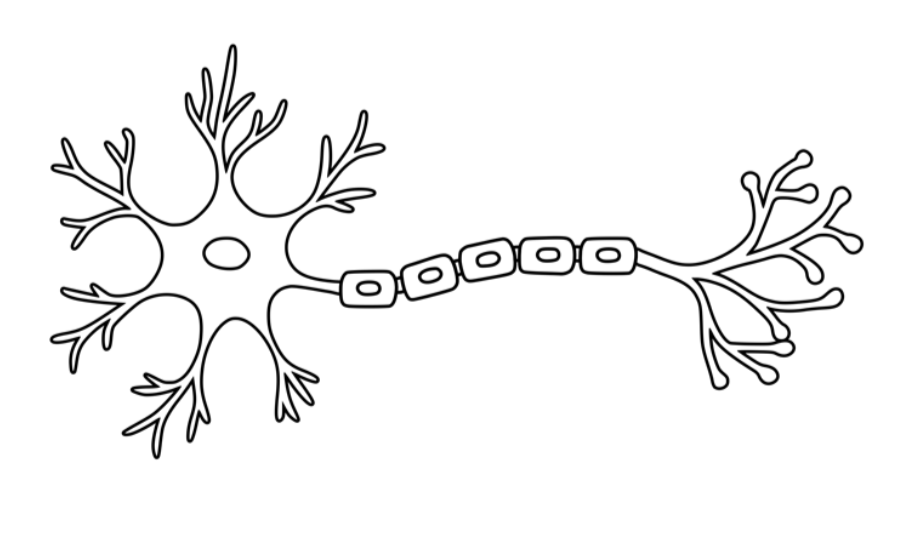
Dendrites(receive neurotransmitters) -> Cell body -> Axon -> Terminal buttons(release neurotransmitters)
400
1 min
What is the difference between the recency effect and the primacy effect?
Recency effect - Recalling the last or recent items of an element.
Primacy effect - Recalling the first or beginning items of an element.
400
2 min
For partial schedules of reinforcement, finish the blank:
1. Interval = ________
2. Variable = ________
3. Ration = _________
4. Fixed = _________
1. Interval = Time
2. Variable = Varied, Random, unpredictable
3. Ration = Responses (number of responses)
4. Fixed = Specific
500
30 sec
In our bodies, where does transduction occur, in order for us to see and hear?
Vision - Retina
Ear - Cochlea
500
5 min
1. What are the 3 elements of a true experiment?
2. In this example, what are the I.V., D.V., E, and C?
A psychologist wants to test whether listening to music affects students’ memory. The researcher randomly assigns college students to two groups. One group studies a list of words while listening to music, while the other group studies the same list in silence. After five minutes, both groups take the same memory test to see how many words they can recall. By comparing the results of the two groups, the researcher can determine whether music influences memory performance.
1. Randomization, manipulation, control
2.
I.V. - Music
D.V. - memory test
E - groups that listen to music
C - Group with no music.
500
3 min
DRAW, LABEL, and IDENTIFY the brain's lobes!
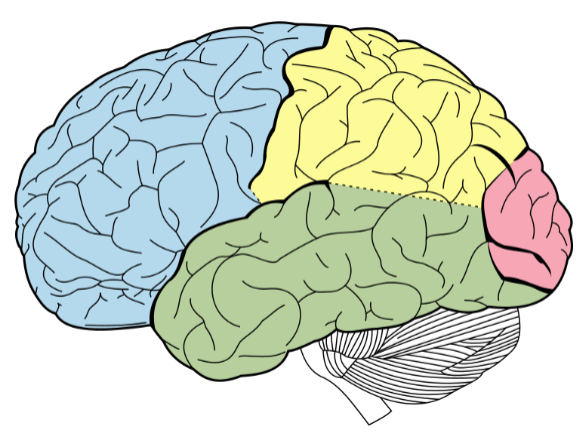
Frontal (executive function)
Parietal(body map) - Includes motor cortex and somatosensory cortex
Temporal(auditory)
Occipital(vision)
Cerebellum(coordination, balance, movement)
500
1 min
Provide an example for both:
1. Lower-level of consciousness
2. Altered state of consciousness
1. Can be daydreaming and includes automatic processing that requires little attention.
Ex: Typing on a keyboard (if you've built up that muscle memory), and starting up your car (having had years of driving experience).
2. Produced by drugs, trauma, fatigue, and possibly hypnosis.
Ex: Undergoing hypnosis for pain relief or feeling the effects after consuming alcohol.
500
3 minutes and obey the layout below!
What is the correct order of Pavlov's classical conditioning AND what object/response was attached to each element?
Hint: There are 5 elements to classical conditioning,
2 objects and 1 response!
Here's the layout:
1. ______ is to the ________
2. ______ is to the ________
3. ______ is to the ________
4. ______ is to the ________
5. ______ is to the ________
1. Bell is to the N.S.
2. Food is to the U.S.
3. Salivation is to the U.R.
4. Bell is to the C.S.
5. Salivation is to the C.R.