Solar System
Celestial bodies
Random facts
Planets
Technology and Satellites
100
A collection of objects in space that revolves around the sun. It includes everything from the huge gas giants to tiny pieces of rock like asteroids.
The solar system.
100
Planets are usually this shape because gravity pulls matter evenly inward.
Round.
100
What is an example of a celestial body that emits light?
Stars or the sun.
100
Although Pluto was originally classified as a planet, new information led to the reclassification of Pluto as a _______
Dwarf planet.
100
These are powerful optical instruments that allow scientists to observe distant objects in space. They come in different types, such as refracting and reflecting.
Telescopes.
200
______ bodies are natural objects that exist outside Earth's atmosphere.
Celestial
200
What is the arrow pointing at in this image?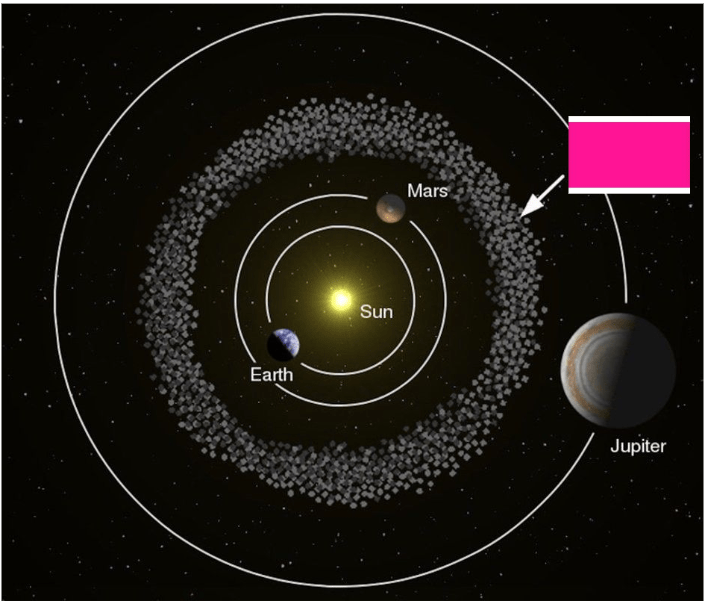
The asteroid belt.
200
What is an example of a celestial body that reflects light?
The moon or the planets.
200
What planet is this?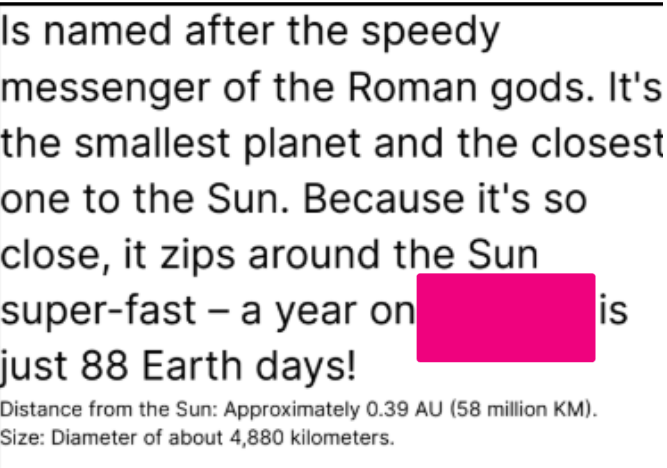
Mercury.
200
Natural _______ are celestial bodies that orbit around larger bodies in space, such as planets. They are also known as moons.
Satellites.
300
Smaller celestial bodies that share characteristics with both planets and asteroids.
Dwarf planets
300
Unlike rocky inner planets, Jupiter and Saturn are mostly made of these materials.
Gases.
300
The regular path that an object takes as it revolves around another object.
An orbit.
300
In order to be a planet, a planet must:
1. Orbit the Sun
2. Be large enough for its gravity to make it round.
3. Have cleared its orbit of other debris.
Which one of these reasons is why Pluto is no longer considered a planet?
3. It's orbit overlaps with the orbit of Neptune and shares its space with many other icy objects in the Kuiper Belt.
300
These are unmanned spacecraft designed to explore specific regions in space. These robotic vehicles are equipped with sensors and cameras to study planets, asteroids, and comets up close.
Probes.
400
Small rocky or metallic fragments that travel through space. When one of these enters Earth's atmosphere and burns up, it creates a streak of light known as a shooting star.
Meteoroids.
400
Name and order the planets in the solar system.
Mercury, Venus, Earth, Mars, Jupiter, Saturn, Uranus, Neptune
400
Which planet has a massive orbit that takes almost 12 Earth years to complete?
Jupiter.
400
What planet is this?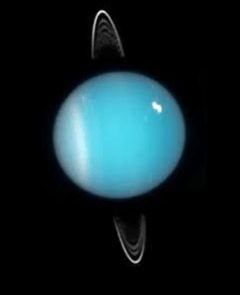
Uranus.
400
This artificial satellite was developed by students and faculty at UofA in Edmonton. It was sucessfully launched from the International Space Station in 2017.
a) Ex-Alta 1
b) The Hubble Space Telescope
c) Sputnik 1
d) GOES - 16
a.
500
Icy bodies that travel through space, leaving a trail of gas and dust behind them. When they come close to the Sun, they develop glowing tails that can be seen from Earth.
Comets.
500
The hottest planet in our solar system.
Venus.
500
Robotic vehicles that can move across the surface of planets or moons. They are equipped with cameras, drills, and scientific instruments to analyze soil samples and rocks.
Rovers.
500
The asteroid belt is between these two planets.
Jupiter and Mars
500
A giant laboratory in space that orbits Earth and is used by scientists from all over the world to study space and conduct experiments. It involves many counties, like Canada, Russia, United States, Japan, and European countries.
The International Space Station (ISS)