Planets
Stars
Space Objects
Universe
Moon
Motion
100
If a planet is small and heavy and made out of rocks and metals, is it a Jovian or Terrestrial planet?
Terrestrial
100
What color star has a temperature of 25000K and a luminosity of 102?
Blue
100
What makes a comet unique?
Made of ice and dust, has 2 tails
100
What is the most common element in the Universe?
Hydrogen
100
What phase of the moon is the arrow pointing at?
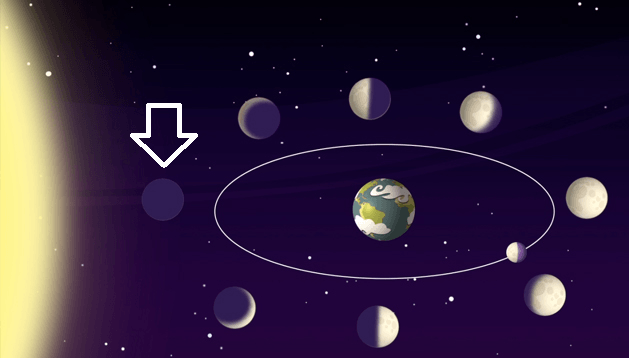
New Moon
100
If a planet is farther from the sun in its orbit, is it moving faster or slower?
Slower
200
Describe two identifying factors of a Jovian planet.
Made out of gas, large, moves swiftly, light, likely to have rings and multiple moons
200
Consider the main sequence stars. As temperature decreases, what happens to luminosity?
Decreases
200
How are a meteoroid and an asteroid different?
A meteoroid is smaller than an asteroid.
An asteroid is larger than a meteoroid.
200
What happened to the universe during the Big Bang and is still currently happening?
The universe expanded and continues to do so
200
What phase of the moon is the arrow pointing at?
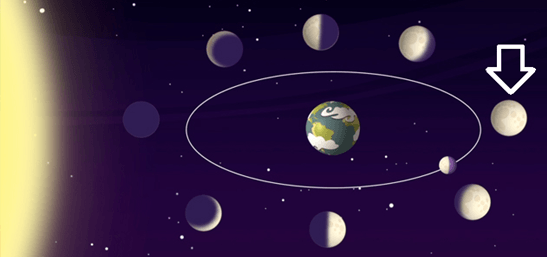
Full moon
200
What is the shape of a planet's orbit around the sun called?
An ellipse
300
What causes the Seasons on Earth?
Earth's Tilt
300
What can a massive star end as?
(Hint: there are TWO options)
Black hole or neutron star
300
How are a meteor and a meteorite different?
A meteor is in the atmosphere while a meteorite has landed on the Earth's surface.
300
What is a nebula?
Cloud of dust and gas where stars and planets are formed
300
What do we call the phases that are slowly revealing the more of the moon (going from New moon to full)?
Waxing phases
300
Saturn and Mercury both orbit the sun. Which one takes longer to do one revolution?
Saturn
400
Why is the Earth tilted?
A large rock, Theia, hit it
400
Where do all stars begin?
In a stellar Nebula
400
Match the following with their definitions:
1. Moon a. ball of plasma powered by fusion
2. Asteroid b. large rocky body orbiting something other than the Sun
3. Star c. small body of ice and dust with 2 tails that orbits the Sun
4. Comet d. small body of rock and metal that orbits the sun
1. b 2. d 3. c 4. a
400
What causes black holes?
Gravity
400
When the moon is moving from full to new, what are these phases categorized as?
Waning
400
What keeps the planets from flying away from the sun? (Keeps them in orbit)
Gravity
500
What causes the tides on Earth?
Gravity! (specifically the moon's)
500
What color is a star that has a luminosity of 104 and a temperature of 2,500K?
Red
500
Match the following with their definition
1. Meteoroid a. small rock landed on the Earth
2. Meteorite b. Small rock orbiting Sun
3. Meteor c. Small rock in our atmosphere
1. b 2. a 3. c
500
What does a nebula create?
Stars!
and sometimes planets
500
What do we call it when we see most of the moon but not all?
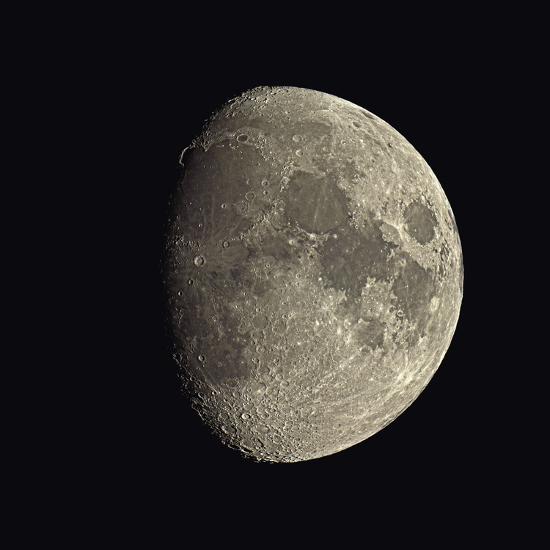
Gibbous
500
What is Earth's rotation and revolution?
Rotation: 24 hrs or 1 day
Revolution: 365 days or 1 year