Sun
Moon
Earth
Stars
Challenge
100
Our solar system's star that is made of hydrogen and helium gases, and supplies the heat and light that sustains life on Earth.
Sun
100
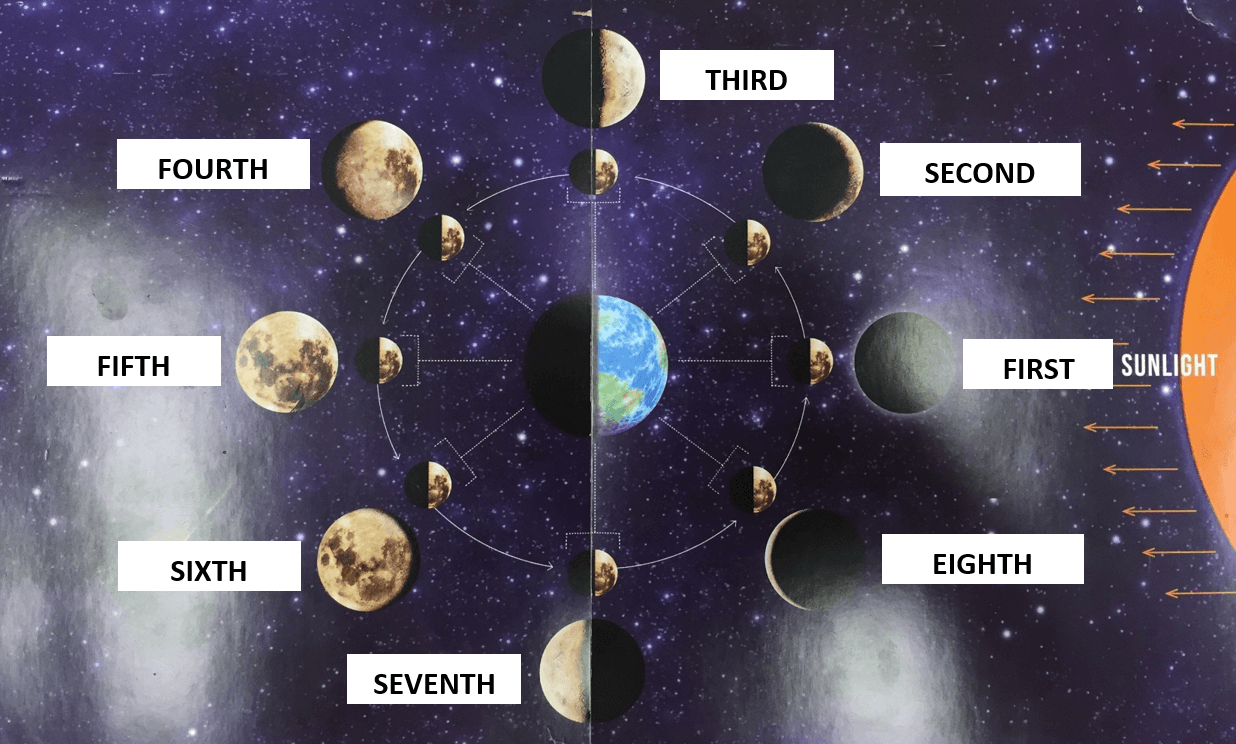 First Phase
New Moon
100
365 days
Earth's Revoluton
100
A huge ball of gases that makes its own heat and light.
Star
100
The distance light travels in one Earth year. About 6 trillion miles. An astronomical unit.
Light year
200
The narrow band of sky that the Sun travels across each day.
Ecliptic
200
The regular rise and fall of the ocean's surface influenced by the moon's gravity pulling on Earth
Tides
200
24 hours
Earth's Rotation
200
A pattern of bright, highly visible stars
Constellation
200
Orbits a star and is big enough for gravity sphere
Planet
300
about 863,000 miles or 1,390,000 kilometers
Diameter of the Sun.
300
a path of an object as it circles around another object in outer space.
Orbit
300
the only planet in the solar system on which life is known to exist
Earth
300
Orbits a star and is big enough for gravity sphere.
Planet
300
The Sun and the planets and other objects that orbit the Sun.
Solar System
400
4.603 billion years
How old the sun is...
400
Sixth Phase
Waning gibbous
400
4.5 billion years
How old Earth is
400
Contains the star Polaris, also know as the North Star.
Ursa Minor
400
A group of stars and planets made up of stars, dust and gas.
Galaxy
500

The compass rose shows the direction of each shadow. Which picture would represent 10:00 am in June?
A
500

which letter would be considered a moon.
W
500
Five friends were looking up in the Ohio sky at noon in June. Rachel asked how the sun would be different at noon in December. Her friends shared their thoughts.
Joey: I think the sun would be higher in the sky. The sun would also be farther away from Earth.
Ross: I think the sun would be lower in the sky. The sun would also be about the same distance from Earth.
Monica: I think the Sun would be lower in the sky. The sun would also be farther away from Earth.
Phoebe: I think the Sun would be the same place in the sky. The sun would also be farther away from Earth.
Which friend’s statement is the most accurate?
Monica
500
The number of named constellations in the sky, most of which were named by the ancient Greeks
88
500
how we see the universe from our position on Earth
Celestial Sphere