Day & Night
Earth's Tilt
Our place in space
Our place in space 2
Wild Card
100
Why do we have night and day
The spinning of the Earth on it's axis
100
The elliptical path the Earth takes to travel around the Sun.
Orbit or revolution
100
What do we call it when there is no moon visible?
New moon
100
How many rocky planets are there?
4
100
Name the planets in order from closest to the Sun to farthest.
Mercury, Venus Earth, Mars, Jupiter, Saturn, Uranus, Neptune.
200
The direction that the earth rotates
Counter-clockwise (objects appear to move east to west)
200
At these times of year (Seasons) the sunlight shines equally on the northern and southern hemispheres.
Spring and Fall
200
The two things that are provided by our star, the Sun.
What are heat and light?
200
What do we call a thin sliver of moon?
Crescent
200
Number of stars in our solar system
One the SUN
300
The length of time that it takes Earth to rotate.
24 hours
300
In this season the Northern Hemisphere is tilted towards the sun, causing longer daylight hours and more direct sunlight.
Summer
300
What is the most massive planet in our solar system?
Jupiter
300
What is the only other planet in our solar system that we believe could sustain life?
Mars
300
What do we call it when you can see half the moon?
First or third quarter
400
What phase of the moon is shown here? 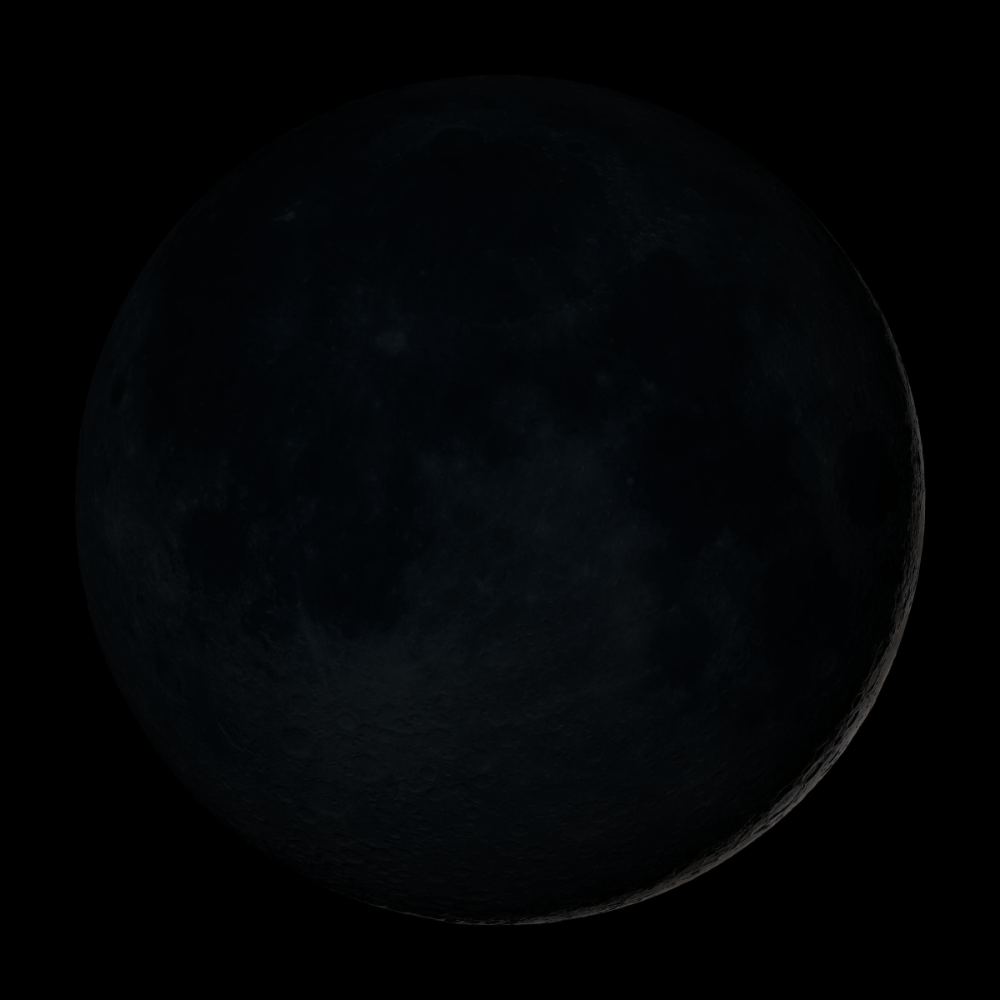
New Moon
400
This part of the Earth gets the most direct light from the sun and has the least variation in daylight hours. It is also the region of the world with the most rainforests.
The Equator
400
The tiny sliver of a moon we see twice a month
Crescent
400
How many planets are in our solar system? Include Earth
8
400
The reasons why some stars appear brighter than others
They are closer or larger or give off more light energy.
500
Why does the moon appears to change shape in the night.
The moon appears to change because of the amount of light it reflects as it orbits the Earth.
500
Two things that change as a result of Earth's revolution.
1. Length of day and night
2. Seasons
3. Star patterns
500
What gets between the sun and Earth during a solar eclipse?
The moon
500
The difference between a meteor and a meteorite.
The meteor is traveling through Earth's atmosphere and a meteorite has made it to the surface
500
Apart from the sun and planets 3 other things found in our solar system.
Comets, asteroids, meteors, dwarf planets