Vocab 1
Vocab 2
Vocab 3
Stars
Planets
General Space Knowledge
MISC.
100
The distance between the Earth and the Sun is called a(n)
Astronomical Unit
100
A huge ball of gas held together by gravity which gives off its own heat and light
Star
100
All the celestial bodies (moons, planets, asteroids, etc.) that orbit the Sun
Solar System
100
Which sentence about objects in the solar system describes ONLY the sun?
A. It prodices its own light.
B. It is mostly made of gases.
C. It has objects that orbit around it.
D. It travels along an almost circular path.
A.
B-- Jupiter & Saturn have surfaces that are made of gases.
C-- most planets have moons that orbit around them (Earth has 1, Mars has 2, Jupiter has almost 80)
D-- The sun doesn't really travel along a path (orbit) but planets, moons, comets, and asteroids all do.
100
List the planets in order of distance from the Sun, starting with the planet closest to the Sun.
Mercury, Venus, Earth, Mars, Jupiter, Saturn, Uranus, Neptune
100
What do we call the small, rocky objects that are scattered throughout space? Hint: There is a belt of them between Mars and Jupiter.
Bonus: What do we call these once they enter an atmosphere and start to burn up? Hint: We think 1 of these killed all the dinosaurs.
Asteroids.
Meteor (bigger) or Meteorite (smaller)
100
The distance of 1 AU
93 million miles
200
When we get outside of the solar system we use this to measure distance. It's how far light travels in 1 year.
Light Year
200
A small rocky body that enters the Earth's atmosphere and burns up
Meteor
200
a system of millions or billions of stars, together with gas and dust, held together by gravity
Galaxy
200
The following question has two parts. First, answer Part A. Then, answer Part B.
Part A
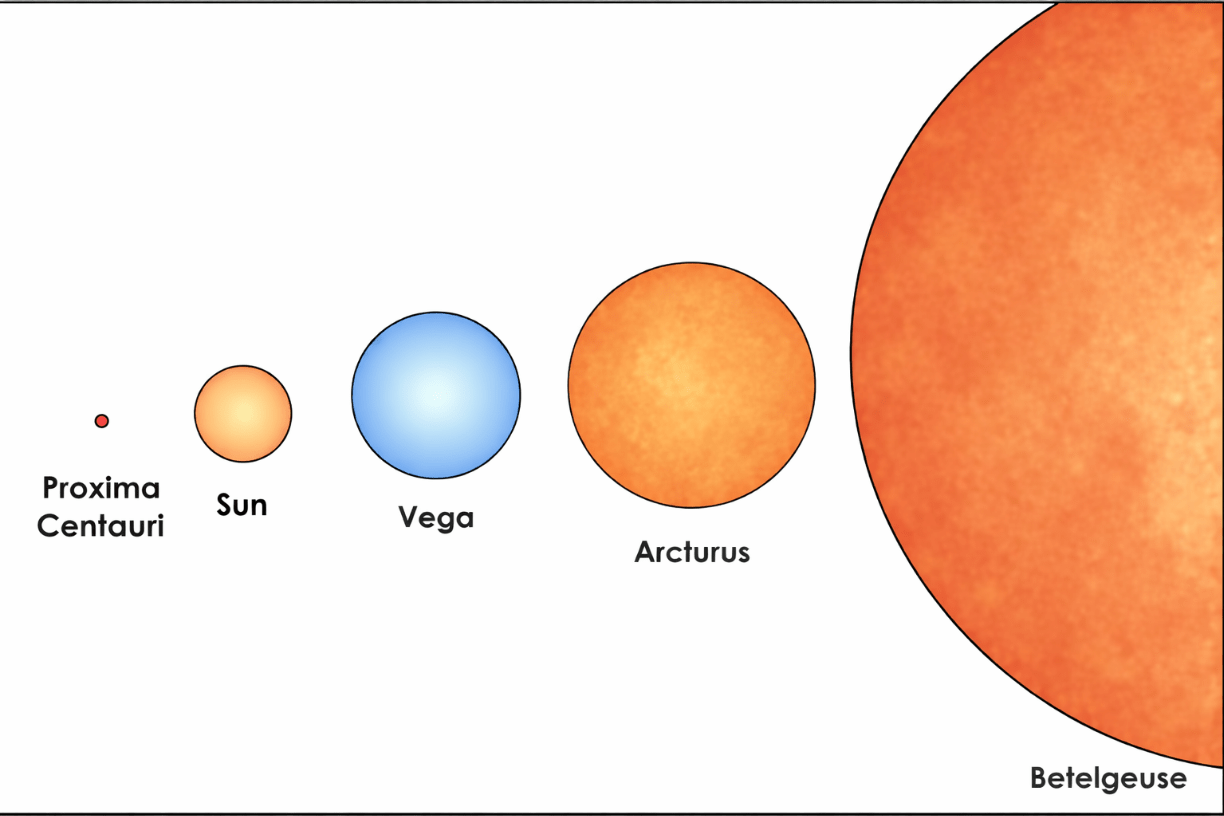
The diagram shows the relative sizes of several stars, including the Sun
Part A
Which star appears the largest from Earth?
Part B
Why does the star selected in Part A appear the largest from Earth?
A. it is the biggest star in the galaxy.
B. It is the hottest star in the Milky Way.
C. It is the closest star to Earth.
D. It is the brightest star in the universe.
E. It puts out more light during the day than the other stars.
Part A: Sun
Part B: C. Distance is the biggest determining factor on brightness of a star. While actual brightness and size play a role, closer stars will always appear brighter than further stars. The sun is NOT the biggest, hottest, or brightest star in the Milky Way galaxy OR the Universe. The amount of light a star puts out does NOT change, we just face the sun during the day and don't face it at night.
200
The inner 4 planets are referred to as this
Terrestrial Planets
200
Which is larger, a star system or a galaxy?
Galaxy
200
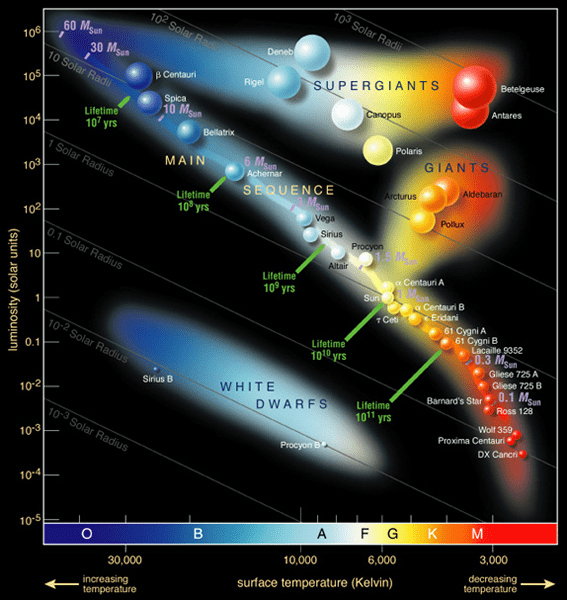
Our Sun is what size of star (officially)??
**Hint this was on the webquest in the graph
Main Sequence
300
Approximate distance of a light year
6 trillion miles
300
Any natural body outside of the Earth's atmosphere
Celestial Body
300
Universe
all existing matter and space considered as a whole. Everything that exists.
300
The largest star size is called a......
supergiant/hypergiant
300
The outer four planets are called this
Jovian planets
300
Which statement BEST explains why Mars and Jupiter are classified as planets and Pluto is classified as a dwarf planet?
A: Pluto is too small to classify as a planet
B: Pluto is too far away to qualify as a planet
C: Pluto has too few satellites to qualify as a planet
D: Pluto has too many objects in its orbit to qualify as a planet.
D: Pluto has too many objects in its orbit to qualify as a planet.
300
According to the table, which statement accurately compares the length of one year for two of these planets?
A: Earth has a longer year than Mars
B: Mars has a longer year than Venus
C: Venus has a longer year than Earth
D: Mercury has a longer year than Venus

B: Mars has a longer year than Venus
400
Rotate
One spin of an object on its axis; the cause of day and night on planets.
400
DAILY DOUBLE!!!
~~~~~~~~~~~~~~~~~~~~~~~~~~~~~~~
~~~~~~~~~~~~~~~~~~~~~~~~~~~~~~~
~~~~~~~~~~~~~~~~~~~~~~~~~~~~~~
~~~~~~~~~~~~~~~~~~~~~~~~~~~~~~
~~~~~~~~~~~~~~~~~~~~~~~~~~~~~~~
~~~~~~~~~~~~~~~~~~~~~~~~~~~~~~~
~~~~~~~~~~~~~~~~~~~~~~~~~~~~~~~
~~~~~~~~~~~~~~~~~~~~~~~~~~~~~~
~~~~~~~~~~~~~~~~~~~~~~~~~~~~~~
~~~~~~~~~~~~~~~~~~~~~~~~~~~~~~~
~~~~~~~~~~~~~~~~~~~~~~~~~~~~~~~
~~~~~~~~~~~~~~~~~~~~~~~~~~~~~~~
~~~~~~~~~~~~~~~~~~~~~~~~~~~~~~
~~~~~~~~~~~~~~~~~~~~~~~~~~~~~~
~~~~~~~~~~~~~~~~~~~~~~~~~~~~~~~
~~~~~~~~~~~~~~~~~~~~~~~~~~~~~~~
~~~~~~~~~~~~~~~~~~~~~~~~~~~~~~~
~~~~~~~~~~~~~~~~~~~~~~~~~~~~~~
~~~~~~~~~~~~~~~~~~~~~~~~~~~~~~
~~~~~~~~~~~~~~~~~~~~~~~~~~~~~~~
What is the difference between a moon and an asteroid?
A moon orbits a planet, an asteroid orbits a star
400
Used to measure luminosity (brightness)
Solar Units
400
True or False: Stars and moons produce their own light.
If False, correct the statement to make it true.
False. Stars produce their own light, moons only reflect it.
400
DAILY DOUBLE!!!
~~~~~~~~~~~~~~~~~~~~~~~~~~~~~~~
~~~~~~~~~~~~~~~~~~~~~~~~~~~~~~~
~~~~~~~~~~~~~~~~~~~~~~~~~~~~~~
~~~~~~~~~~~~~~~~~~~~~~~~~~~~~~
~~~~~~~~~~~~~~~~~~~~~~~~~~~~~~~
~~~~~~~~~~~~~~~~~~~~~~~~~~~~~~~
~~~~~~~~~~~~~~~~~~~~~~~~~~~~~~~
~~~~~~~~~~~~~~~~~~~~~~~~~~~~~~
~~~~~~~~~~~~~~~~~~~~~~~~~~~~~~
~~~~~~~~~~~~~~~~~~~~~~~~~~~~~~~
~~~~~~~~~~~~~~~~~~~~~~~~~~~~~~~
~~~~~~~~~~~~~~~~~~~~~~~~~~~~~~~
~~~~~~~~~~~~~~~~~~~~~~~~~~~~~~
~~~~~~~~~~~~~~~~~~~~~~~~~~~~~~
~~~~~~~~~~~~~~~~~~~~~~~~~~~~~~~
~~~~~~~~~~~~~~~~~~~~~~~~~~~~~~~
~~~~~~~~~~~~~~~~~~~~~~~~~~~~~~~
~~~~~~~~~~~~~~~~~~~~~~~~~~~~~~
~~~~~~~~~~~~~~~~~~~~~~~~~~~~~~
~~~~~~~~~~~~~~~~~~~~~~~~~~~~~~~
List 4 characteristics of terrestrial planets
Few moons, no rings, hotter temperatures, smaller diameters, shorter orbital periods/shorter years, slower rotation/longer days, rocky composition
400
DAILY DOUBLE!!!
~~~~~~~~~~~~~~~~~~~~~~~~~~~~~~~
~~~~~~~~~~~~~~~~~~~~~~~~~~~~~~~
~~~~~~~~~~~~~~~~~~~~~~~~~~~~~~
~~~~~~~~~~~~~~~~~~~~~~~~~~~~~~
~~~~~~~~~~~~~~~~~~~~~~~~~~~~~~~
~~~~~~~~~~~~~~~~~~~~~~~~~~~~~~~
~~~~~~~~~~~~~~~~~~~~~~~~~~~~~~~
~~~~~~~~~~~~~~~~~~~~~~~~~~~~~~
~~~~~~~~~~~~~~~~~~~~~~~~~~~~~~
~~~~~~~~~~~~~~~~~~~~~~~~~~~~~~~
~~~~~~~~~~~~~~~~~~~~~~~~~~~~~~~
~~~~~~~~~~~~~~~~~~~~~~~~~~~~~~~
~~~~~~~~~~~~~~~~~~~~~~~~~~~~~~
~~~~~~~~~~~~~~~~~~~~~~~~~~~~~~
~~~~~~~~~~~~~~~~~~~~~~~~~~~~~~~
~~~~~~~~~~~~~~~~~~~~~~~~~~~~~~~
~~~~~~~~~~~~~~~~~~~~~~~~~~~~~~~
~~~~~~~~~~~~~~~~~~~~~~~~~~~~~~
~~~~~~~~~~~~~~~~~~~~~~~~~~~~~~
~~~~~~~~~~~~~~~~~~~~~~~~~~~~~~~
Describe in detail why the Sun appears to be the brightest star. Make sure to use all 3 characteristics that affect the brightness of a star in your answer.
Although it is an average star in terms of size (Main Sequence) and luminosity (actual brightness), it is the closest star to Earth so it appears to be the brightest.
400
Which action is caused by the same force that causes objects to fall towards the surface of Earth?
A: Earth orbits the Sun
B: Sunlight travels to the planets
C: The tails of comets point away from the Sun
D: Earth is tilted on its axis
A
500
Revolve
The movement of a celestial body around a star, planet, or moon. 1 revolution of a planet around a star = 1 year.
500
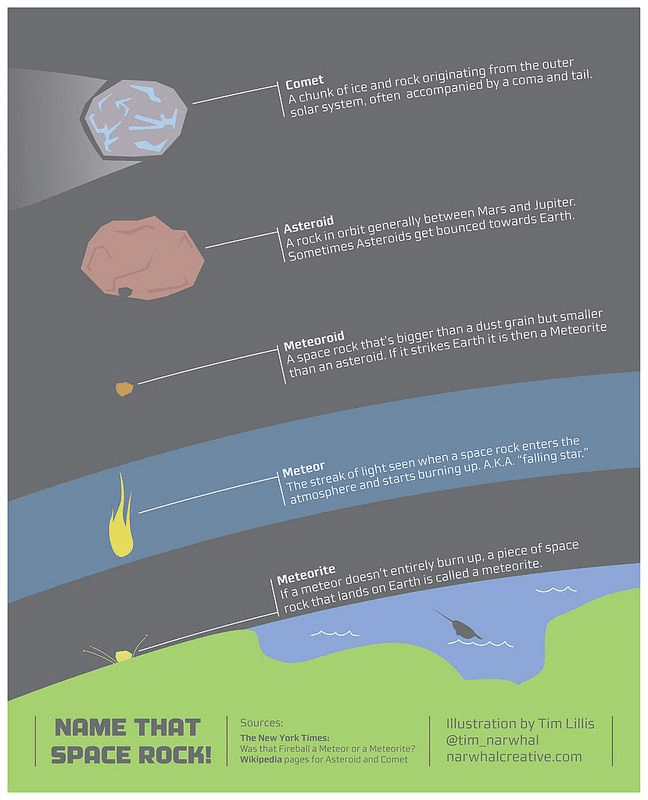
What is the difference between a meteor, an asteroid, and a comet?
meteor -- enters Earth's atmosphere & stars to burn, typically a smaller piece broken off of an asteroid.
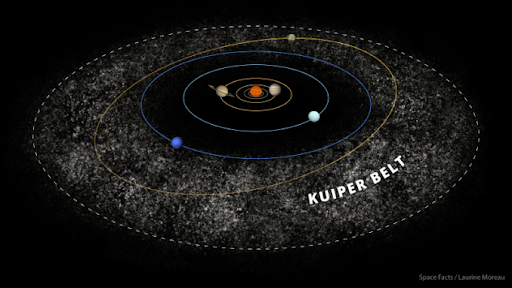
asteroid -- rocky & metal body that orbits a star (slightly bigger than a meteor) (typically in the Asteroid Belt but also in the Kuiper Belt).
comet -- rocky & ICE body that orbits a star (typically further away in the Kuiper Belt & Oort Cloud).
500
The brightness of a celestial body, usually a star
Luminosity
500
1. List the 3 factors that contribute to a star's relative brightness.
~~~~BONUS~~~~
2. Which factor makes the biggest impact on apparent brightness (how bright we view a star from Earth)?
Actual brightness, size, and distance from Earth
Distance from Earth.
--If a smaller star is closer to Earth than a larger star, it will appear brighter.
-- If a dimmer star is closer to Earth, it will appear brighter.
500
List 5 characteristics of Jovian Planets
Many moons, many rings, gas/ice surface, colder temperatures, bigger diameters, faster rotation/shorter days, longer orbital periods/longer years, rock/ice core
500
List the 3 bands/collections of asteroids/comets in order of distance from the Sun, starting with the one closest to the Sun
Asteroid belt, Kuiper Belt, Oort Cloud


500
Which planets are having a conversation?
1. "Dude, it's so cold out here! I'm frozen!"
2. "I mean I get it, kind of. Half of me is frozen but the other half is burning up. Do you think I'm sick??"
1. "I shouldn't be the judge of that, everything looks tipped on it's side to me!"
2. "I hate to be the one to tell you this... but it's just you-- YOU'RE on your side...."
1. "Well that's just your opinion, if it were true then my buddies out here would have told me! Must be hard for you to see from all the way up there. Probably to bright or maybe you're just too tiny."
2. "Awkward...."
3. "At least you guys are still considered planets...My surface hurts from running into all these comets and asteroids and I only pass by all you other guys once every 248 years."
1 & 2. "Take it up with the IAU, little buddy. Maybe in 3006 they'll change their minds like they did in 2006...."
1. Uranus
2. Mercury
3. Pluto
600
In your own words, describe how rotate is different than revolve. Identify 1 commonly experienced event that is caused by each.
Rotate is when an object spins in place and does not travel. A commonly experienced event for this is when Earth spins on its axis (which takes 24 hours) and causes day to turn into night.
Revolve is when an object orbits or travels around another object such as a planet revolving around a star or a moon revolving around a planet. Earth takes 365 days to revolve around the Sun which is 1 whole year.
600
Place the following in order from smallest to largest:
Star, Galaxy, Moon, Universe, Star System, Asteroid, Planet
Asteroid
Moon
Planet
Star
Star System
Galaxy
Universe
600
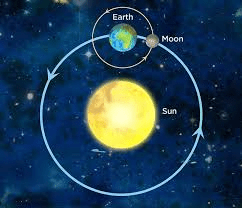
Act out the difference between rotate and revolve.
Using 3 of your teammates, act out how a star, planet, and moon (such as the Sun, Earth, and moon) interact.

600
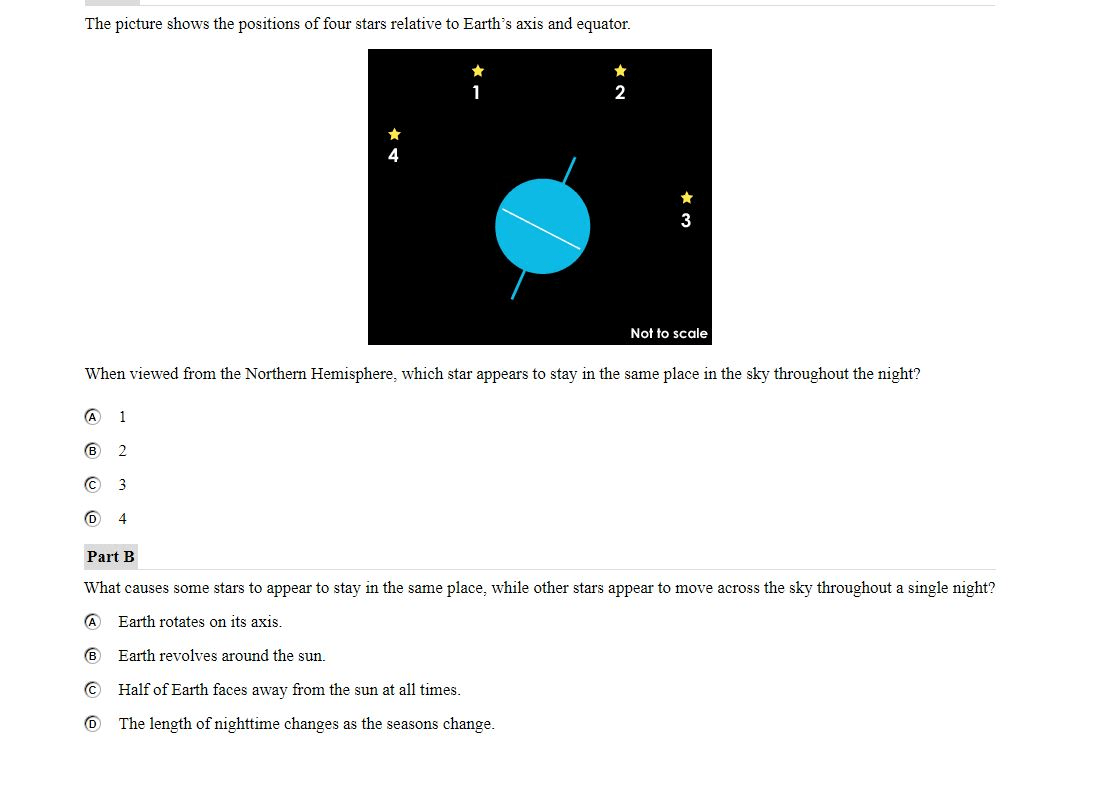
Describe the difference between Seasonal and Circumpolar constellations. Give an example of each.
Seasonal are only visible during certain times of the year. Examples of these are the Zodiac constellations such as Taurus, Virgo, and Leo.
Circumpolar constellations are always visible because they look like they are spinning around the North or South Pole. The Big and Little Dippers are examples of these.
600
List the 3 characteristics that celestial bodies must follow in order to be considered a planet
AND
Identify which characteristic was the reason Pluto was demoted to Dwarf Planet status in 2006.
1. Enough gravity/mass to be round.
2. Orbit/revolve around a star.
3. Enough mass/gravity to clear its orbit from debris (R.I.P. Pluto, getting bullied by the comets & asteroids in the Kuiper Belt)
600
2.
A.
600
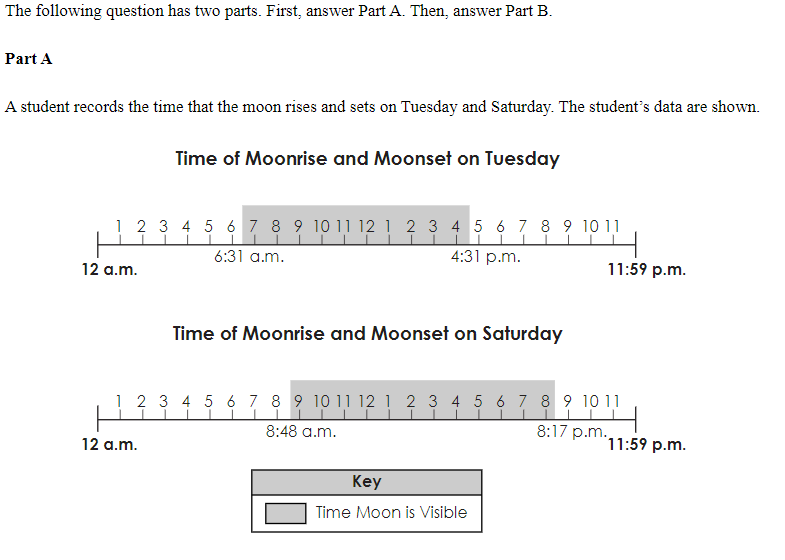
Part A:Which statement explains how the moon is visible during the daytime hours?
A: The sun absorbs light from the moon.
B: The sun emits more light toward the moon.
C: The moon appears brighter than the surrounding sky.
D: The moon produces the same amount of light as the sun.
Part B: Which pattern supports the explanation for the student's data?
A: The sun's revolution around Earth
B: The moon's revolution around Earth
C: The moon's revolution around the sun
D: Earth's movement along its orbital path
C
B