Social Structure
Political Structure
Agoge/Military
Economy
Women/Marriage
Who said this
100
A boy is how old when he becomes a Spartiate
30
100
What was the power of the Ekklesia
Vote yes or no on proposals from the Gerousia
100
At what ages did boys enter and leave the Agoge
7 & 30
100
What alternate currency is supposed to have replaced currency
iron bars (pelanors)
100
True, False, Unknown Women trained with men in the nude
False
100
The king shall offer in behalf od the state all public sacrifices, as being himself of divide descent.
Xenaphon
200
Helots outnumbered Spartans by what ratio
7:1, 8:1 or 10:1 depending on translation
200
Name the responsiblities of the Two Kings
findings husbands for widows
Roads
Appointing Religious proceedings
Commanding the army
200
Identify 2 activities in Stage 1
§Built up physical skills
§Encouraged to watch each other’s behaviour
§Minimal reading and writing taught; vocal and instrumental music taught, along with poetic chants and dance; trained in boxing, wrestling, javelin and discus
§Exercised naked, no bathing allowed
§Hair cut short, given a single tunic for the whole year, walked barefoot
200
The basis of the Sparta economy as
Agriculture
200
A Spartan woman's skirt was known as
a khitoniskoi
200
If Sparta were deserted with just its temples remaining then people would find it hard to believe that it was as powerful as it was represented as being
Thuycidides
300
Which group had independence
Periokoi
300
How many members are there on the Gerousia and what's the breakdown
30 28 and two kings
300
What happened at age 24
presented with their armour and became full time soldiers
300
What was Aristotles' problem with land ownership in Sparta?
- There was an inequal division of land ownership
- Women could inherit land from their fathers
300
What is the proof that motherhood was highly valued
one of 2 groups given a headstone
300
There was a sense in which everyone regarded himself as a father, tutor and commander of each boy
Plutarch
400
Helots lived where
Kleros
400
Which arm of government was responsible for drafting laws
Gerousia
400
Name 3 roles in the Agoge with their greek names
paidonomos
eiren
Hebantes
400
The Kleros provided
–Support for the Spartan owner and his family
–The Spartans contribution to his mess
–A surplus to pay the peioikoi for armour and weapons
–Food and shelter for the helots and their families.
400
Name four elements of Spartan Womens education
Moussika (Dance and Poetry)
Horsemanship
Athletics
400
Our Trachinian friend brings us excellent tidings. If the Medes darken the sun, we shall have our fight in the shade.
Herodotus
500
Name the four inferiors
Tresantes, Partheniai, Neodamodes, Mothoces
500
Name the range of powers of the Ephors (3)
´Overseeing and vision of the Kings (and on campaign)
´Controlled public finances
´Supervised the krypteia and declared war on the helots at the beginning of their
´Foreign policy
´Selected age groups to go to war, issuing orders to mobilise
500
Name the weaknesses of the Phalanx
Wheeling to the right
lack of flexibility
Discipline and training needed
500
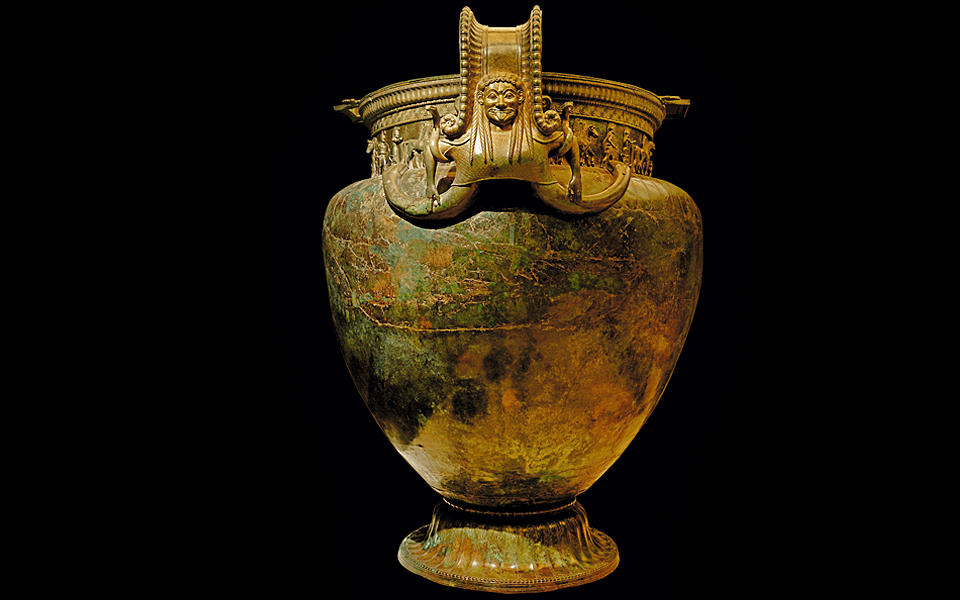
Vix Krater
500
Describe the process of the marriage ceremony
Shave hair, dress in male attire left alone in tehn dark man sneak in and carry her to bed
500
“It is beautiful when a brave men of the front ranks falls and dies, battling for his homeland, and ghastly when a man flees planted fields and city and wanders begging with his mother, ageing father, little children and true wife.
Tyrtaeus
600
Name 3 obligations of the Periokoi
Fight in emergency, taxation and magistrates, attend funeral of the king
600
Name the two dominant tribes of Sparta
Agiads & Eurpontids
600
Why did young and old boys have a close relationship during the Agoge
- To secure a place in the Syssitia
- As a reference to Hykinthos and Apollo
- As a mentor/mentee relationship
600
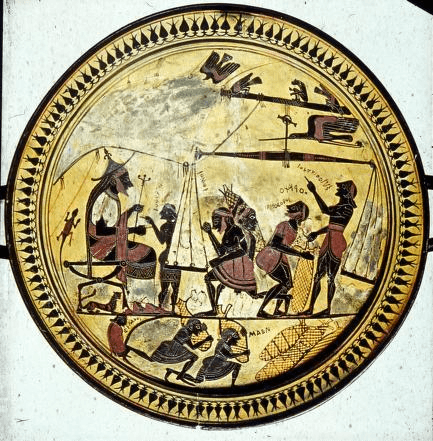
Arkesilas Cup
600
name two practices Lycrugus instituted for the health and training of females
•The killing of weak and deformed children
•Later marriage “when they were in their prime and ripe for it”
•Visits to wives by stealth so that the males “were ready for intercourse rather than sated and pale”
•Permission for sharing wives for the bearing of “fine children who would be linked to fine ancestors”
600
With regard to Lykurgus the lawgiver there is nothing whatever that is undisputed; as his birth, his travels, his death, and, besides all this, his legislation, have all been related in various ways; and also the dates of his birth do not in any way accord.
Plutarch