Of Mice and Meds
Immunofluorescent Staining
The Catcher in the Eye
Three Blind Mice
Mice-ellaneous
100
Which mouse facility can our lab remove and return mice to?
Taub, we need to go through a quarantine period to bring mice back into TMF after removal
100
What is the purpose of the xylene and ethanol series incubations?
To remove paraffin and rehydrate tissues
100
Name the cell layers
RPE, outer segment, inner segment, outer nuclear layer, outer plexiform layer, inner nuclear layer, inner plexiform layer, ganglion cell layer
100
How do you evaluate retinal degeneration using H&E staining?
Measure the overall thickness of the retina, measure the ONL, measure the INL, count the number of nuclei in ONL, and count the number of nuclei in INL
100
Which virus is typically used for gene therapy delivery in the retina?
AAV8
200
When should you wean a litter of pups?
P21, CCM gives you 48 hours to wean
200
When imaging immunofluorescent staining, which "color" channel would you use for Alexa488 anti-mouse secondary?
GFP or green
200
Which cell types are in the inner retina?
Bipolar, amacrine, horizontal, and muller glial cells.
200
How would you determine which cell types are likely involved in the pathology?
1. ERGs
2. H&E
3. confirm by immunofluorescent staining
200
Our lab has identified several novel IRD genes, which cellular processes/pathways do they participate in (name 2)?
Splicing (CWC27)
Unfolded Protein Response (ATF6)
Potassium channel (KCNJ13)
Ceramide synthesis (TLCD3B)
Biosynthesis of NAD (NMNAT1)
ER homeostasis (REEP6)
300
What are the steps to euthanize a mouse?
1. Anesthetize (isofluorane)
2. Cervical Dislocation
3. Decapitation
300
What is PNA used to label?
Cone photoreceptors
300
Describe the path of signal transduction in the retina
Photoreceptors > bipolar cells > ganglion cells > brain via optic nerve
or
Photoreceptors > bipolar cells > amacrine cells > ganglion cells > brain via optic nerve
300
What is a scotopic ERG and what is a photopic ERG?
scotopic ERGs are conducted on dark-adapted mice using low-level flash intensity that increases (rods)
Photopic ERGs are conducted on light-adapted mice using only high flash intensities.
300
List the steps to passage cells.
1. remove media
2. wash cells
3. trypsinize cells and prepare plates
4. Add media to suspend cells and neutralize trypsin
5. Passage cells into new plates, distribute cells, incubate
6. Clean up
400
How many mice can be housed in a single cage?
Six per cage if less than 6 weeks old
Five per cage if less than 25g each
Four per cage if over 25g each
400
Name 3 primary antibodies and which cell-type they label.
Rhodopsin - Rods
PNA - cones
Pkca - rod bipolar
RBPMS, TUJ1 - Ganglion cells
Otx2 - Photoreceptors and bipolar cells
Calbindin - Horizontal Cells
GFAP - muller glial cells
Syntaxin - amacrine cells
400
What role does the RPE play in phototransduction?
RPE phagocytoses POS and converts all-trans retinol to 11-cis retinal to be returned to OS
400
Show where the a-wave and b-wave come from on the scotopic wave.
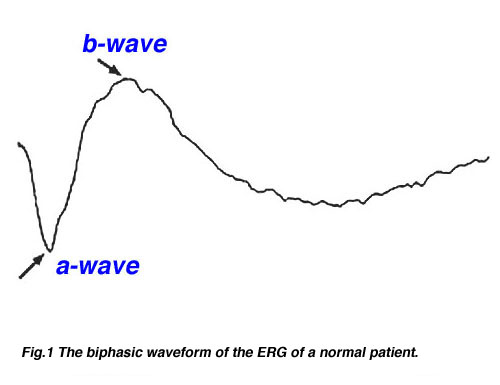
400
How do you prepare a 1% agar gel in this lab?
Prepare mold
0.6g agar in 60 mL TBE with ethidium bromide, microwave 1 minute
pour and allow to solidify
500
What drug is used for long-term anesthesia (e.g. for ERGs) and what is it composed of?
Rodent III is composed of Ketamine, Xylazine, and Acepromazine
500
What do you need to take into account when planning a co-staining experiment (name at least 2)?
Species of primary antibodies
Available secondary antibodies - species
Available secondary antibodies - fluorescent labels
Overlap of excitation/emission of fluorescent labels
Antigen retrieval buffer - antigens may not have compatible antigen retrieval methods
Embedding method - antigens may not have compatible embedding methods
500
What are some differences between the mouse and human retina (list at least 2)?
Mice do not have a macula
Rod to cone ratio differs (humans 5% of PRs are cones, mice 2.8%)
Mice have dichromatic vision (cannot see red)
Photoreceptor density (mice more dense at center)
500
For new knockout mouse lines, what is the first thing you should do?
Check for RD genes that are known to exist in the different mouse strains and back-cross to a clean WT.
500
How do we determine a patient's molecular diagnosis?
First check for known IRD genes by exon capture
Then check for novel disease variants in WES or WGS data using our lab pipelines