Research basics
Study designs
Validity
Stats
Measures/Stats
100
A researcher notices the same pattern across several observations and uses those observations to develop a broader explanation.
What is inductive reasoning
100
Participants are randomly assigned to either a new therapy or a comparison condition. This feature is central to this type of study.
What is a true experiment?
100
Whether a measure actually represents the psychological concept it claims to measure.
What is construct validity?
100
A researcher concludes that a treatment works when there is actually no treatment effect in the population.
What is a Type I error?
100
Asking participants to select colors, the rank/order does not matter. What level of measurement is this?
What is a nominal scale?
200
A researcher begins with an existing theory, derives a prediction from it, and collects data to evaluate that prediction.
What is deductive reasoning?
200
Every participant completes both the quiet-room and background-noise conditions.
What is a within-subjects design?
200
Researchers want their findings to apply to people, settings, and situations beyond the original study.
What is external validity?
200
The same researcher later concluded that studying a little bit over time was not helpful, even though it actually is.
What is a Type 2 error?
200
Number of correctly solved problems has equal units and a meaningful zero, placing it on this measurement scale.
What is a ratio scale?
300
Calculating the average anxiety score for the participants in your sample is an example of this type of statistical analysis.
What are descriptive statistics?
300
One group receives Treatment A and another group receives Treatment B, with each participant experiencing only one treatment.
What is a between-subjects design?
300
This type of validity is strongest when researchers can rule out confounds for an observed effect.
What is internal validity?
300
______ is associated to type 1 errors as _______ is associated to type 2 errors.
What are alpha and beta?
300
This type of measurement can be helpful when we rank the top 10 fastest runners who finish a 5K race.
What is an ordinal scale?
400
Using sample results to draw conclusions about a larger population requires this type of analysis.
What are inferential statistics?
400
While Ms. Frizz tested the 5th graders on Calculus, she noticed that all of the 5th graders failed, resulting on a ____ effect?
What is a floor effect?
400
When your depression scale is correlated/similar to the Becks Depression Inventory, it is showing good _______ validity; When your depression scale is also correlated with a happiness scale, it is bad _____ validity; when experts look at your questions to see if they are good enough, is ______ validity; when your measure stands up well to the gold-standard or predicts real-world outcomes is _________ validity?
What is convergent; discriminant; face; criterion
400
_____ is our magic number with reliability that we aim for (least viable number)
What is .80?
400
This level of measurement is used when tracking temperature (i.e., 27 degrees celsius)
What is interval scale?
500
A scientist repeatedly notices evidence supporting an existing belief while overlooking contradictory findings.
What is confirmation bias?
500
Collecting data from the easiest to reach is __________; selecting entire groups of some populations (e.g., by ethnicity) is ______; selecting individuals purely by chance is called __________. Selecting some people from each group (e.g., only 5 people per group) from each population is called ______.
What are convenience sampling, cluster sampling, random sampling, and stratified sampling?
500
All valid measures are _______ but not all _______ measures are valid?
What is reliable?
500
Reliability: Cronbach's alpha is for _________, while Intraclass Correlation Coefficient is for ________ and ________
internal consistency; inter-rater; test-retest
500
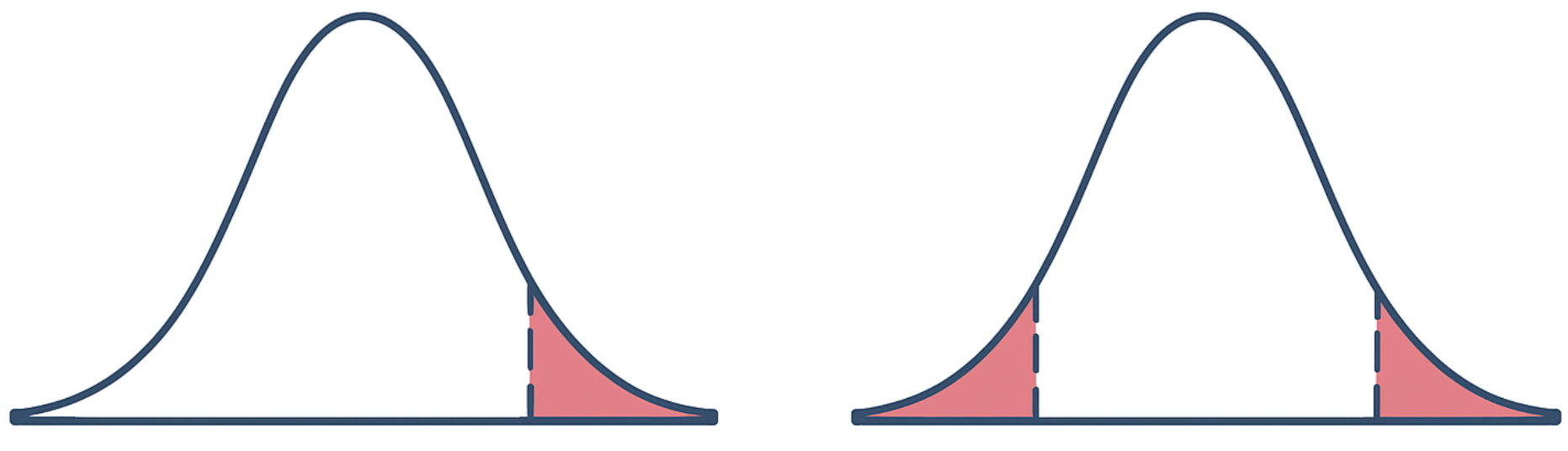 What is this a picture of and what number(s) are associated with the shaded areas?
One tailed test (left), two tailed test (right)
One tailed tests measure 95% or .05 significance, whereas 2-tailed tests assess 95% significance across 2 areas so its 2.5 per side.