Linear Functions
Logarithms
Trig & the Unit Circle
Derivatives
Finding Maxes & Mins
Miscellaneous
100
What is the slope of the following line? What is its y-intercept?
y = \frac{2}{5}x+3
\text{slope }m = \frac{2}{5}
y\text{-intercept }b = 3
100
Completely simplify the expression
5e^{\ln(a^2)}
5a^2
100
\text{Find the exact values of}\cos(0) and \sin(0).
cos(0)=1, sin(0)=0
100
Differentiate the function.
f(x) = 3/4x^6+5x^3-2x+9
f'(x) = 9/2x^5+15x^2-2
100
How do we know when a point x = p is a critical point of f(x)?
A point x = p is a critical point of f(x) if: p is in the domain of f such that f'(p) = 0 or f'(p) is undefined.
100
Describe the steps you need to do to compute f(g(1)) for any functions f(x) and g(x).
(1) Compute g(1)
(2) Note that g(1) represents some number. We plug this number into f(x) to get f(g(1))
200
Determine the slope and y-intercept of the line whose equation is
7y+12x-2=0
\text{slope }m=-\frac{12}{7}
y\text{-intercept }b= \frac{2}{7}
200
Completely simplify the expression
\ln(1/e) + \ln(ab)
\ln(a)+\ln(b)-1
200
Convert the following radians into degrees
\text{(a) } \frac{3\pi}{2}
\text{(b) } \frac{5\pi}{3}
\text{(a) } \frac{3\pi}{2} = 270 \text{ degrees}
\text{(b) } \frac{5\pi}{3} = 300 \text{ degrees}
200
Differentiate the function. Simplify your answer.
f(x) = 4/sqrtpi-x^pi+pi^x
f'(x) = -pix^{pi-1}+ln(pi)pi^x
200
Suppose x = 2 is a critical point of a function f(x). If f'(0) > 0 and f'(3) < 0, is the critical point a local max or a local min? Justify your answer.
x = 2 would be a local max by the First Derivative Test. In particular,
f'(0) > 0 means f(x) is increasing to the left of x = 2
f'(3) < 0 means f(x) is decreasing to the right of x =2
which means f(x) must reach a local max at x = 2
200
The nearest Wawa to Park Science Center is approximately 1.8 miles away. What is this distance in inches? (1 mile = 5280 feet, 1 foot = 12 inches)
114,048 inches
300
Find the equation for the line that passes through the points (-1,0) and (2,6).
y=2x+2
300
Solve for x.
2x-1=e^{\ln(x^2)}
x=1
300
Find point P and the indicated angle \theta.
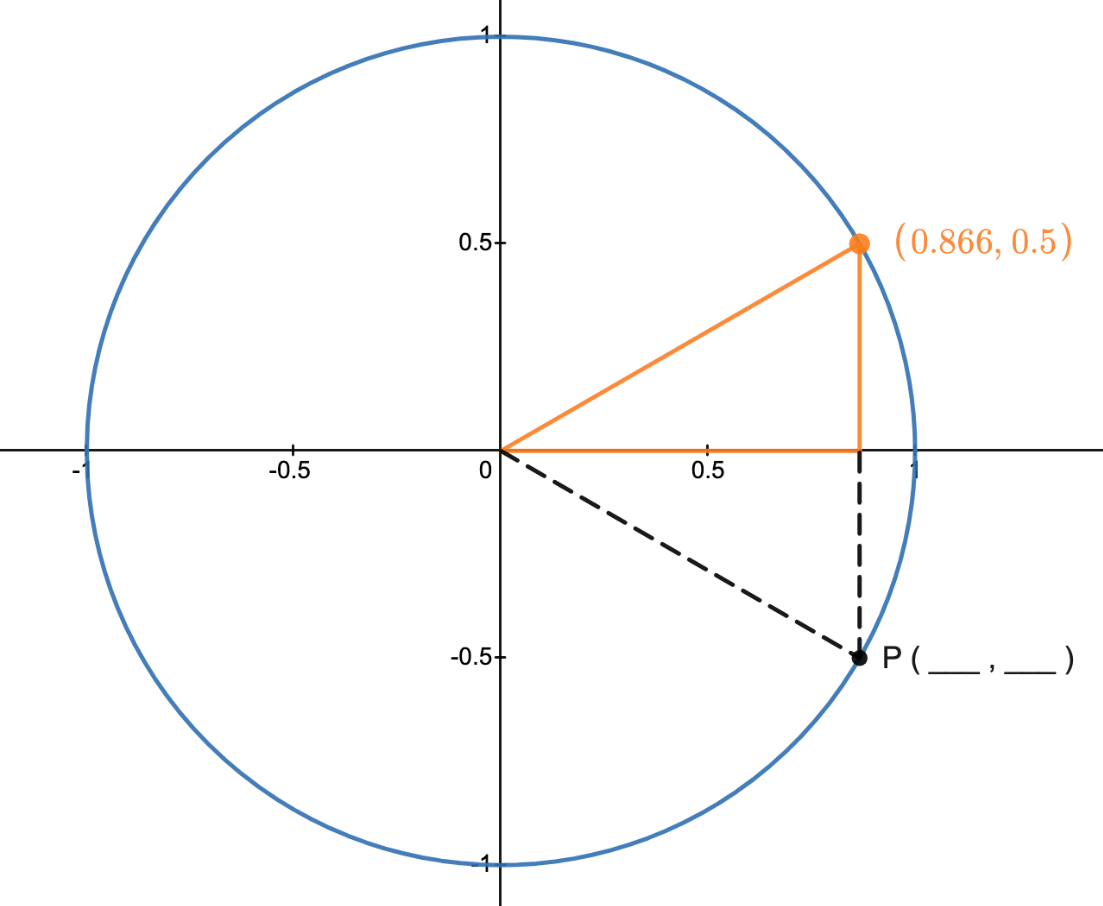
\text{Point }P=(\frac{\sqrt(3)}{2},-\frac{1}{2})
\text{Angle }\theta=\frac{\pi}{6} \text{ or }30\text{ degrees}
300
Differentiate the function. Simplify your answer.
f(x) = (3e^x-e^{3x})(3e^x+e^{3x})
18e^{2x}-6e^{6x}
300
Find any critical points of the following function.
f(x) = xe^{-x}
x =1
300
Let s(t) represent the distance (in mm) of a particle from a fixed position at time t (in seconds). What is the formula for the average velocity of this particle between times t = a and t = b? What are the units?
(s(b)-s(a))/(b-a)
\text{units: mm/s}
400
Match the graphs below with the following equations. Note that graphs may not be drawn to scale.
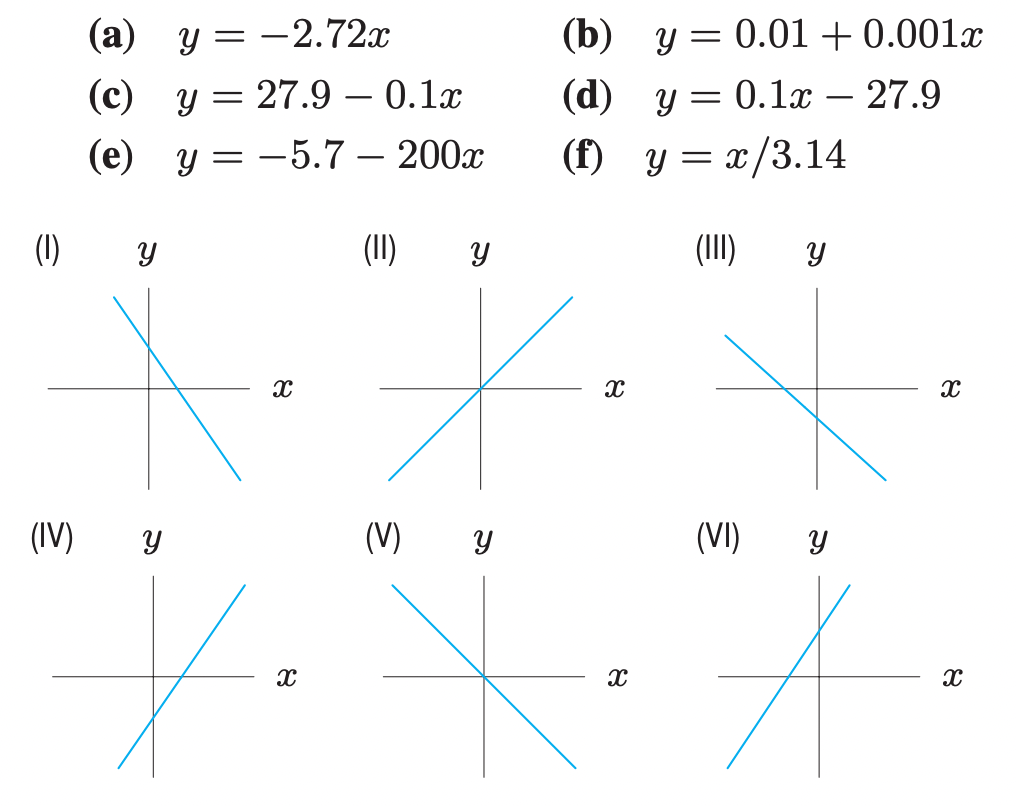
(a) = graph (V)
(b) = graph (VI)
(c) = graph (I)
(d) = graph (IV)
(e) = graph (III)
(f) = graph (II)
400
Solve for x.
7^{x+2}=e^{17x}
x=\frac{-2\ln(7)}{\ln(7)-17}
400
Find the indicated angle using the following image of the unit circle.
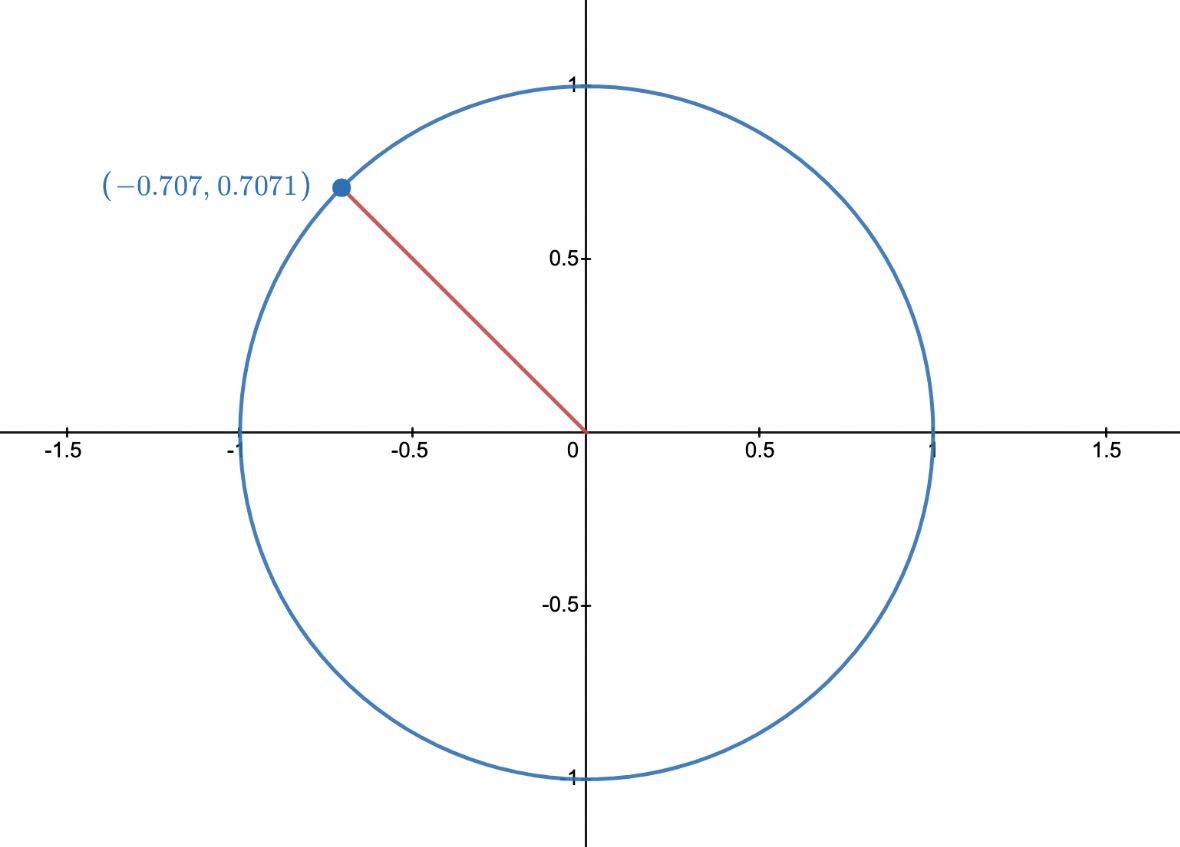
\theta=\frac{3\pi}{4}\text{ or }135 \text{ degrees}
400
Differentiate the function.
f(x) = sqrt(1+e^sqrt(3+x^2))
f'(x) = 1/2(1+e^sqrt(3+x^2))^{-1/2}\cdot e^sqrt(3+x^2) \cdot 1/2(3+x^2)^{-1/2}\cdot 2x
400
Find any local maxima or local minima of the function.
f(x) = x/(x^2+1)
There is a local minimum at x = -1 and a local maximum at x = 1.
400
Simplify the following expression. Your final answer should have no negative exponents.
((a^3b^2c^{-1})/(a^{-6}b^3c^4))^{-2}
(b^2c^{10})/a^{18}
500
Find equations for the lines through the point (1,5) that are parallel to and perpendicular to the line with equation y+4x=7.
\text{Parallel line: }y=-4x+9
\text{Perpendicular line: }y=\frac{1}{4}x+\frac{19}(4}
500
Solve for x.
4e^{2x-3}-5=e
x=\frac{\ln(e+5)-\ln(4)+3}{2}
500
Fill out the first quadrant of the unit circle.
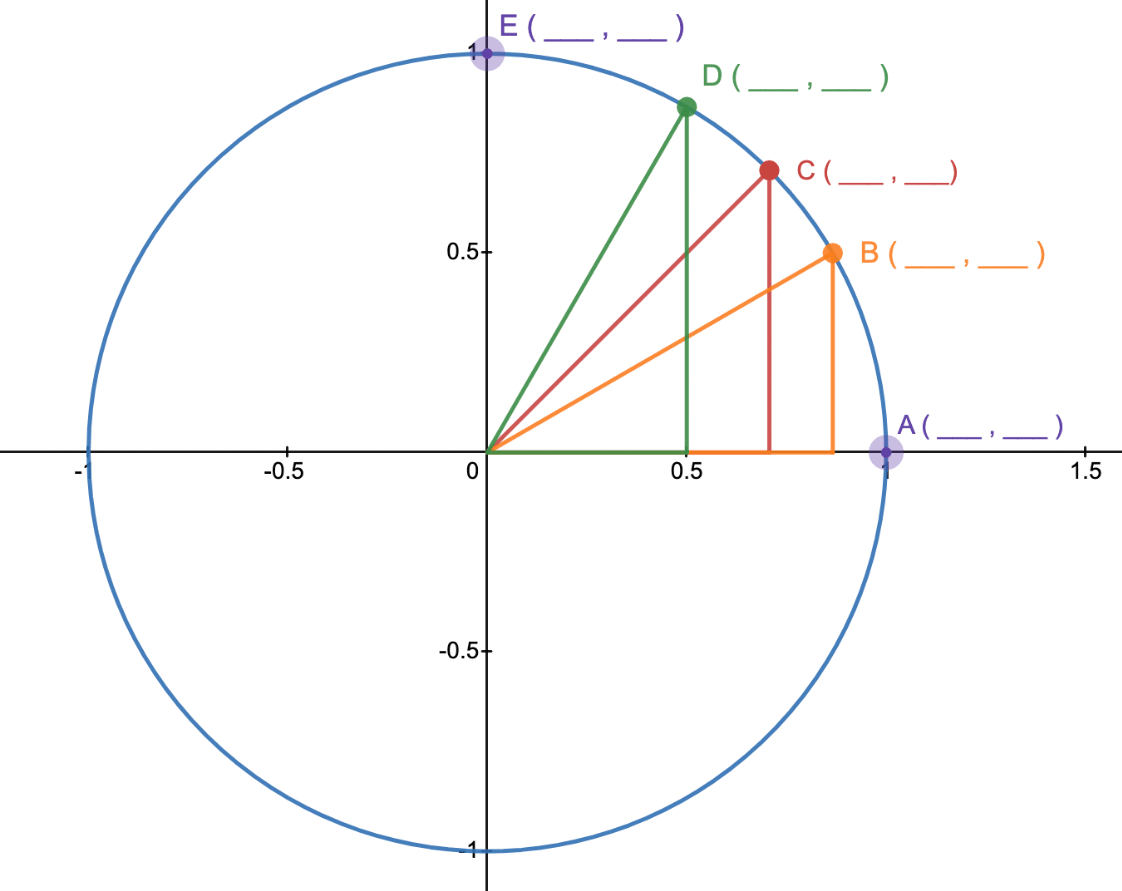
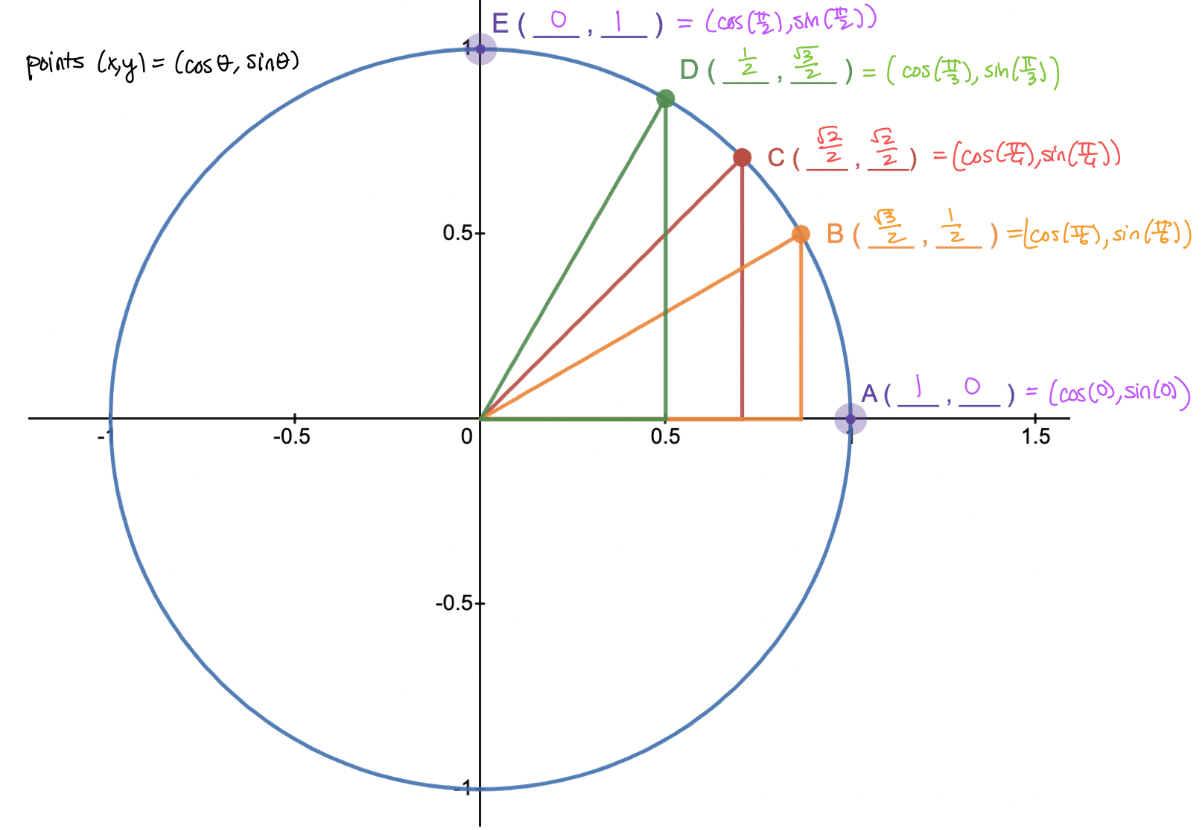
500
The derivative rule for ln(x) is d/dx(lnx) = 1/x .
Differentiate the function.
f(x) = ln(ln(ln(ln(3x+1))))
f'(x) = 1/(ln(ln(ln(3x+1))))\cdot 1/ln(ln(3x+1))\cdot 1/ln(3x+1) \cdot 1/(3x+1)\cdot 3
500
Find any local maxima or local minima of the function.
f(x) = 3x^4-4x^3+6
There is a local minimum at x = 1. There is a critical point at x = 0, but it is neither a local maximum nor a minimum.
500
Let the following exponential function P(t) represent the population (in thousands) of a city at time t (in years). What is the doubling time?
P(t) = 360e^{0.02t}
The population will double to be 720,000 people at time t = ln(2)/0.02 \approx 34.7 \text{ years}