Cody's Eye Cogs & Wares
Gammeltoft's ExoGarden
Leibold's Shaky Lake
Mitcham Museum of Art
Jordan's Testing Gym
100
At what gestational age is the pupillary light reflex normally present?
31 weeks
100
How do you treat partially accommodative esotropia?
Give full cycloplegic refraction. Surgically correct any residual ET after CRX
100
Which nystagmus is associated with Chiari malformation? Craniopharyngioma?
Chiari: Periodic Alternating (think "1 or 2, 1 or 2?")
Craniopharyngioma: See-saw (imagine pivot point in center of brain)
100
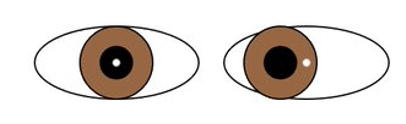 How many prism diopters of deviation, roughly?
60 PD
100
Describe the Bruckner Test
Comparing red reflex and corneal light reflex between eyes using direct ophthalmoscope
200
What is the difference between Sherrington's and Herring's Law?
Sherrington's: When an agonist muscle contracts, it’s antagonist muscle relaxes
Herrings: Yoke eye muscles receive similar innervation when making conjugate change in eye position
200
What is the difference between sagging eye and heavy eye syndrome? What deviation do they cause?
Sagging eye: age
Heavy eye: myopia
Dehiscence between LR/SR => esotropia
200
What is the difference between a saccadic oscillation and saccadic intrusion?
Oscillation:
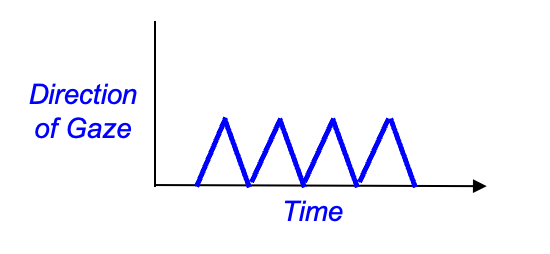
Intrusion:
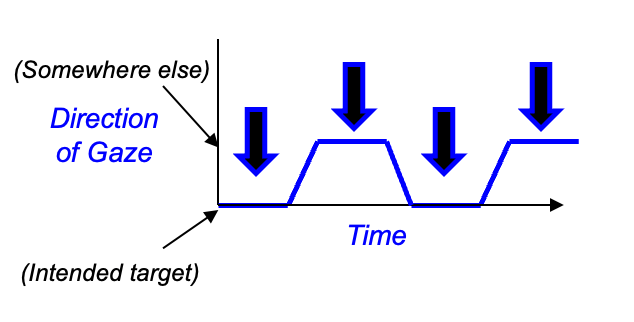
200
Draw out which divisions of CN3 supply which EOMs
Upper: SR, Levator
Lower: MR, IR, IO
200
Describe the difference between Hirschberg and Krimsky tests
Hirschberg: corneal light reflex to assess strabismus
Krimsky: Hirschberg + prisms
300
List the four types of congenital anomalies and provide an ocular example for each
Agenesis: anophthalmia
Hypoplasia: ON hypoplasia
Hyperplasia: distichiasis
Dysraphism: coloboma, NLDO, PFV
300
Name 3 causes of incomitant esotropia
CN6 palsy
Slipped muscle
Heavy Eye Syndrome
Congenital cranial dysinnervation disorders (Duane)
Implants/post-surgical (scleral buckle, tube shunts)
EOM restriction
TED
Orbital wall fractures
300
What is Alexander's Law?
Nystagmus increases in intensity as eyes are moved in direction of the fast phase
300
If a red maddox rod is placed over the right eye in a patient with an exotropia, draw what the patient will see
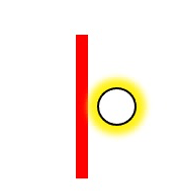
300
What condition does an AC/A ratio of 1:1 suggest?
Convergence insufficiency (normal is 3:1-5:1)
400
What is the primary, secondary, and tertiary action of superior oblique?
Intorsion, Depression, Abduction
400
An X(T) kid has a +2.00 D hyperopia. Should you correct it?
No (can worsen XT)
Correct if > +4.00 D, or if myopic
400
If you see opsoclonus, name 2 associations with this condition.
1. Paraneoplastic (neuroblastoma, SCLC, breast/ovarian)
2. Acute cerebellar ataxia
3. Post-viral
4. Post-encephalitis
400
In a Worth 4 Dot test, if red lens is over the right eye and green over the left, draw out what a patient with monofixation syndrome in the left eye will see
Far:
Near: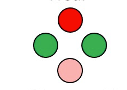
400
How does a positive angle kappa affect Hirschberg testing? Cover testing?
Hirschberg: simulates exotropia
Cover: no change
500
When and where does retinal vascularization begin and at what age is it complete?
16 weeks of gestational age at optic nerve head, reaches temporal ora by 40 weeks
500
What is central fusion disruption?
Loss of fusional abilities despite visual restoration, when sensory XT has been present for a long time before surgery
500
What are the 2 goals of nystagmus treatment, and give 2 treatments for each goal
1. Decrease intensity (BO prism; large recession of MR/LR OU)
2. Improve head position (Prisms to shift null point; Kestenbaum-Anderson)
500
Draw out what the patient would see if the right eye had extorsion. Intorsion? 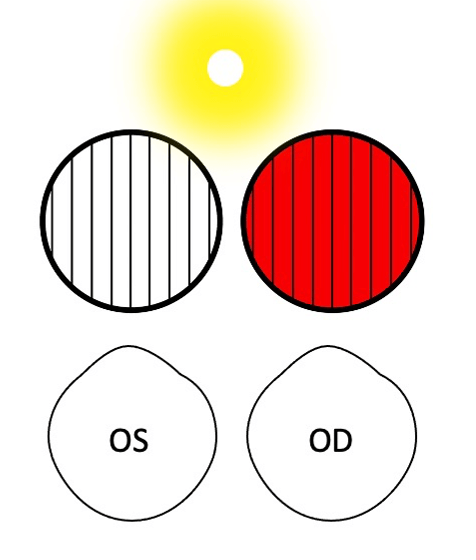
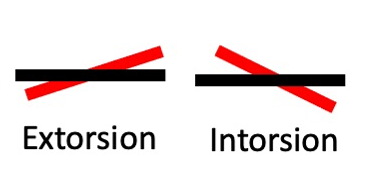
500
Describe the 3-step Parks-Bielschowsky Test
Step 1: Determine which eye is higher via cover testing
Step 2: Identify the gaze (ie, right vs left) in which the deviation gets worse
Step 3: Tilt the head toward each shoulder, and see which direction worsens the deviation