Get It on Paper
Worry Time
The Worry Tree
Make a Plan
Back to the Present
100
What is the first strategy the reading suggests for tackling worries?
Write them down.
100
What is the name for a planned, short period used to write down worries and look for solutions?
Worry time
100
What tool named after a plant can help you sort through worries?
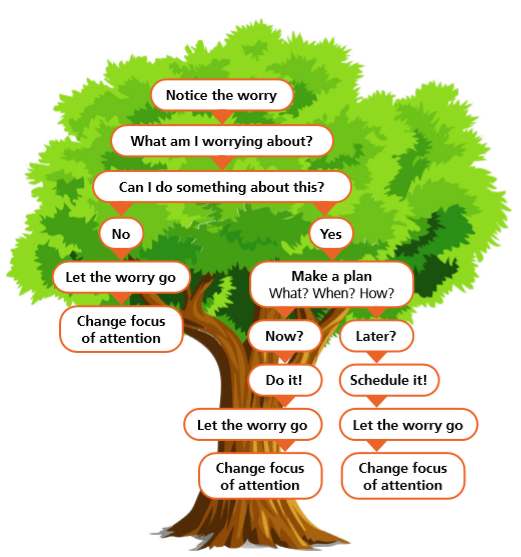
The worry tree
100
If you can do something practical about worry, what should you write down?
A plan of action
100
True or false: The goal is to completely eliminate all worry from life.
False. Worrying is part of life, and we cannot control everything.
200
Besides paper, where does the reading suggest you could record your worries?
A notes app on your phone
200
About how many minutes does the reading suggest setting aside for worry time?
10-15 minutes
200
The worry tree helps distinguish problems you can solve from what other kind of worry?
Hypothetical worries or worries beyond your control.
200
Should your plan of action be vague or specific?
Specific.
200
Why is denying the problem/stressor bad for you?
Denying the problem/stressor is bad for you because it will continue to affect you.
300
How can writing worries down help your mind?
It can help clear your mind and make concerns easier to work through.
300
Name the two activities the reading suggests doing during worry time.
Write worries down and try to find solutions
300
What question can help you decide whether a worry needs a practical action?
"Is there anything practical I can do about it?"
300
Complete the three planning questions:
1. "What would you do?"
2. "How could you do it?"
3.
"When would you do it?"
300
You already took a useful action, but the worry returns. What could you remind yourself?
"I have already taken action," then try to shift attention.
400
Instead of trying to work through every concern at once, how does the reading suggest handling them?
One by one
400
A worry pops up during another activity. What reminder could you use if you already have a regular worry time?
“I’ll set that aside for my worry time"
400
Besides deciding whether you can take action, what does the worry tree help you decide about timing?
Whether to act immediately or schedule an action for later.
400
The office you need to call is closed until tomorrow. What can you do now to make a plan?
Schedule the call and write down what you need to ask. Accept similar specific plans.
400
Why does the reading encourage trying different present-focused strategies rather than expecting one to work immediately for everyone?
They can take time and practice, and people need to see what works best for them.
500
Denise has several worries running through her head. She writes each one down. What could she do next to begin working through them?
Choose one worry and consider whether there is something practical she can do about it.
500
True or false: If setting worries aside feels difficult at first, the technique has failed. Explain.
False. The reading says it may be difficult at first and can get easier with practice.
500
Jenny worries about getting to an appointment and also worries that it might rain that day. Name one part she can act on and one part she cannot control.
She can plan transportation or prepare for rain. She cannot control the weather.
500
Which is a more specific plan, and why?
A: “I’ll handle my appointment sometime.”
B: “After lunch, I’ll ask staff to help me confirm my pickup time.”
B. It says what the person will do, how they will get help, and when they will do it.
500
BONUS QUESTION!
Roughly what is the percentage of people who normally show physical symptoms of stress?
A) 10-30%
B) 40-60%
C) 70-90%
C! Roughly 77 percent of people normally show physical symptoms of stress.