More MCMC
Modeling
Primary Diagnostics
Secondary Diagnostics
Weights
100
The starting point (iteration 0) of the MCMC for the stutter variance constant (k2) and allele variance constant (c2).
What are the modes of the prior gamma distributions?
100
During amplification, copies of the allele are created. Stutter products are also created. The sum of allelic product and stutter product is called this.
What is Total Allelic Product (TAP)?
100
This diagnostic should align with the analyst's manual interpretation of the profile. It describes the relative contributions of each donor to the profile.
What are the Mixture Proportions?
100
This diagnostic represents the number of post burn-in iterations that the MCMC ran for during its analysis. It indicates how clustered the parameter values had to be about a specific point in order to be accepted.
What are Total iterations?
100
These values for a given locus are the number of times each genotype combination is accepted during post burn-in divided by the total post burn-in iterations across all chains.
What are the Genotype weights?
200
The starting point (iteration 0) of the MCMC for the degradation measure (Dn) for each contributor.
What is zero?
200
This variance constant is used to determine the level of stochastic variation in peak heights present in the profile.
What is the Allele Variance constant (c2)?
200
These weights should align with the analyst's intuitive expectations from the manual interpretation of the profile. The "best" guesses should have the highest weightings.
What are Genotype Weights?
200
This diagnostic gives an indication of how well the chains are mixing during the MCMC.
What is the Acceptance Rate?
200
This value is used in the weights section of STRmix reports to represent genotypes considering drop-out.
What is Q?
300
The starting point (iteration 0) of the MCMC for the template amount (tn) of each contributor.
What is the value determined by the Smart Start algorithm?
300
If this variance constant has increased markedly from the mode of the prior distribution, then this may indicate that the DNA profile is sub-optimal or that the number of contributors is incorrect. Four prior distributions for this variance constant were determined during validation.
What is the Stutter Variance Constant (k2)?
300
This diagnostic is available if an LR was performed. They should align with the analyst's intuitive expectations from the manual interpretation of the profile.
What are Per-Locus LRs?
300
This diagnostic informs the analyst how many independent samplings have been taken from the posterior distribution of the MCMC likelihood. A low value indicates the potential for large differences in weights if the interpretation is repeated.
What is the ESS, Effective Sample Size?
300
This value is used in the component interpretation section of the STRmix report when the corresponding genotype has less than 99% weighting.
What is F?
400
The starting point (iteration 0) of the MCMC for the LSAE (Al).
What is 1?
400
The first 10,000 iterations of the MCMC process. The time when the MCMC chain goes from complete randomness to some sensible position.
What is Burn-in?
400
This diagnostic does not seem intuitive.
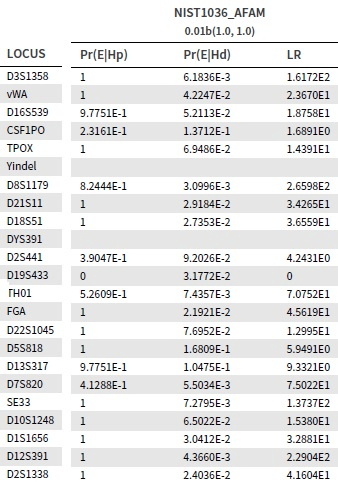
What is the Per-Locus LR diagnostic?
400
This diagnostic is a measure of the with-in and between chain variance. It informs the user whether the MCMC analysis has likely converged.
What is the GR, Gelman Rubin?
400
The weights are calculated during what part of the MCMC STRmix analysis?
What is deconvolution?
500
The starting point (iteration 0) of the MCMC for the Replicate multiplier (Ry) and Kit multiplier (Bk).
What is the values proportional to their observed fluorescence but with the sum of log(mean)=0?
500
Deconvolution happens during this stage. This is the phase where the MCMC guesses start to count towards the weighting of various genotype sets.
What is Post Burn-in?
500
This diagnostic is examined using this information:
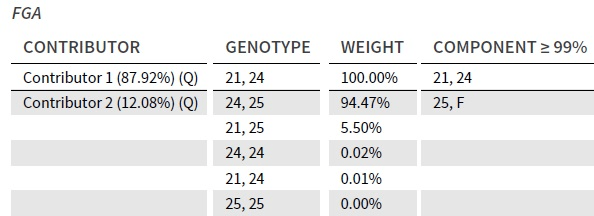
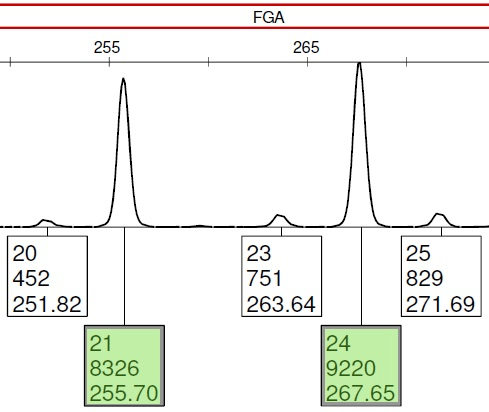
What are the Genotype weights?
500
These variance constants are the average value across the entire post burn-in MCMC analysis. They can assist with determining the level of stochastic variation in peak heights present in the profile.
What are the Allele and Stutter variance constants diagnostics?
500
Prior to STRmix what were the possible weights for each locus in a given profile (manual interpretation)?
What is 1 or 0?
600
The number of default post burn-in accepts per chain. This additional number can be run if the GR is >1.2 at the end of the default number of accepts.
What are 50,000 and an additional 10,000?
600
This parameter, determined during validation, has a set frequency of 0.0001 and a cap of 200rfu. It is modeled using a Uniform distribution with α=0, β=0.
What is Drop-in?
600
This secondary diagnostic can be used to examine unintuitive genotype weights.
What is the degradation plot diagnostic?
600
This diagnostic is a measure of how much variation there is between loci peak heights. It can indicate degradation or inhibition within a profile.
What is the LSAE, Locus Specific Amplification Efficiency?
600
This information is provided by the analyst to allow STRmix to deconvolute a profile and calculate weights (in addition to the validated variance models for stutter, PH variance, LSAE).
What are the NOC and the DNA profile (alleles, peak heights and sizes)?
700
The Mx Priors tool requires the analyst input these two parameters for each contributor prior to the start of the run.
What are the mean and variance?
700
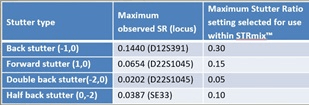
This threshold, determined during validation, is the % above which STRmix can no longer model a peak in stutter position as solely originating from stutter.
What is Maximum Allowable Stutter?
700
This tool can be used when unintuitive mixture proportions are obtained when compared with the e-gram. It allows the user to inform STRmix of each contributor's mixture proportion, prior to deconvolution.
What is Mx Priors?
700
This diagnostic shows how well STRmix has been able to describe the observed data (profile).
What is the Average Log(likelihood)?
700
These are repeated many, many times and the relative amount of time that a genotype set is the focus of the deconvolution becomes the weight for that genotype set.
What is an iteration?