Graphs & Kinematics
Forces
Free-fall & Uniform Circular Motion
Universal Law of Gravitation
Conservation of Energy & Work
100
A 500 kg airplane is initially flying at a speed of 45 m/s. Over the next 2,500 m, the plane decelerates at a rate of -0.8 m/s2. Identify the vector in this scenario. Explain.
-0.8 m/s2
Vectors have both a magnitude and direction - direction given by negative.
Vectors include - displacement, velocity, acceleration, and force.
100
A rollercoaster posts a warning that abrupt stops are common. In the case of an abrupt stop, expect your body to slam against the belt/straps. What law of motion is this warning referring to? What's another word for this phenomena?
Newton's first law of motion - an object in motion will stay in motion. Also known as INERTIA.
100
A pen with a mass of 0.1 kg and a stapler with a mass of 0.5 kg are dropped from the same height. Which will hit the ground first?
They both hit at the same time since they both accelerate at rate of -9.8 m/s2.
100
Two people, one meter apart exert a millionth of a N of gravitational force on each other. What would happen to the force of gravity they exert on each other if the distance between them doubled?
They would exert 1/4th the original gravitational force.
100
A 3 kg ball is dropped from a height of 10 m. At a certain point, the ball has 28.5 J of gravitational potential energy and 14.5 J of kinetic energy. Calculate the total mechanical energy of the ball when it hits the ground.
Total mechanical energy = PE + KE
TME = 28.5 + 14.5 = 43.0 J
This is the TME at EVERY point.
200
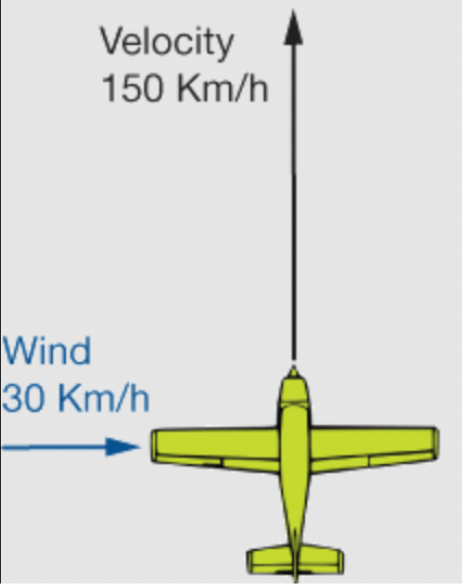
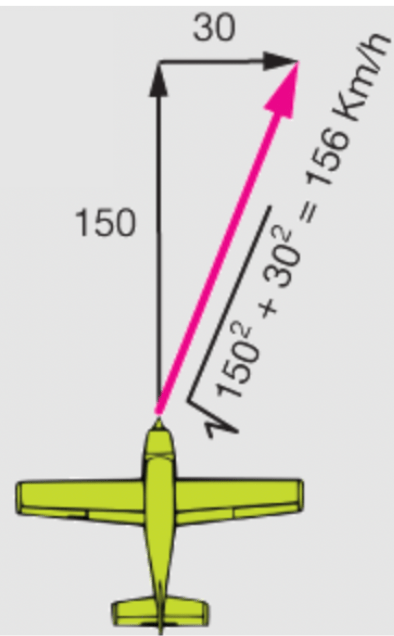
Draw a vector that accurately represents the overall velocity of the plane given its set velocity and crosswinds.
200
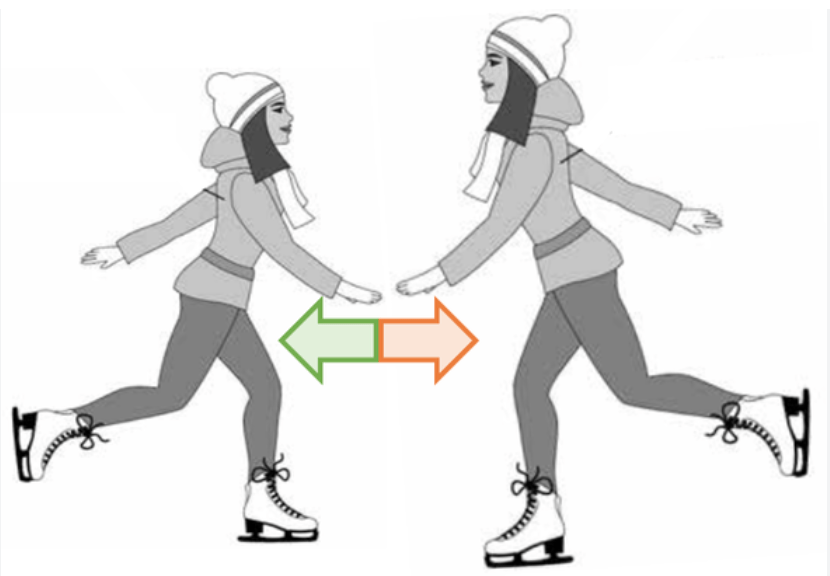
A mother (60 kg) and daughter (30 kg) are ice skating at the Galleria Mall. If the mother and daughter hold onto each other and then push away, draw what the force interaction between them would look like.
EQUAL AND OPPOSITE!!
200
Two cats jump off the same table. One jumps forward and the other jumps straight down. Which will land first?
Both will land at the same time since horizontal motion has no effect on vertical motion, meaning they will both still accelerate at a rate of -9.8 m/s2.
200
Mars has a mass of 6.42 x 10²³ kg. Its closest moon, Phobos, has a mass of 1.06 x 10¹⁶ kg. If Phobos orbits Mars at a distance of 9.38 x 10⁶ m, what gravitational force does Phobos experience from Mars?
Fg = G((m1m2)/d^2)
Fg = (6.67*10^-11)((6.42*10^23*1.06*10^16)/(9.38*10^6)^2)
Fg = 5.16*10^15
200
Which point on the track does this chart represent if there IS friction?
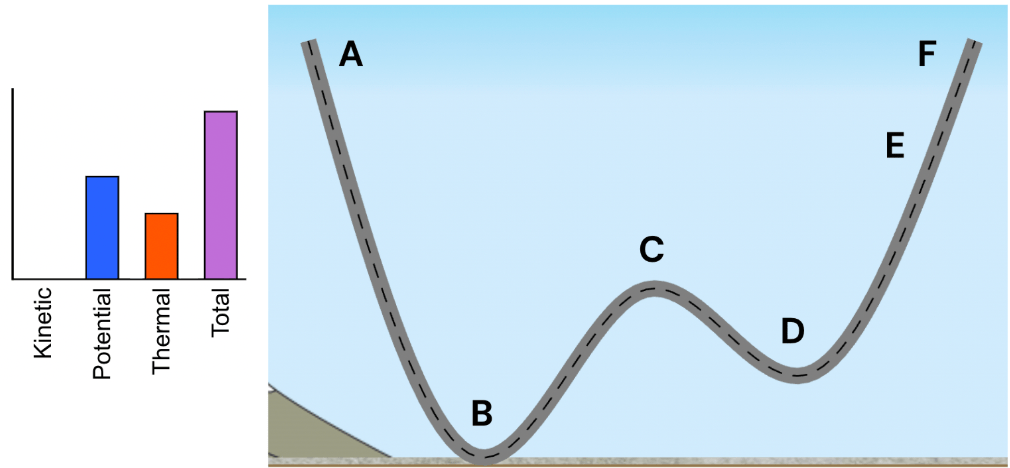
Point E - No kinetic energy but some potential energy has been lost to friction (thermal).
300
Given the following position vs time graph, calculate the velocity at point C.
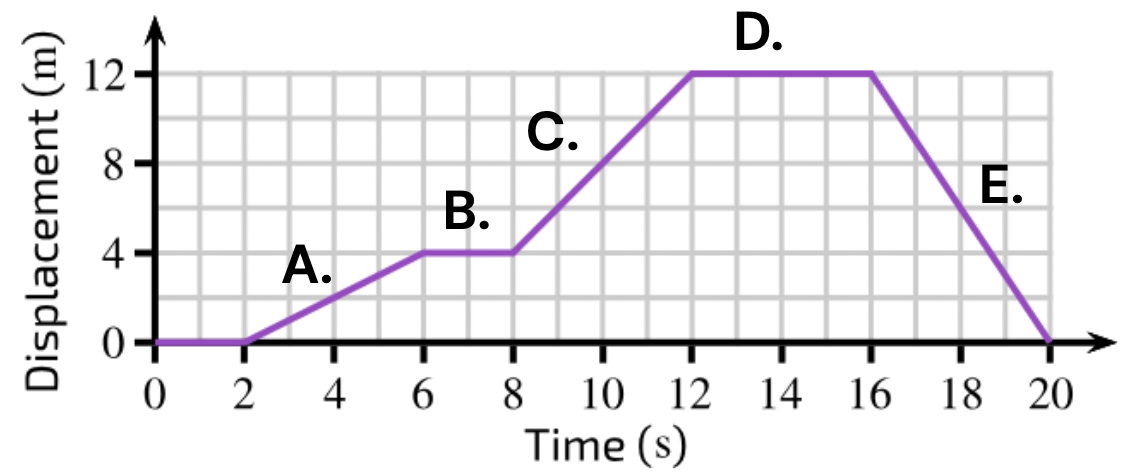
v = d/t
v = 8/4 = 2 m/s
300
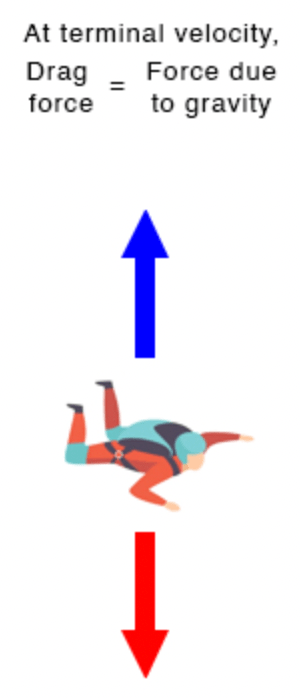
A skydiver reaches terminal velocity after 11.5 seconds. Draw the forces of gravity and drag on the skydiver once they have reached terminal velocity.
A skydiver is moving at a constant rate once they have reached terminal velocity. Therefore, the net force should be 0 N.
300
A truck is driving at a constant speed around the curve shown.
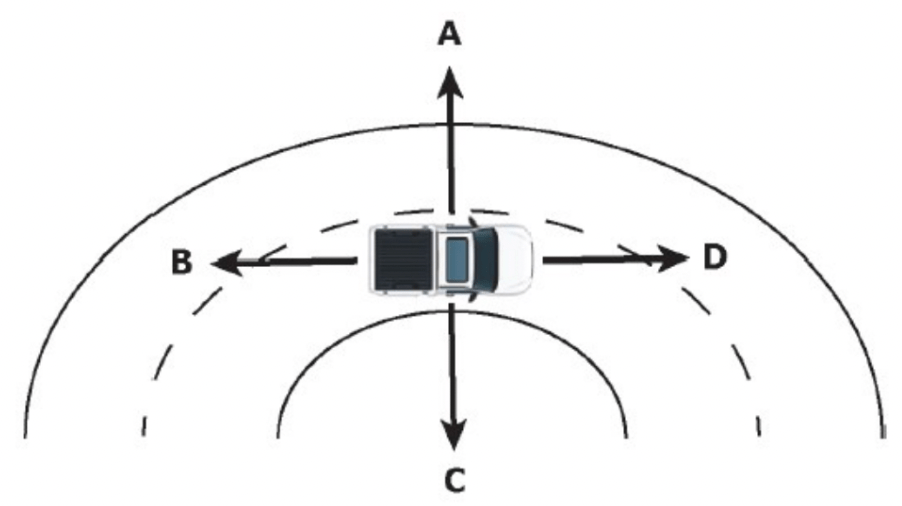
What is the direction of the trucks acceleration? What is this called?
C - towards the center - known as centripetal acceleration.
300
Below, Halley's comet's orbit has been tracked and predicted based on available data of its velocity and forces acting on it. During which year will Halley's comet have the fastest velocity. Why?
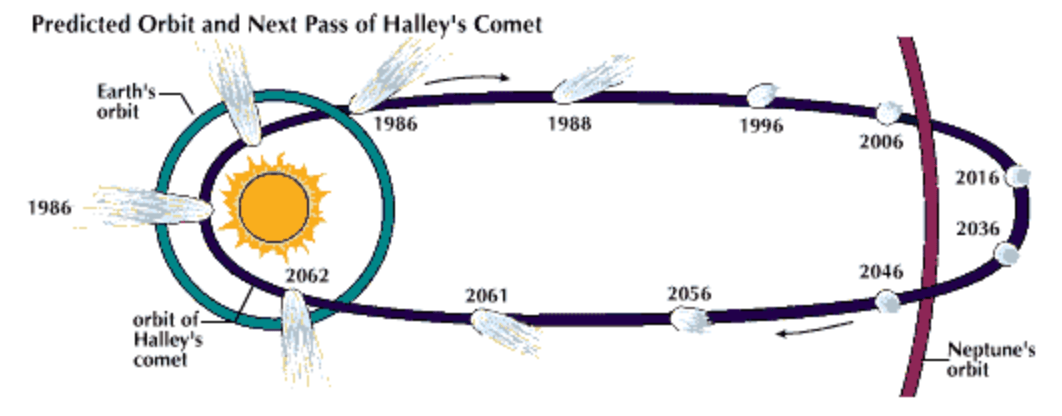
1986 because it experiences the most gravitational force.
300
What chart best represents the energy of a skater at point D if there IS friction?
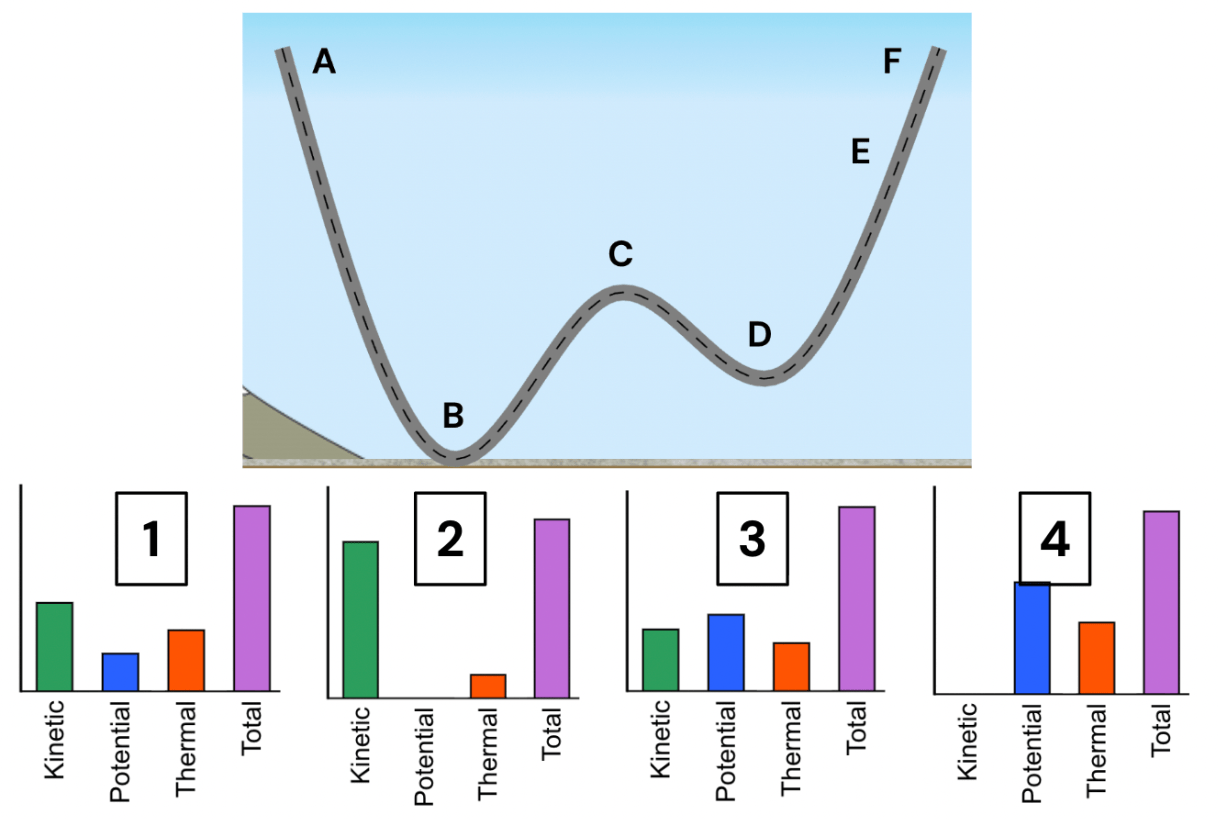
Chart 1 - since the point is lower than C (the halfway point), there is more kinetic than potential energy. Some of the energy has been lost to friction (thermal).
400
Draw the position vs time graph that represents the same motion shown by this velocity vs time graph.
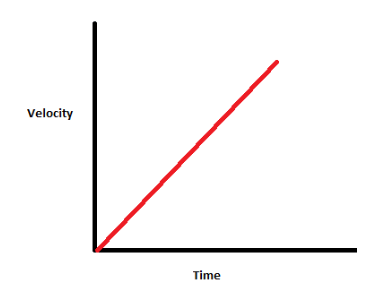
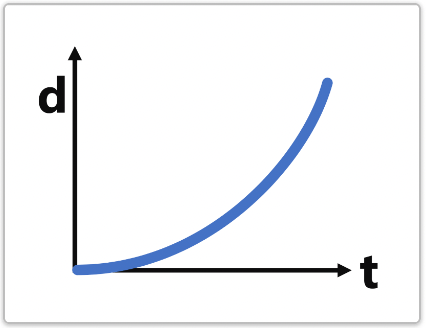
400
The following forces are applied to a 3 kg box.
Fa = 24.7 N
Fg = 29.4 N
Ff = 17.2 N
FN = 29.4 N
Calculate the acceleration experienced by the box.
Net force = 24.7 - 17.2 = 7.5 N
a = F/m = 7.5/3 = 2.5 m/s2
400
What is the centripetal acceleration of a car traveling 14 m/s around a curve that has a radius of 5 m?
ac = v2 / r
ac = 142 / 5
= 39.2 m/s2
400
Calculate the gravitational force exerted on a 50 kg astronaut by the Earth if they are drifting in space 1.25 x 10⁹ m away from the Earth.
Fg = G ((m1*m2)/d^2)
Fg = (6.67*10^-11) ((50*5.97*10^24)/(1.25*10^9)^2)
Fg = 0.013 N
400
A 2.5 kg object started from rest and accelerated to 14 m/s in 10 seconds. How much work was done on the object?
W = F*d = triangleKE
W = triangleKE
Since no initial velocity, Change in KE would equal Final KE
W = 1/2*2.5*14^2 =245
500
A ball rolls down a hill over 15 seconds. At t = 2s, the ball is rolling at a rate of 3 m/s. By t = 8 s, the ball has accelerated to 18 m/s. What is the balls rate of acceleration?
a = (vf - vi) / (change in time)
a = (18 - 3) / (8 - 2)
a = (15) / (6) = 2.5 m/s2
500
A 5.0 kg ball experiences the following forces.
Fa = 12 N
Fg = 49 N
Ff = 12 N
FN = 41.5 N
Calculate the acceleration experienced by the ball.
Net force = 41.5 - 49 = -7.5 N
a = F/m = -7.5/5.0 = -1.5 m/s2
500
A car traveling around a roundabout that has a radius of 12 m accelerates at a rate of 27 m/s2. What is the car's velocity going around the roundabout?
ac = v2 / r
27 = v2 / 12
27 x 12 = v2
sqrt(27*12) = v = 18 m/s^2
500
At aphelion, a comet is 3 times further from the sun than at perihelion, when it is closest to the sun. How does the force at perihelion compare to the force at aphelion?
Inverse Square Law.
If distance is 1/3 at perihelion than at aphelion, then F is 9x what it is at aphelion.
Fp = 9 Fa
500
Calculate the power used to move a box 12 m by a force of 15 N over 5 seconds.
P = W/t
W = F*d = 12*15 = 180
P = 180/5 = 36 W