1
2
3
4
5
100
Which of the following is the most important factor used to distinguish a scientific experiment from other forms of scientific investigations?
A-Recording observations and making predictions about a natural phenomenon.
B-Researching a question about the natural world to answer.
C-Purposefully changing one variable to see how it affects another variable.
D-Using equipment for the purpose of measurement and data collection.
Purposefully changing one variable to see how it affects another variable.
100
The picture below illustrates (shows) which of the following wave behaviors?

reflection
100
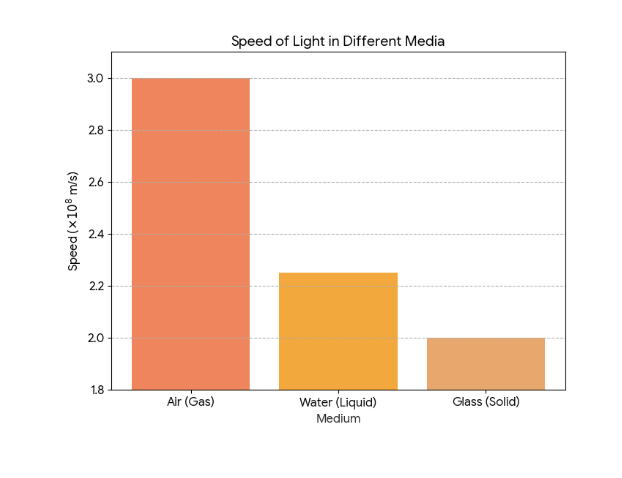
Based on the Speed of Light in Different Media graph above, in which of the listed media does light travel the slowest
Glass (solid)
200
Keesha did an experiment to study the rate of photosynthesis in the water plant Elodea. She placed a piece of the plant in a beaker of water and set the beaker 10 centimeters (cm) from the light source. Keesha counted the bubbles released from the plant every minute for five minutes (min). She repeated the process two more times. First, she moved the light to 20 cm from the beaker, and then she moved the light to 30 cm from the beaker. Keesha's experiment setup and data are shown below.
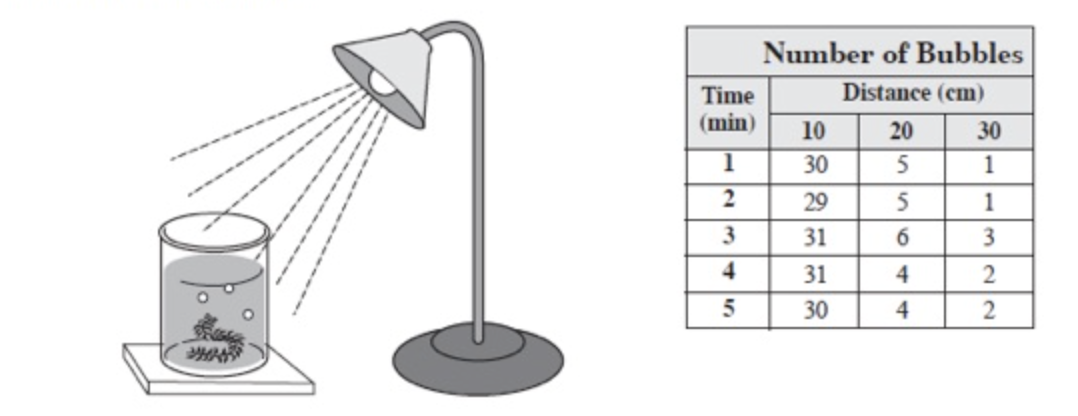
What is the outcome variable (dependent variable) in this experiment?
the number of bubbles produced
200
Which statement describes the difference between kinetic energy and potential energy?
A-Kinetic energy is the energy of motion, while potential energy is stored energy due to the position or state.
B-Kinetic energy is related to the substance's temperature, while potential energy is related to its shape.
C-Kinetic energy is stored energy, and potential energy is the energy of motion.
D-Kinetic energy is related to the shape of the substance, while potential energy is related to the substance's temperature.
Kinetic energy is the energy of motion, while potential energy is stored energy due to the position or state.
200
The image below best illustrates which type of wave behavior?

A-Absorption
B-Refraction
C-Diffraction
D-Reflection
Refraction
200
Gail’s cross country coach advised her to eat well-balanced meals in order to have plenty of energy for their upcoming track meet. Which energy transformation will Gail experience during her track meet?
A-heat energy to mechanical energy
B-mechanical energy to electrical energy
C-chemical energy to mechanical energy
D-mechanical to heat energy
chemical energy to mechanical energy
200
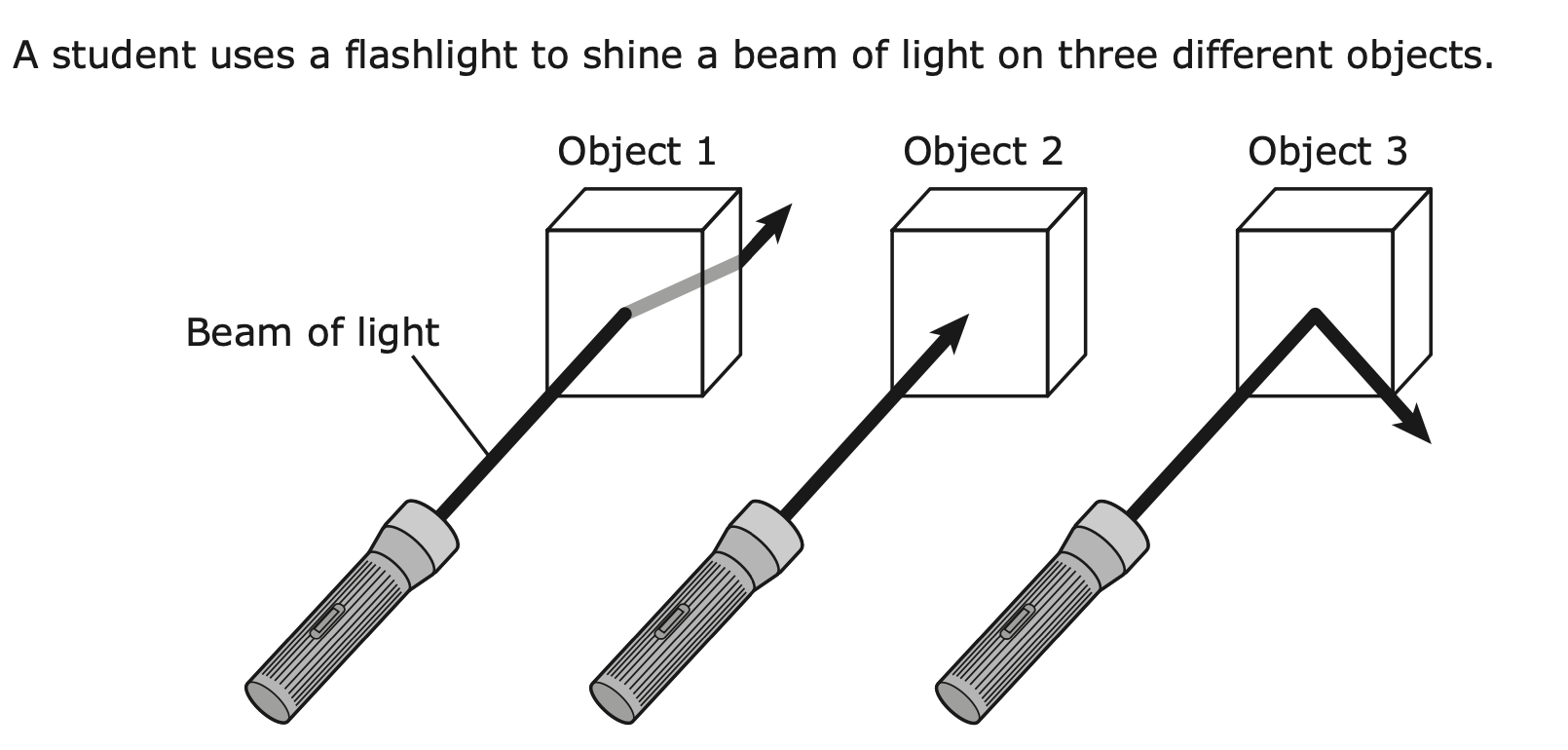
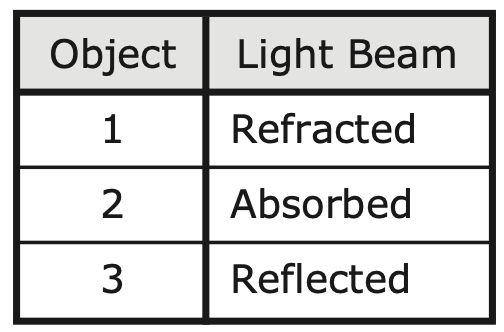
Which table describes what happened to the light beam as it interacts with each object?
300
Which statement describes the difference between kinetic energy and potential energy?
A-Kinetic energy is the energy of motion, while potential energy is stored energy due to the position or state.
B-Kinetic energy is related to the substance's temperature, while potential energy is related to its shape.
C-Kinetic energy is stored energy, and potential energy is the energy of motion.
D-Kinetic energy is related to the shape of the substance, while potential energy is related to the substance's temperature.
Kinetic energy is the energy of motion, while potential energy is stored energy due to the position or state.
300
The bending of light when it moves from air into water is evidence that...
A-Water absorbs all of the light's energy.
B-Light travels at the same speed in both air and water.
C-Light travels faster in water than in air.
D-Light travels at different speeds in air than in water.
Light travels at different speeds in air than in water.
300
Sunlight is composed of energy that is visible to humans and energy that is not visible to humans. Which statement describes how the visible energy from the Sun is DIFFERENT from the non-visible energy?
A-It travels at different speeds.
B-It has different wavelengths.
C-It travels a different distance.
D-It has different amplitudes.
It has different wavelengths.
300
Energy can be transferred in many ways. The Sun's energy arrives to Earth as electromagnetic radiation through waves. The electromagnetic waves have a wide range of wavelengths. The electromagnetic spectrum shows the electromagnetic waves organized by their wavelengths.
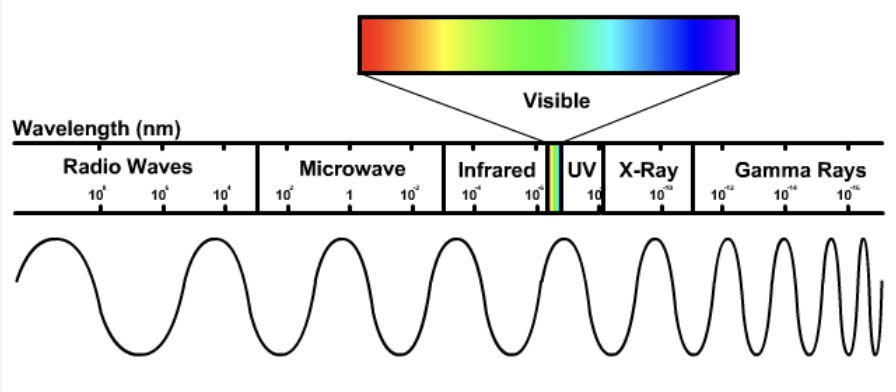
Which of the following groups of waves is listed correctly in order of increasing energy?
A-X-rays, visible, radio
B-Radio, visible, X-rays
C-Infrared, visible, radio
D-Visible, gamma rays, X-rays
Radio, visible, X-rays
300
Ultraviolet rays from the sun are able to reach Earth’s surface because _________.
A-they require air to travel through.
B-they have more energy than infrared rays.
C-they can travel through a vacuum such as empty space.
D-they can penetrate through clouds.
they can travel through a vacuum such as empty space.
400
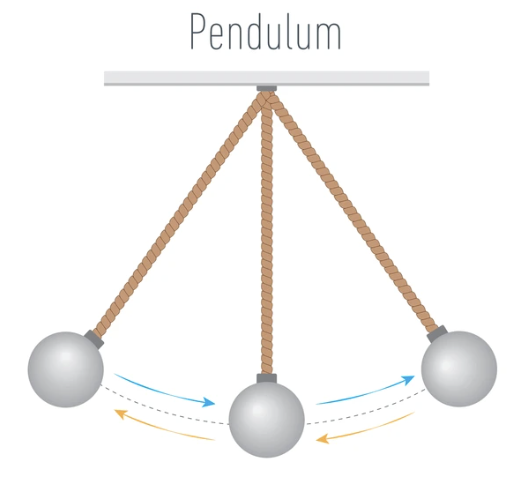
A pendulum swings back and forth. At the lowest point of its swing, what type of energy is at its maximum/greatest?
A-chemical energy
B-kinetic energy
C-potential energy
D-thermal energy
kinetic energy
400
Which sentence describes an example of heat transfer through radiation?
A-The Sun's rays heat the surface of the pond, and a large rock.
B-A turtle warms up by laying directly on the hot surface of a large rock.
C-Warm water from the surface of the pond slowly circulated and heats the cooler water below.
D-Hot air rises over the rock, pond, and the turtle in flowing currents that move heat through the lower atmosphere.
The Sun's rays heat the surface of the pond, and a large rock
400
Which of the following scenarios is an example of a temperature change without a change of state of matter?
A-Heating a block of metal from 20°C to 100°C.
B-Ice melting into liquid water on a warm day.
C-Water turning to ice in a freezer.
D-Steam turning back into a liquid on a cold surface.
Heating a block of metal from 20°C to 100°C.
400
Which of the following statements is generally true about the speed of light compared to the speed of sound?
A-They both travel at the same speed in water.
B-The speed of light is always faster than the speed of sound.
C-The speed of sound is always faster than the speed of light.
D-They both travel at the same speed in a vacuum.
The speed of light is always faster than the speed of sound.
400
Ocean currents play a significant role in transferring heated water toward the Earth's poles.
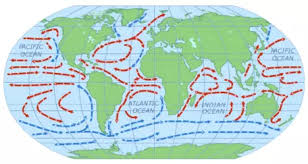
Which method of heat transfer is responsible for the ocean current movement?
A-conduction
B-convection
C-radiation
D-reflection
convection
500
Examples of objects that use different types of energy to perform their functions are shown.
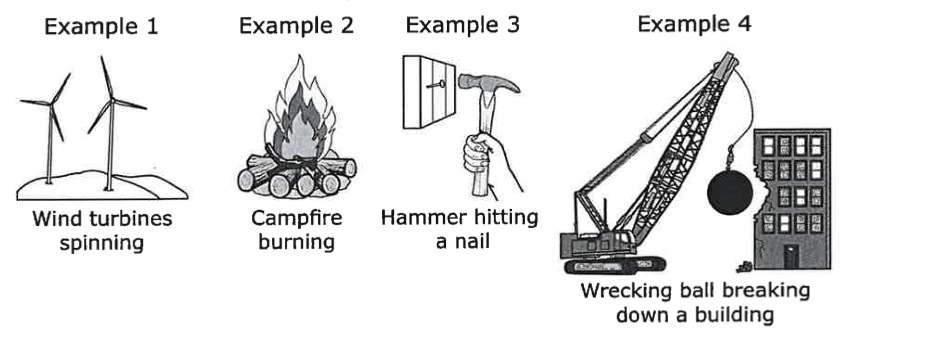
Which examples use mechanical energy to perform their functions?
A-Examples 1 and 2
B-Examples 3 and 4
C-Examples 1, 3, and 4
D-Examples 1, 2, and 3
Examples 1, 3, and 4
500
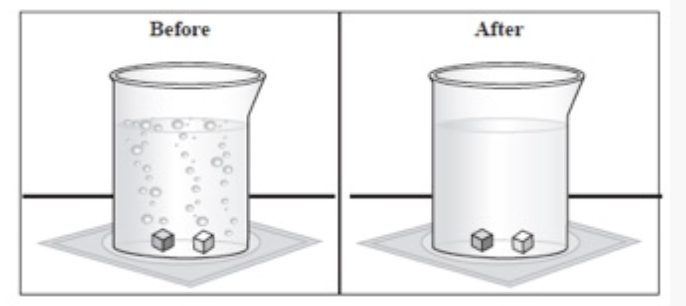
Mrs. Aldaco added a copper (Cu) cube that is at room temperature and an aluminum (Al) cube that she just removed from the freezer to a beaker of boiling water. She left the cubes in the water for three hours. Which of the following describes a heat flow that took place during those three hours?
A-The heat flowed from the aluminum cube to the beaker.
B-The heat flowed from the copper cube to the boiling water.
C-The heat flowed from the aluminum cube to the copper cube.
D-The heat flowed from the boiling water to the aluminum cube.
The heat flowed from the boiling water to the aluminum cube.
500
Dew forms on the grass in the morning. This is because warm, moist air cools down overnight, and water vapor turns back into liquid water. This process is called condensation.
Does condensation involve adding heat or removing heat from the system?
A-Removing heat, because the gas particles must lose energy to become a liquid.
B-Neither adding nor removing heat, only a change in pressure.
C-Both adding and removing heat.
D-Adding heat, because the air is getting warmer.
Removing heat, because the gas particles must lose energy to become a liquid.
500
Why does sound travel faster in a solid than a gas?
A-Solids have particles that are tightly packed which allows the vibrational energy of the sound wave to be transferred quickly.
B-Solids have particles that are spread far apart which allows the vibrational energy to travel randomly.
C-Solids have particles that compress easily and the vibrational energy is absorbed quickly.
D-Solids have particles that are larger and less dense which allows the vibrational energy to escape.
Solids have particles that are larger and less dense which allows the vibrational energy to escape.
500
For a constant wave speed such a sound wave (person's voice) traveling through a wooden wall, if the frequency of the wave increases, what must happen its wavelength?
A-The wave's speed increases but the wavelength remains the same.
B-The wavelength remains the same.
C-The wavelength decreases.
D-The wavelength increases.
The wavelength decreases.