Heat
Endo and exothermic reactions
Calorimetry
Equilibrium and Le Chatelier
Other
100
Heat flows from ______________ to ____________
High to low
100
Use table I to identify an exothermic reaction.
various.
100
What is specific heat?
amount of energy needed to change 1g of a sample by 1 degree c.
100
how would I shift an equilibrium to the reactants side for the first equation listed in table I?
add product, heat it up
100
Magnesium has two naturally occurring isotopes: Magnesium-24 and Magnesium-26. The atomic mass of Magnesium-24 is 23.985 amu, and the atomic mass of Magnesium-26 is 25.983 amu. If Magnesium-24 has a 78.99% natural abundance and Magnesium-26 has a 21.01% natural abundance, calculate the average atomic mass of magnesium.
increase surface area, increase temperature, increase concentration.
200
Heat is the averages _______________________________________________________________________ of particles in a sample
(multiple words)
Kinetic Energy
200
In an endothermic reaction, the potential energy of the reactants is _____________ than the potential energy of the products.
less than
200
What formula would you use to calculate the amount of energy required to heat a 500ml sample of water at 60 degrees to 65 degrees.
q=mc delta t
200
Explain why the following statement is wrong. "To shift an exothermic reaction to the products side, add more heat to the system."
This will shift equilibrium to reactants side because energy is a product in exothermic reactions.
200
List 3 ways to increase the rate of a chemical reaction
increase surface area, increase temperature, increase concentration.
300
Does a 5g sample of lead at 80 degrees C have more kinetic energy than a 5g sample of air at 40 degrees C?
Yes, lead has more bc it has a higher temp
300
Identify an exothermic phase change.
condensation, freezing, deposition.
300
How much energy must be put into 1 gram of liquid water to increase the temperature by 1 degree C?
4.18J
300
Describe 3 different ways to shift the equilibrium of a system.
Change temp.
Change concentration of reactant/product.
Change pressure (for gases).
300
Draw a potential energy diagram for an endothermic reaction.
PE of reactants is lower than PE of products.
400
Describe the heat transfer that must occur for you to perceive heat from a chemical reaction occurring inside a beaker.
from reacting chemicals to glass to hand
400
Draw a graph to represent the change in potential energy over time in an exothermic reaction. Label the heat of reaction
correct graph and label.
400
Explain what equation(s) to use (and how) when calculating the amount of energy a sample absorbs in an upward phase change.
q=mHf and q=mHv
+ proper explanation.
400
What is equal in systems at equilibrium?
Rate of forward and rate of reverse reaction.
400
What does a catalyst do?
Provide alternate pathway with lower activation energy.
500
State one action that would decreases the average kinetic energy of particles in the top of a warm hot plate. Describe how this action would decrease the kinetic energy.
put ice on it, let it cool, etc.
500
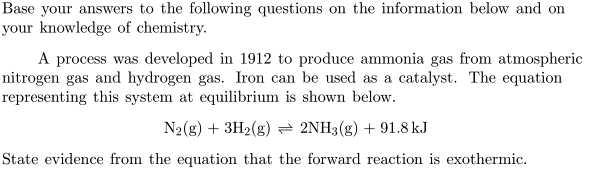
heat on product side
500

1250J
500
Define Le Chatlier's Principle.
If there is a stress on a system at equilibrium, then that system will shift to mitigate the stress.
500
what must happen for 2 particles to react with each other?
collide with proper orientation and proper energy.