Lit Trivia Miscellany
That's So Puritan!
Authors Facts
Historical Context
Name That Genre
Events and Movements!
Final Jeopardy
100
This early American writer wrote The Day of Doom, one of the first bestsellers in American history.
Michael Wigglesworth
100
This author’s sermon, “Sinners in the Hands of an Angry God,” described God’s wrath as holding sinners over the pit of hell like a spider over a flame.
Jonathan Edwards
100
He wrote "Rip Van Winkle," a story about a man who sleeps through the American Revolution.
Washington Irving
100
This is the name for those Americans in the pre-Civil War years who were opposed to the legality of American slavery.
Abolitionists / Abolitionism
100
“Sinners in the Hands of an Angry God” is an example of this genre, which was often delivered from the pulpit.
A sermon.
100
Writers from this era focused on the advancements of rationalism and science; others also wrote about rights, natural laws, and political rights.
Revolutionary / Enlightenment Era
200
This author's captivity narrative detailed her experiences during King Philip's (Metacom's) War.
Mary Rowlandson
200
This poet, often considered America’s first published poet, wrote “The Author to Her Book.”
Anne Bradstreet
200
This belief system common to early American colonists emphasized God's providence, original sin, and strict moral conduct.
Puritanism
200
This series of trials in 1692 involved accusations of witchcraft and the execution of 19 people.
The Salem Witch Trials.
200
“Rip Van Winkle” and “The Fall of the House of Usher” are examples of this shorter form of prose narrative, a genre made popular by early American writers.
The short story.
200
This American literary movement emerged in the pre-Civil War years, emphasizing individualism, self-reliance, and a return to natural wonder.
Transcendentalism
300
This troubled author wrote, among many other things, "The Cask of Amontillado" and an essay entitled "Imp of the Perverse."
Edgar Allan Poe
300
This judge of the Salem Witch Trials later repented his role and wrote about his guilt in his diary.
Samuel Sewall
300
This author of "Somnambulism, a Fragment" was also a leading intellectual with an interest in abolition and women's suffrage, and was hugely influenced by thinkers like Mary Wollstonecraft in England.
Charles Brockden Brown
300
The Compromise of 1850, the Fugitive Slave Act, and the publication of this novel heightened tensions before the Civil War.
Uncle Tom's Cabin
300
The captivity narrative by Mary Rowlandson belongs to this genre (and was in fact hugely influential to it).
The personal narrative.
300
This religious movement, officially called the Religious Society of Friends, emphasized equality, pacifism, simplicity, and the "inner light" of God.
Quakers or Quakerism
400
This famous first line from Moby-Dick directly addresses the reader, demonstrating in its first sentence the book's relentless narrative style.
"Call me Ishmael."
400
This colonial venture is most often associated with those Puritans whose original position regarding the Church of England was that of separatism, not purification.
Plymouth Plantation (The Pilgrims)
400
This novel, written by Harriet Beecher Stowe, is credited with influencing public opinion on slavery during the Civil War era.
Uncle Tom's Cabin
400
This philosopher and essayist from Concord, Massachusetts, protested slavery and the Mexican-American War by refusing to pay taxes, inspiring the essay Civil Disobedience.
Henry David Thoreau
400
Anne Bradstreet’s “The Author to Her Book” is an example of this literary genre.
Poem/Poetry.
400
Most commonly associated with the period in American history from around 1812-1861, this word refers to the historical and literary era in American life leading up to the Civil War.
Antebellum Era
500
This Methodist minister and indigenous activist wrote A Son of the Forest, one of the first autobiographies by an indigenous American writer, as well as An Indian's Looking-Glass for the White Man.
William Apess
500
In this sermon, John Winthrop describes the Puritan mission in Boston as the establishment of a "city upon a hill."
A Model of Christian Charity
500
This is one of the most significant facts about the full title of Frederick Douglass's Narrative upon its publication.
It includes the appositive phrase "..., A Slave, Written By Himself."
500
These two Enlightenment political philosophers were hugely influential to the American founders (name either of them).
John Locke and/or Thomas Hobbes
500
Thomas Paine’s Common Sense belongs to this genre, which aims to persuade readers about a political cause.
Pamphlet
500
The Declaration of Sentiments, written in 1848 and delivered at the Seneca Falls Convention, was a major, keystone document in this larger movement's history.
Women's Suffrage (the right to vote)
500
Match these authors with their work:
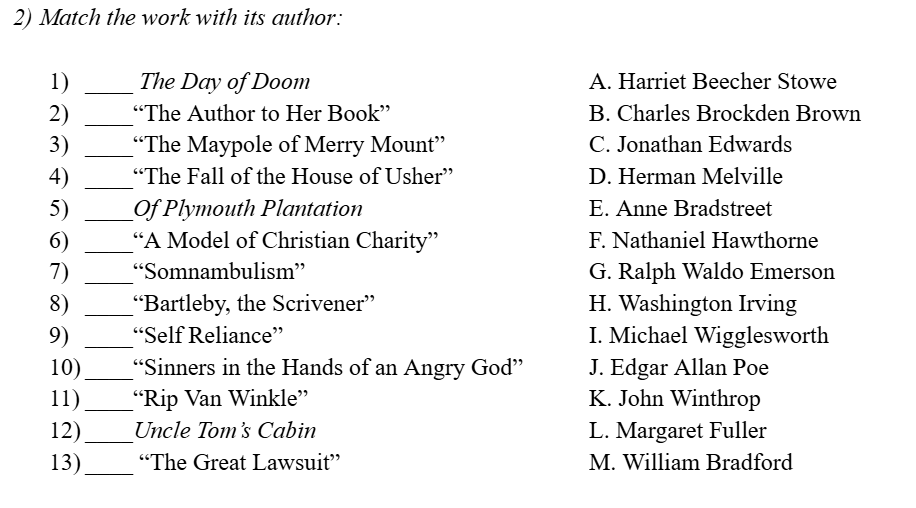
1) I 2) E 3) F 4) J 5)
M 6) K 7) B 8) D 9) G
10) C 11) H 12) A 13) L