Periodic Table 1
Periodic Table 2
Periodic Table 3
Periodic Table 4
Periodic Table 5
100
The electrons in the outer energy level
What are valence electrons?
100
Subatomic Particle with a negative charge
What is an electron?
100
The atomic number is equal to this
What is the number of protons (and electrons) an atom of an element has?
100
Atomic mass - Atomic number
What is the formula for finding the neutrons of an atom?
100
A subatomic particle with no charge.
What is a neutron?
200
The location of protons and neutrons.
What is inside the nucleus?
200
Reactivity of an atom with a full outer energy orbital.
What is nonreactive or not reactive at all?
200
The periodic table is arranged —
A. by the atomic number
B. by the number of neutrons
C. by symbols
D. in alphabetical order
A. by the atomic number
200
A student receives a model of an atom that contains seven protons, neutrons, and electrons, and has an atomic mass of approximately 14. What procedure can the student use to identify the atom?
A. The student can reference the periodic table and find the element that has an atomic number of 7, which represents the number of neutrons in the atom.
B. The student can reference the periodic table and find the element that has an atomic number of 14, which represents the number of protons and neutrons in the atom.
C. The student can reference the periodic table and find the element that has an atomic number of 14, which represents the number of electrons and neutrons in the atom.
D. The student can reference the periodic table and find the element that has an atomic number of 7, which represents the number of protons in the atom.
D. The student can reference the periodic table and find the element that has an atomic number of 7, which represents the number of protons in the atom.
200
The location of electrons.
What is the electron cloud?
300
Columns (up and down) on a periodic table
What are groups?
300
List the most common type of element from the greatest to the least. (nonmetals, metals, metalloids)
metals
nonmetals
metalloids
300
Which of the following scientist made the statements on the left side of this diagram below: Niels Bohr, Ernest Rutherford, John Dalton, J.J. Thomson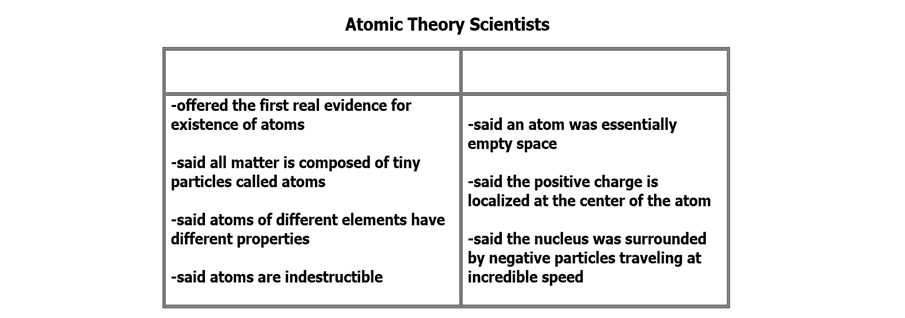
John Dalton
300
The number of neutrons in an atom of neon with a mass number of 21
What is 11.
300
The Law of Conservation of Matter and Energy states that —
A. Matter and energy are not created but destroyed; they do not change form in any way.
B. Matter and energy are created and destroyed; they also change from one form to another.
C. Matter and energy are neither created nor destroyed; they merely change from one form to another.
D. Matter and energy are created and destroyed; they do not change form in any way.
C. Matter and energy are neither created nor destroyed; they merely change from one form to another.
400
Balance the following equation:
Na + Cl2 → NaCl
2Na + Cl2 → 2NaCl
400
Subatomic particle with a positive charge
What is a proton?
400
Examine the periodic table.
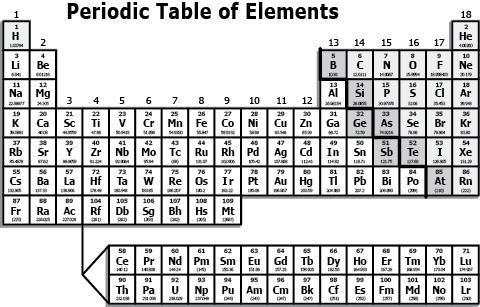
What group of elements are also known as the halogens?
A. Group 2
B. Group 17
C. Group 18
D. Group 1
B. Group 17
400
UCA_PROD_00002VYNKR
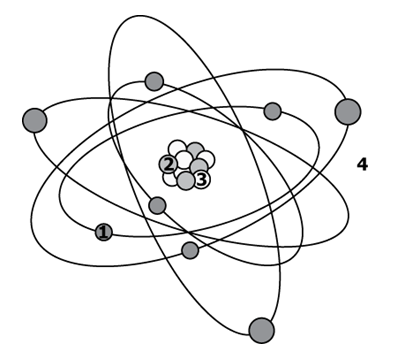
Which statements are correct concerning the components of an atom?
A. Number 2 could be either a proton or neutron.
B. Number 3 is either positive or negative.
C. Number 1 is an electron.
D. Number 1 has a positive charge.
E. Number 4 is a neutron.
F. Number 3 is either a neutron or electron.
A. Number 2 could be either a proton or neutron.
C. Number 1 is an electron.
400
Which term is not displayed on the periodic table?
A. Atomic Number
B. Atomic Mass
C. Atomic Radius
D. Chemical Symbol
C. Atomic Radius
500
A student using the periodic table realizes that water is not listed on it. What can the student infer from this observation?
A. Water is a combination of elements listed in the periodic table.
B. Water is made up of elements yet to be discovered.
C. Water is a liquid and liquids are not listed in the periodic table.
D. Water is a combination of substances that are not elements.
A. Water is a combination of elements listed in the periodic table.
500
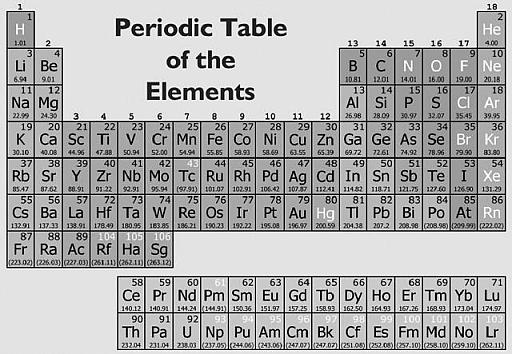
Referring to the periodic table, what is true about neon?
A. Neon will not bond with other elements.
B. Neon is a very reactive metal.
C. Neon is a very reactive nonmetal.
D. Neon has two valence electrons.
A. Neon will not bond with other elements.
500
Beryllium (Be), Magnesium (Mg), Calcium (Ca), Strontium (Sr), Barium (Ba), and Radium (Ra) are in the same column in the periodic table. Why are these elements in the same column in the periodic table?
A. They have similar properties.
B. They have atoms of the same size.
C. They have very different properties.
D. They have the same number of protons
A. They have similar properties.
500
The subatomic particle with no mass
What is the electron.
500
How many carbon atoms are present on the reactant side of the cellular respiration equation?
C6H12O6 + 6 O2 → 6 CO2 + 6 H2O
A. 2
B. 6
C. 12
D. 24
B. 6