On the Battlefield
The Powder Keg
Wartime Innovation
The Homeland
International Affairs
100
The area between the trenches with barbed wire and many dangers.
No Man's Land
100
Take Me Out! This Archduke's assassination led to the start of WWI.
Franz Ferdinand
100
This was the first war to use airplanes.
World War I
100
Who has the power to declare war in the United States?
Congress
100
This country was entirely blamed for World War I, and was forced to pay $33 billion in reparations to the Allies.
Germany
200
A type of combat in which opposing troops fight from long, narrow ditches facing each other.
Trench Warfare
200
This occurs when one nation exercises its political or economic control over smaller and/or weaker nations. The larger nation often steals the weaker countries resources.
Imperialism
200
These were fights in the skies among pilots in airplanes. Combatants would shoot at each other with machine guns on the wings of their plane.
Dogfights
200
Americans grew these in their backyards, when much of the country's food was being rationed.
Victory Gardens
200
This illness killed over 20 million people worldwide in 1918 including 550,000 Americans.
The Flu
300
This happens when there is little movement in war, as both sides are equally powerful and hold their ground.
Stalemate
300
This country had the world's strongest Navy in the early 1900s.
Britain
300
A new invention, used in WWI, that would crush barbed wire and easily go through difficult terrain while firing at the enemy with machine guns.
Tank
300
A time period in the U.S. from 1916-1930 in which African Americans moved from rural/southern areas (farms) to urban/northern areas (cities).
The Great Migration
300
This document ended World War II.
The Treaty of Versailles
400
One of the longest and bloodiest battles of WWI. 750,000 French and German soldiers died between February and December of 1916.
Battle of Verdun
400
These were the two names of the alliances which fought against one another during World War I.
Central Powers: Germany, Austria-Hungary, and the Ottoman Empire (Turkey).
Allied Powers: England, France, Russia, Japan, Italy, and eventually the United States.
400
The new poisonous gas invented in WWI by Germany that killed or seriously injured anyone who breathed it.
Mustard Gas
400
These pieces of paper paid for 2/3 of WWI. People loaned money to the government and would get back more money later (Example: Pay $100 now, get $150 back in 10 years).
Liberty Bonds
400
The Bolsheviks, led by Vladimir Lenin, adopted this form of government, where all businesses are owned by the state and all wealth is meant to be shared equally.
Communism
500
This early WWI battle saved Paris, France from being taken over by Germany.
Battle of the Marne
500
Take a look at this image. What concept does it demonstrate? (Hint: It was created by Otto von Bismark to protect Germany)
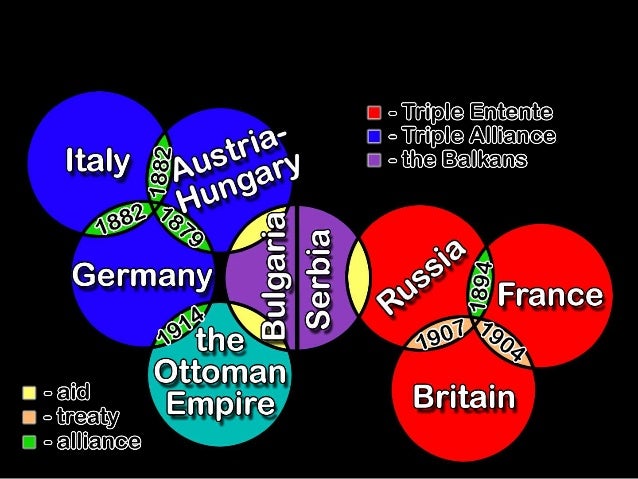
Alliance System
500
Germany began using this new form of aircraft to drop bombs on Allied cities in Europe.
Blimps
500
This act limited the freedom of speech in WWI throughout the United States. It announced that printing, writing, or stating any criticism of the U.S. government was illegal.
The Sedition Act
500
This country had an alliance with Germany but instead decided to switch sides before World War I began to fight against Germany.
Italy