Shape of My Heart
Tell it to my Heart
What's Love Got To Do With it?
Total Eclipse of the Heart
My Heart Will Go On
Un-Break My Heart
100
Fill in the blanks
The common metaphor is to think of the heart as a ___________.
But consider that the heart is actually ______ ______.
Pump
Two, Pumps
100
Where can S1 be heard the loudest?
The Apex
100
The SA node is known as the ?
Pacemaker
100
What is Edema?
Swelling of legs or dependent body part due to increased interstitial fluid
100
What is Tachycardia?
Rapid heart rate, greater than 95 beats per minute in adults
100
What is the pharmacological class of Clonidine?
Antihypertensive
200
What does the pumping of the heart?
The Myocardium- Muscular wall of the heart.
200
Where is S2 the loudest?
The base
200
What is the formula for Cardiac Output?
CO = SV×HR
200
What is cyanosis, and what causes it?
Cyanosis is a dusky blue discoloration of the skin and mucous membranes due to an excessive amount of deoxygenated hemoglobin in the blood.
200
What is a Thrill?
A palpable vibration on the chest wall accompanying severe heart murmur.
200
What is the Pharmacological class of Furosemide & what is a side effect of furosemide?
Loop Diuretic
Electrolyte depletion: Hypocalcemia, Hypokalemia, Hypochloremia, Hypomagnesemia, Hyponatremia, Hypovolemia.
300
What vessels return unoxygenated venous blood to the right side of the heart?
The Superior & Inferior Vena Cava
300
What is S3 and when does it occur?
A Third heart sound that occurs immediately after S2.
300
What is #5 called and what does it mean?
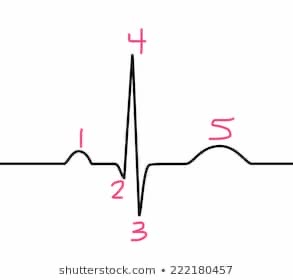
T wave—Repolarization of the ventricles
300
Describe the Opening Snap
A Sharp, High-pitched, Snapping sound heard in early diastole, it's associated with mitral stenosis.
300
How do you assess for Jugular Vein Distension (JVD)?
Patient supine
Head of bed elevated 30–45 degrees
Turn head slightly away
Use tangential lighting
300
What is the pharmacological classification of Amiodarone, and what is it used for?
Antiarrhythmic, Class III Potassium Channel Blocker
Indicated for Supraventricular & Ventricular Arrhythmias.
400
What is the tough, fibrous, double-walled sac that surrounds the heart called? and what does it contain?
The Pericardium. Serous Pericardial fluid
400
What is S4 and when does it occur?
Fourth heart sound S4 occurs just before S1.
400
Which Number is the P wave and what does it stand for?
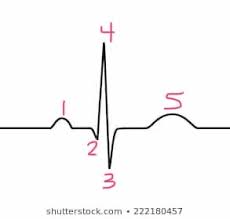
#1, P wave—Depolarization of the atria
400
What is Pericardial friction rub?
high-pitched, scratchy extracardiac sound heard when the precordium is inflamed
400
Describe a Summation Gallop.
A summation gallop occurs when S3 and S4 are both present and merge, often during tachycardia.
Sounds like: Quadruple rhythm S1, S2, S3, S4
Associated with: Severe heart disease, Cardiac stress
Decompensated heart failure
400
What is the pharmacological class of Digoxin & what must you check before administering Digoxin and for how long must you check it?
Class V Cardiac/ Digitalis Glycosides
Check the Apical pulse for one full minute
500
What is the right AV valve called? And what is the main purpose of the valves?
The Tricuspid
The main purpose of the valves is to prevent backflow of blood.
500
What is a s gentle swooshing sound that can be heard on the chest wall?
A murmur
500
What numbers make up the PR interval and what does it stand for?
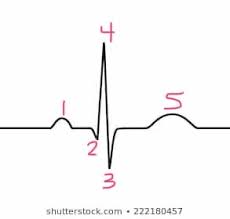
#1-2, PR interval—From the beginning of the P wave to the
beginning of the QRS complex (the time necessary for atrial depolarization plus
time for the impulse to travel through the AV node to the ventricles)
500
What is Mitral stenosis?
calcified mitral valve impedes forward flow of blood into the left ventricle during diastole
500
What is Angina Pectoris & when does it occur?
Angina pectoris is acute chest pain that occurs when the myocardial demand exceeds its oxygen supply.
500
What is the pharmacological class of Verapamil? Name two conditions it can be used for.
Antiarrhythmic Class IV Calcium Channel blocker
It can be used for
Supraventricular Tachycardias
Hypertension
Angina
600
What is another name or names for the Left AV valve? and during what phase do the AV valves open?
Bicuspid or Mitral Valve
The AV valves open during the heart’s filling phase, or diastole, to allow the ventricles to fill with blood.
600
What is the first heart sound? When does it occur and what does it signal?
The first heart sound (S1) "LUB" occurs with closure of the AV valves and thus signals the beginning of systole.
600
What numbers make up the QRS complex and what does it mean?
#2,4,3=QRS complex—Depolarization of the ventricles
600
What is Mitral regurgitation?
mitral insufficiency; an incompetent mitral valve allows regurgitation of blood back into the left atrium during systole
600
What is Cor pulmonale?
It is right ventricular hypertrophy and heart failure due to pulmonary hypertension
600
What is the Pharmacological class of Atenolol? Name 3 conditions it can be used for.
Antiarrhythmic Class II Selective Beta 1 adrenergic Antagonist.
Indicated for Hypertension, Angina pectoris, A-Fib, Chronic control supraventricular tachycardia, ventricular tachycardia, and prevention of recurrent MI.
700
Where are the Semilunar valves found? What are their names and where are they located?
Semilunar (SL) valves are set between the ventricles and the arteries.
The SL valves are the pulmonic valve in the right side of the heart and the
aortic valve in the left side of the heart.
700
What is the second heart sound? When does it occur and what does it signal?
The second heart sound (S2) "Dub" occurs with closure of the semilunar valves and signals the end of systole.
700
What does the timing of the Carotid Artery Pulse coincide with?
Its timing closely coincides with ventricular systole or (S1).
700
What is left ventricular hypertrophy (LVH) & when does it occur?
Left ventricular hypertrophy (LVH) increase in thickness of the myocardial wall that occurs when the heart pumps against chronic outflow obstruction (e.g., aortic stenosis)
700
What is Coarctation of Aorta?
It is a severe narrowing of the descending aorta, a congenital heart defect.
700
Name two conditions Procainamide is used for & what is a contraindication for it?
Ventricular & Atrial Arrythmias
Premature Contractions
Tachycardia
Contraindicated with Electrolyte imbalances.
800
The valves’ thin leaflets are anchored by collagenous fibers to papillary muscles embedded in the ventricle floor. What are those fibers called?
Chordae Tendineae
800
Describe what happens during Diastole?
In diastole the ventricles are relaxed, and the AV valves (i.e., the tricuspid and mitral) are open The pressure in the atria is higher than that in the ventricles; therefore blood pours rapidly into the ventricles. Toward the end of diastole the atria contract and push the last amount of blood (about 25% of stroke volume) into the ventricles. This active filling phase is called presystole, or atrial systole, or sometimes the atrial kick. It causes a small rise in left ventricular pressure. (Note that atrial systole occurs during ventricular diastole, a confusing but important point.)
800
Name all four characteristics of all heart sounds. (how would you describe heart sounds)
1. Frequency (pitch)
2. Intensity (loudness)
3. Duration
4.Timing
800
Explain Paradoxical splitting.
Opposite of a normal split S2, so that the split is heard in expiration, and in inspiration, the sounds fuse into one sound.
800
What is Aortic Stenosis, and what does it do?
Aortic stenosis is the calcification of the aortic valve cusps that restricts forward flow of blood during systole.
800
What is the pharmacological class of Lisinopril, what is it used for, and who is it contraindicated in?
ACE inhibitor/Angiotensin Converting Enzyme
Used for (CHF) Chronic Heart Failure, and Hypertension.
Contraindicated in Pregnancy.
900
Name the correct direction of blood flow through the heart.
Right atrium, right ventricle, pulmonary artery, lungs, pulmonary vein, left atrium, left ventricle
900
Describe what happens during Systole?
Now so much blood has been pumped into the ventricles that ventricular pressure is finally higher than that in the atria; thus the mitral and tricuspid valves swing shut. The closure of the AV valves contributes to the first heart sound (S1) and signals the beginning of systole. The AV valves close to prevent any regurgitation of blood back up into the atria during contraction. After the ventricle’s contents are ejected, its pressure falls. When pressure falls below pressure in the aorta, some blood flows backward toward the ventricle, causing the aortic valve to swing shut. This closure of the semilunar valves causes the second heart sound (S2) and signals the end of systole.
900
Describe Preload & Afterload.
Preload is volume—it is the venous return that builds during diastole.
Afterload is pressure—it is the opposing pressure the ventricle must generate to open the aortic valve against the higher aortic pressure.
900
Explain Pulmonic regurgitation?
Pulmonic insufficiency; backflow of blood through incompetent pulmonic valve into the right ventricle.
900
What is Aortic Regurgitation & what does it do?
It is (aortic insufficiency) an incompetent aortic valve that allows backward flow of blood into the left ventricle during diastole.
900
What is Hydrochlorothiazide? Name the four conditions it is used for.
A Thiazide Diuretic, it is used for
1.CHF
2.Hypertension
3.Edema
4.Renal disease