How the Internet Works
Cyber Threats & Attacks
Security on the Internet/Additional Vocab
Domain Names
Blast From the Past
Cybersecurity Tools & Safe Practices
100
What is an IP Address? What is the purpose?
A number assigned to any item that is connected to the Internet. IP addresses provide a unique number for identifying devices that send and receive information on the Internet
100
What do we call software designed to harm, exploit, or disrupt a system?
What is Malware?
100
What is the time elapsed between the transmission and the receipt of a request.
Latency
100
Defined as the website names that use words and letters to describe them
Domain names
100
What is a difference between Analog and Digital Data?
Analog Data= smooth data
Digital Data= Choppy copy
100
What is one simple practice that greatly increases account security?
Strong and unique Passwords
200
What is a Packet?
Small chunks of information that have been carefully formed from larger chunks of information. How information is sent over the internet. The internet traffic process in which information is broken into smaller packets that are sent along different routes, and reassembled at their destination
200
What kind of cyber attack tricks people into giving away sensitive information through fake emails or messages?
Phishing.
200
One is the massive network of physical connections like cables and routers, and the other is the system of webpages that lives on top of that network.
What is the difference between the Internet and the World Wide Web?
200
What’s the function of the DNS (Domain Name Service)?
Translating the site name in text format to a numeric IP address
200
Which value is greater: 135 or 10000111?
135= 10000111
200
What process scrambles data so it can only be read with a key?
Encryption
300
What is a computer network?
A computer network is any group of interconnected computing devices capable of sending or receiving data.
300
What type of attack overwhelms a website or server with excessive traffic, causing it to crash?
A Distributed Denial of Service (DDoS) attack.
300
Which of the following is true of how the Internet has responded to the increasing number of devices now using the network?
Moore's Law- The protocols of the Internet were designed to SCALE as new devices are added
300
Which part of a domain name is the top-level domain (TLD)?
The far right side of the domain name
300
8 bits is enough to represent 256 different numbers. How many total bits do you need to represent 513 different numbers
10 bits
300
What security method requires two or more ways to verify a user’s identity?
Multi-Factor Authentication (MFA)
400
What is Fault Tolerance?
The Internet having a lot of redundancy and duplication built into it makes it have this trait
400
What attack relies on manipulating people rather than breaking technical systems?
Social engineering.
400
What is a measure of bit rate - the amount of data (measured in bits) that can be sent in a fixed amount of time?
What is Bandwidth
400
What does URL stand for?
Uniform Resource Locator
400
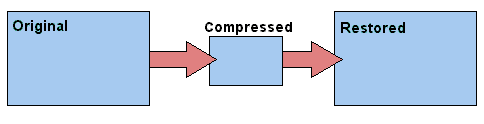
What is the difference between lossy vs lossless compression?
Lossy: Compression that removes data that can’t be returned to its original format
Lossless: Compression that removes data that can be returned to its original format
400
What security tool monitors and controls incoming and outgoing network traffic to block threats?
A firewall.
500
How does HTTP represent a level of abstraction?
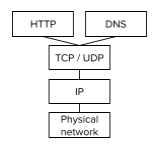 HTTP is built on top of TCP/IP and other layers of protocols. At this higher level, we do not need to know how the lower levels work exactly.
500
Q: What type of malware locks or encrypts a user’s files and demands payment to restore access?
Ransomware
500
What is difference between TCP and UDP?
Transmission Control Protocol (TCP)- quality
User Datagram Protocol (UDP)- speed
500
What’s the syntax of second-level domains?
500
In ASCII, the uppercase letter "G" is represented by the decimal (base 10) value 71. What would be the letter Q written in the decimal (base 10) value?
81= 01010001
500
In public-key cryptography, what key is shared openly and what key must remain secret?
The public key is shared; the private key remains secret.