Nature of Waves
Wave's Properties
Wave's Speed
Wave's Behavior
Waves
100
What is the primary difference between transverse and longitudinal waves?
Transverse waves oscillate perpendicular to the direction of propagation, while longitudinal waves oscillate parallel to it.
100
Describe the difference between a longitudinal wave with a large amplitude and one with a small amplitude.
In a longitudinal wave with a large amplitude, the compressions are more dense and the rarefactions are less dense. In a longitudinal wave with a small amplitude, the compressions are less dense than in high-amplitude waves, and the rarefactions are more dense.
100
The musical note A above middle C has a frequency of 440 Hz. If the wavelength is measured to be 0.80m, what is the speed of the wave?
350 m/s
100
The angle of _________ is equal to _____________.
incidence / the angle of reflection
100
You make a transverse wave by shaking the end of a long rope up and down. Explain how you would shake the end of the rope to make the wavelength shorter.
To make the wavelength shorter, you would increase the frequency of shakes
200
What happens when waves come into contact with a boat? Explain if the wave move the boat to a different position.
Waves carry energy without transferring matter from place to place. Waves may move the boat up and down and maybe even back and forth, but they do not change its location.
200
The _______ is the highest point on a transverse wave, and the ____ is the lowest point.
crest / trough
200
If 100 waves pass a given point in 4 seconds, what is the wave's frequency?
25 Hz
200
How is your brain fooled into seeing a broken straw?
The brain interprets the light waves that enter the eye as if they have traveled in a straight line, which can cause you to see the portion of the straw in the water as if it were in a different location.
200
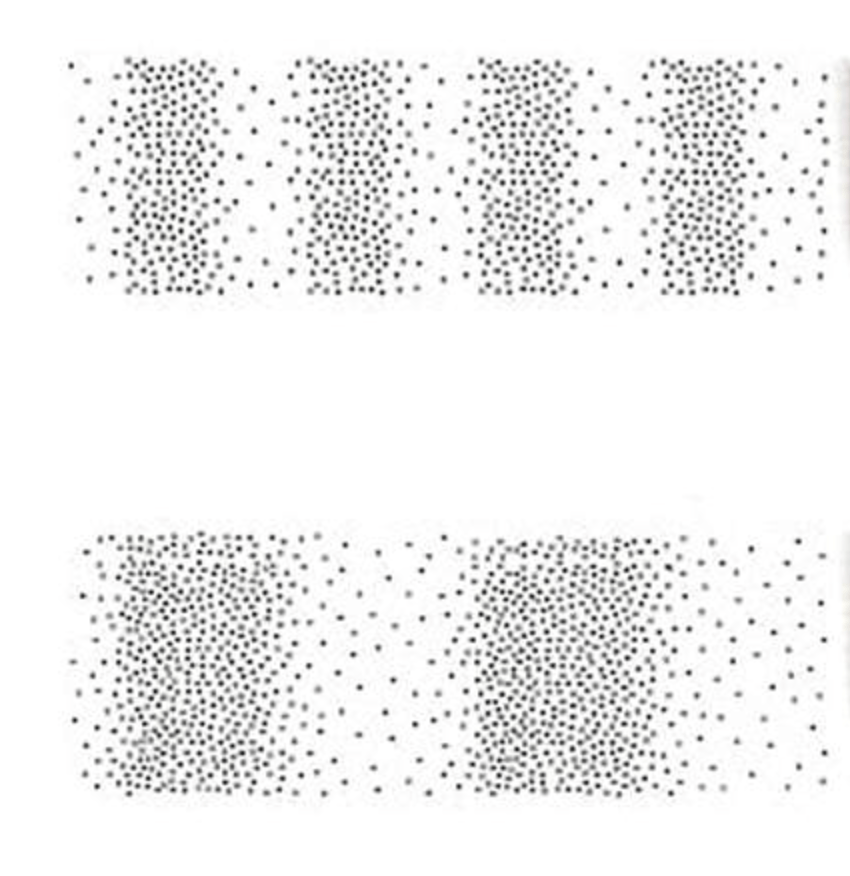
Which of the longitudinal waves has a higher frequency?
The first one
300
Contrast how you would move a spring to make a transverse wave with how you would move a spring to make a longitudinal wave.
You would move the spring forward and backward, creating compressions, to make a longitudinal wave. You would move the spring left and right, like a rope, to make a transverse wave.
300
In a longitudinal wave, a ____ is an area where the particles are spread apart and a ____ is an area where the particles are close together.
rarefaction / compression
300
Calculate the frequency of a water wave that has a wavelength of 0.5 m and a speed of 4 m/s.
8 Hz
300
How light would respond differently when striking an object that is not transparent than when striking an object that is transparent, such as a glass window.
Light that strikes an object that is not transparent would reflect. It would not also refract as it might when striking a transparent object.
300
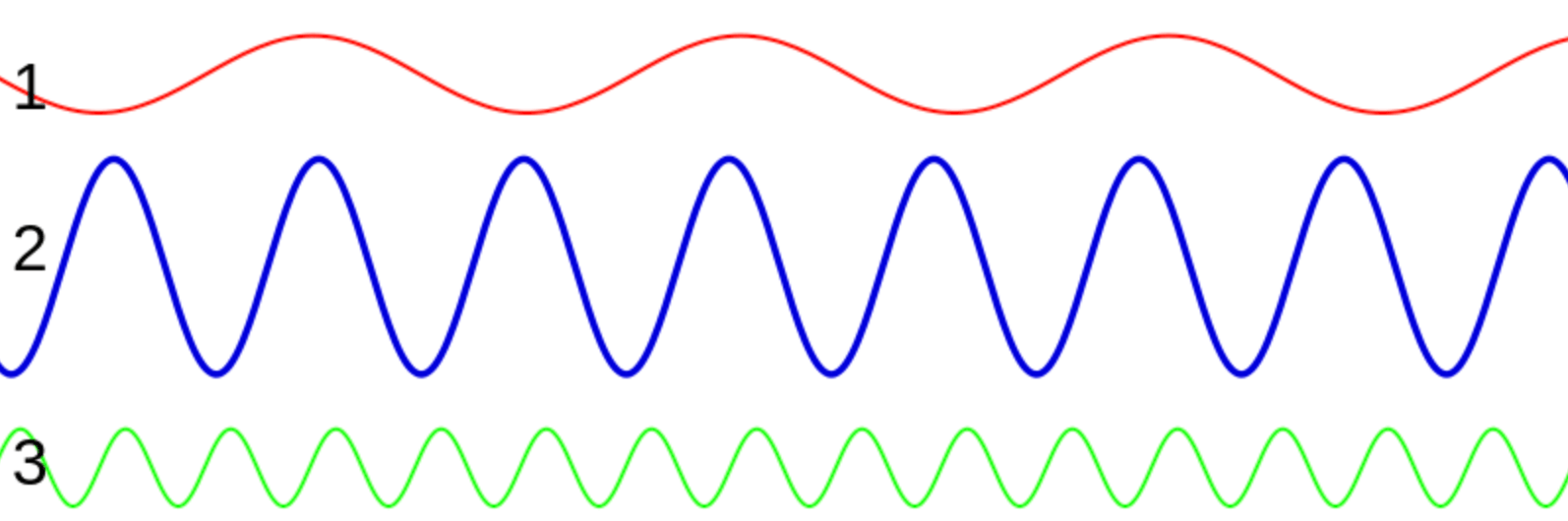
The mechanical wave with more energy is
Number 2
400
Examples of mechanical waves are: (list 3)
sound waves, earthquakes, coil spring.
400
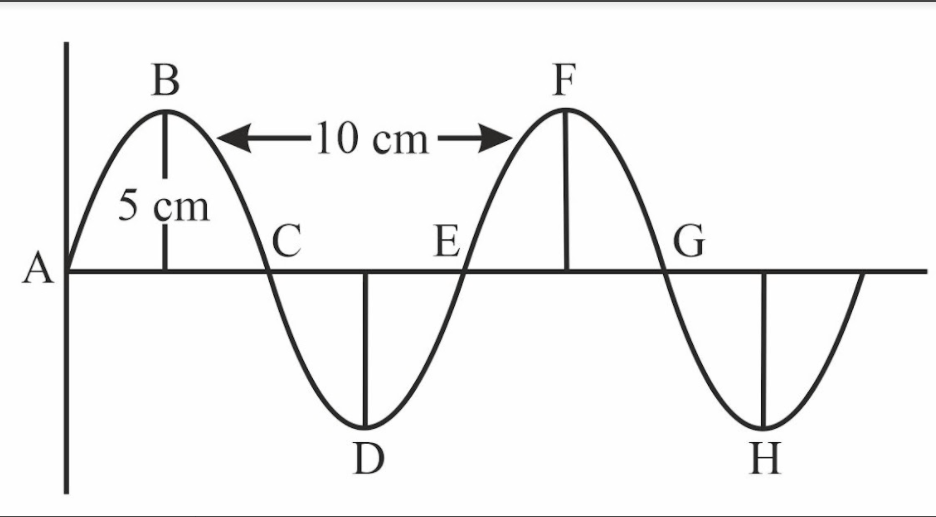
What is the wavelength in this image?
10 cm
400
An FM radio station broadcasts radio waves with a frequency of 96,000,000 Hz. What is the speed of these radio waves if they have a wavelength of 3.1 m?
300,000,000 m/s
400
Describe What are two situations in which a wave will diffract?
A wave diffracts when it passes around an object or through a narrow opening.
400
Which waves can carry matter?
None, waves carry energy
500
Identify a mechanical wave that is also a longitudinal wave.
Sound
500
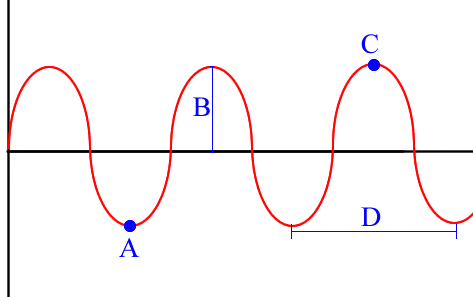
On this wave diagram, what is A?
Trough
500
An ocean wave travels a distance of 300 meters in 25 seconds. Calculate the speed of the wave.
12 m/s
500
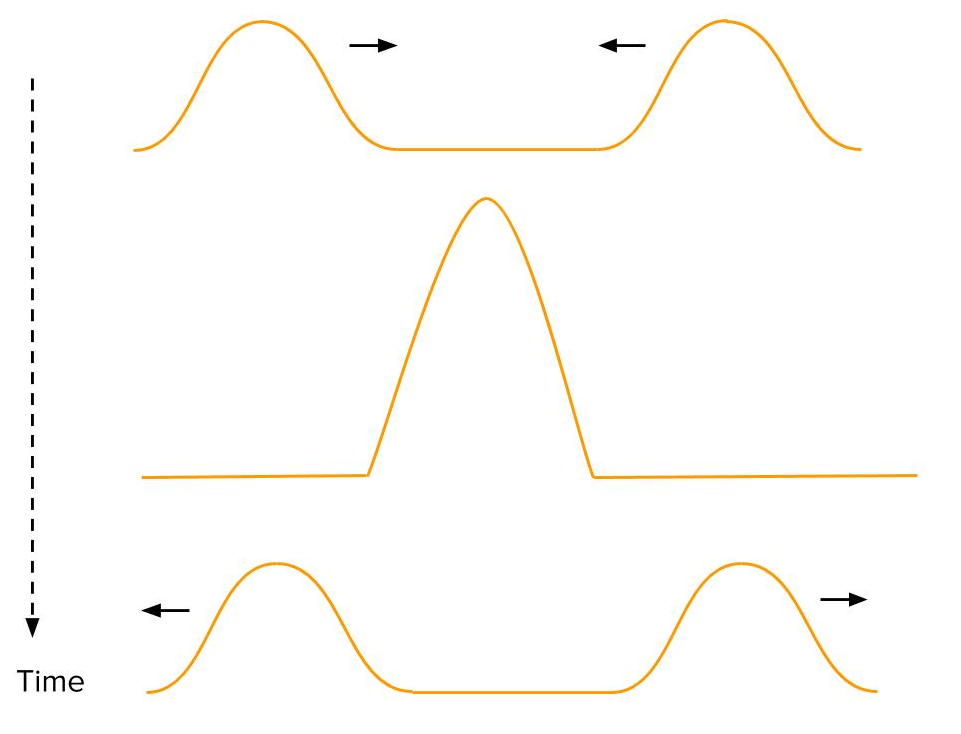
The two waves will undergo _________________ when they meet.
Constructive interference
500
Do all waves need a medium to travel?
Not all, electromagnetic waves can travel in a vacuum