Rocks & Minerals
A trio of theories
Heating things up
When plates collide
Naturally, that'd be a disaster
100
True of False: Coquina, which is made of compacted shells, is considered a mineral.
False
Minerals are inorganic
100
Describe one piece of biological evidence that supports the theory of Continental Drift.
Fossils of animals in plants found in climates where those organisms could not currently survive
Fossils of animals and plants found across continents now separated by oceans when those animals and plants could not have crossed the oceans
100
True or False: Heat always transfers from an object with higher temperature to an object with lower temperature
True
100
Name a geologic feature that commonly occurs at continental to continental convergent plate boundaries.
Mountains
100
This is a mass movement of land, earth, and/or rock down a slope due to gravity - often triggered by earthquake activity.
Landslide
200
Name a mineral biological importance and a mineral of economic importance to Montana.
Biological: Iron, Salt, Calcium, Sodium, Potassium, Flouride, phosphorus, chloride, zinc, iodine, etc...
Economic: Copper, sapphires, talc, gold, platinum, palladium
200
This theory describes how new oceanic floor is created in areas where oceanic plates are moving apart and magma rising to the surface cools to form new rock.
Sea Floor Spreading
200
This type of heat transfer does not require contact or a medium to transfer energy.
Radiation
200
Draw a sketch to show plates move at each type of boundary:
Divergent
Transform
Convergent

200
This was the largest volcanic eruption in the continental United States. It occurred due to tectonic activity between the Juan de Fuca and North American plates.
Mt. Saint Helens eruption
300
Describe how rocks are different from minerals.
Rocks are mixtures of minerals or mineral like matter. They can include many different components, including organic matter.
300
Why didn't people believe Alfred Wegner when he proposed his theory of continental drift?
He did not have a mechanism to explain why plates moved and he was not a geologist
300
Daily Double!
Write down how much of your score you are willing to wager before hearing the question - first team to answer gets a shot a double their wager, all other teams can still score the # of points wagered if correct.
Heat transfers from Earth's core to the mantle. As the mantle heats up it becomes less dense and begins to rise. As it approaches the crust it cools, the density increases and it sinks. These convection currents move the plastic asthenosphere layer. The lithospheric plates that rest on the asthenosphere get drug along as the asthenosphere moves and this is why plates move.
300
Rift valleys commonly form at this type of boundary.
Your answer must include the name of the boundary and the types of plates involved.
Continental Divergent boundary
300
Crust is neither created nor destroyed at this type of boundary, which is also known for having large earthquakes.
Transform
400
List four characteristics of all minerals:
1: Inorganic
2: Orderly Crystalline Structure
3: Definite chemical composition
4: Solid at room temperature
5: Naturally Occurring
400
Where would you expect to find older oceanic crust, near the Atlantic coastline of North America or near the mid ocean ridge in the Atlantic ocean?
Near the Atlantic coastline.
New crust is formed at the mid ocean ridge and crust gets progressively older as you move outward laterally from the ridges.
400
Convection currents in which layer are responsible for Earth's magnetic field?
Outer core
400
Which plate subducts when oceanic and continental crust collide and why?
Oceanic, because it is more dense than the continental plate
400
A deadly tsunami crashed into Japan in 2011 - what tectonic event caused this disaster to occur?
A major earthquake occurred in the ocean along a subduction zone which displaced the water and triggered the tsunami
500
Write a path along the rock cycle that would take magma to sedimentary rock.
Magma --> cooling --> Igneous rock --> Weathering and Erosion --> sediments --> Compaction and cementation --> Sedimentary rock
500
Describe a piece of geologic evidence, other than the jigsaw puzzle fit of the continents, that supports the theory of continental drift.
Similar rock formations (both age and type) that are now widely separated
Similar glacial deposits found in Antarctica, India, and South America
Mountain ranges with rocks of the same type, structures, and ages are now on opposite sides of the Atlantic ocean.
500
List the three sources of the heat generated in Earths core and underline which of these is presently generating heat.
Accretion
Gravitational Compression
Radioactive Decay (Present)
500
The Hawaiian islands are volcanic but are not located at a plate boundary - explain how this happens....
Hawaii is formed by a hot spot - there is a mantle plume of less dense magma that has risen up to the crust in this location and as the plate moves over it a chain of volcanic islands has formed.
500
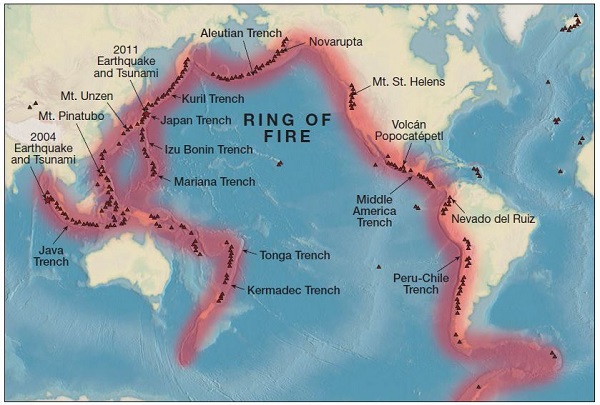
Why does the Ring of Fire has more earthquakes, volcanoes, and tsunamis than the Mid-Atlantic ridge?
There are numerous convergent plate boundaries and subduction zones along the ring of fire whereas the Mid Atlantic ridge is a divergent boundary.