Calculations
Enthalpy
Entropy and Spontaneity
Energy Diagrams
Conceptual
100
Calculate the total heat required to raise the temperature of 10.0 g of liquid water (specific heat capacity = 4.18 J/g·°C) by exactly 5.0°C.
What is 210 J?
100
If for the reaction A-->B ΔH = -20kJ, calculate ΔH for the reaction 3B-->3A.
What is +60kJ?
100
Predict whether the sign of entropy (ΔS) will be positive or negative for the reaction H2O (l) --> H2O (g)
What is positive?
100
Is the reaction shown here endothermic or exothermic?

What is exothermic?
100
If a piece of hot metal is dropped in a bucket of water, what direction does the heat flow?
What is from the metal to the water?
200
A 20.0 g piece of an unknown metal releases 600 J of heat as its temperature cools from 90.0°C down to 30.0°C. Calculate the specific heat capacity of this metal.
What is 0.5 J/goC
200
Calculate ΔH for the reaction A+B-->2D given the steps:
A+B-->2C (ΔH = +30kJ)
C-->D (ΔH = -20kJ)
What is -10kJ?
200
A particular reaction is highly exothermic and results in an increase in system disorder. Determine under what temperature conditions the reaction is spontaneous.
What is spontaneous at all temperatures?
200
Is the reverse reaction of this image endothermic or exothermic?

What is endothermic?
200
Is the reaction occurring in a hand-warmer packet endothermic or exothermic?
What is exothermic?
300
The molar heat capacity of liquid ethanol is 112 J/mol·°C. Calculate the quantity of heat required to raise the temperature of 2.00 moles of ethanol by 10.0°C.
What is 2240 J?
300
Write the balanced equation whose enthalpy change is equal to the standard enthalpy of formation for liquid water.
What is H2 (g) + O2 (g) --> H2O (l)
300
For the reaction 2A-->B, entropy of A is given as 60 J/moloK, and entropy of B is given as 100 J/moloK. Calculate the net entropy change of the reaction.
What is -20 J/K?
300
What letter represents the enthalpy change of the reaction?
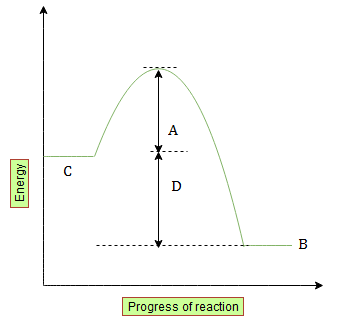
What is D?
300
For the reaction of a salt dissolving in water, describe what the system is and what the surroundings are.
What is the salt is the system and the water is the surroundings?
400
A combustion reaction heats a 5.00 kg pot (c=0.420 J/goC) by 120o C, calculate the heat released by the reaction in kJ.
What is 252 kJ?
400
For the reaction 2A + B-->C, the standard enthalpies of formation are given as: A = -10kJ/mol, B = 0kJ/mol, and C = -50kJ/mol. Calculate the net ΔH for this overall reaction.
What is -30kJ?
400
A chemical reaction has a ΔH of +80kJ and a ΔS of +250J/K, calculate the temperature at which the reaction becomes spontaneous.
What is 320K?
400
Calculate ΔH for the reaction shown

What is +200kJ?
400
Explain why the heat of vaporization is always significantly larger than the heat of fusion(melting) for any given substance.
What is vaporization involves completely overcoming IMF so molecules can freely move, whereas fusion only weakens IMF so molecules can slide past each other.
500
A 100.0 g sample of water at 80.0°C is thoroughly mixed with a 50.0 g sample of water at 20.0°C inside a coffee-cup calorimeter. Determine the final equilibrium temperature of the system.
What is 60.0o C?
500
Given the reaction CH4(g) + 2O2(g) --> CO2(g) + 2H2O(g) has ΔH = -800kJ, calculate ΔHf of CH4(g) given ΔHf of CO2(g) = -393kJ/mol and ΔHf of H2O(g) = -242kJ/mol.
What is -77kJ/mol?
500
At a temperature of 298K, a chemical reaction releases 40.0 kJ and has a ΔS of -100J/K. Determine whether the reaction is spontaneous by calculating ΔG.
What is -10.2kJ (spontaneous)?
500
Given the image below, calculate ΔH for the reaction C(graphite) + O2(g) --> CO(g).
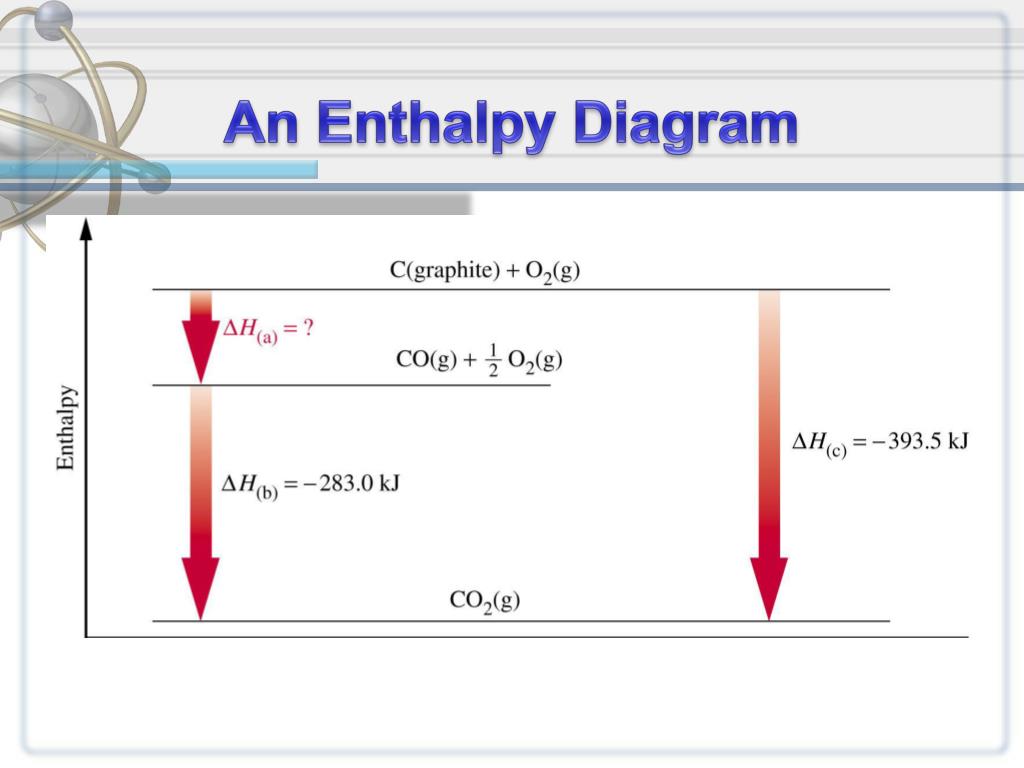
What is -110.5 kJ?
500
Explain why ice freezing is a spontaneous process within the context that all spontaneous processes result in an increase in total entropy of the universe.
What is the process is exothermic, so the heat released increases the entropy of the surroundings more than the entropy of the ice decreases.