Heat Transfer 1
Heat Transfer 2
Vocabulary
Phases and Heating Curves
Other
100
what is the standard unit for measuring heat
Joule (J)
100
Another unit for measuring heat (not SI)
What is a calorie
100
Another name for the 1st Law of Thermodynamics (Energy is not created or destroyed in a system)
Law of Conservation of Energy
100
What phase(s) is/are present between C and D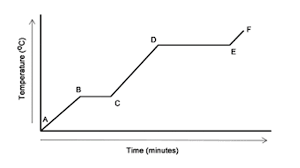
liquid
100
Give two examples of endothermic processes
An ice pack, melting ice, boiling water, getting warm by a fire, etc
200
You hold an ice cube in your hand and the ice cube begins to melt. Identify the system which is endothermic.
Ice cube
200
How much heat is required to raise the temperature of 250.0g of mercury by 52.0°C? (the specific heat for mercury is 0.14 J/g°C)
What is 1800J
200
Is the specific heat for metal generally higher or lower than for water? Does this mean it is easier or more difficult to heat/cool down a metal than water
The specific heat for metal is lower than that of water. It is easier to heat/cool down metals than water.
200
Between what two letters does melting occur?
B-C
200
Give two examples of an exothermic process
A candle flame, a hot pack, freezing water, condensing steam, combustion, etc
300
In the following equation what is q and ΔT?
q = mCΔT?
q = heat energy
ΔT = change in temperature
300
72.0 g of water is cooled from 75.0 oC to 55.0 oC. Calculate the energy transfer.
- 6020 J
Notice the negative!
300
What units are specific heat measured in?
What is J/g°C
300
At what letter is the lowest kinetic energy?
A
300
An 85.0 g piece of metal at 125.0OC is placed in 50.0 mL water with an initial temperature of 25.0OC. The water and metal reach equilibrium at 38.0OC.
What is the specific heat of the metal?
0.368 J/gOC
400
Heat is released in a process. Is q positive, negative, or zero?
negative
400
What is the specific heat of a metal which has a mass of 25.0g, heated from 60.0 degrees Celsius to 110.0 degrees Celsius, and absorbed 162.4J of heat?
What is 0.130 J/g°C
400
In the first calorimetry lab we did this unit, we used metal and water. If the water gained 550 J energy, what was the total energy change of the metal?
-550 J
Negative must be included to show the metal lost energy.
400
What phase(s) is/are present between B and C?
Solid and Liquid
400
50.0 mL water at 75.0OC is mixed with a second sample of water at an initial temperature of 25.0OC. The final temperature of the mixture is 62.5OC. What is the volume of the second sample of water?
16.7 mL
500
What would be the final temperature of 125.0g of steam which started at 115oC if you added 4000.J of heat to it? (the specific heat of steam is 1.90 J/g°C)
132OC
500
30.0 g water at initial temperature of 40.0 degrees Celsius releases 1510 J energy. What is the final temperature of the water?
28.0 oC
500
Temperature is the measure of average _____ of a substance.
Kinetic Energy
500
Between what two letters are the particles moving fast and are far apart?
E-F
500
Energy always transfers from ______ to ______. When does this transfer of energy stop?
high temperature to low temperature.
Energy transfer stops when the objects are at the same TEMPERATURE.