War in the West
Britain Says...
Colonists Fight Back
Tensions Rising
Who/What Am I?
100
What two European countries fought for control of land in North America during the French & Indian War?
Britain and France
100
What British policy had allowed the colonies to mostly govern and trade by themselves?
Salutary Neglect
100
What is it called when people refuse to buy certain goods as a form of protest?
Boycott
100
Who led a Native rebellion against the British after the French & Indian War?
Pontiac
100
What is a group of ordinary citizens trained to fight in an emergency called?
Militia
200
What valuable region did both Britain and France want to control?
The Ohio River Valley
200
What 1763 British order tried to prevent colonists from settling west of the Appalachian Mountains?
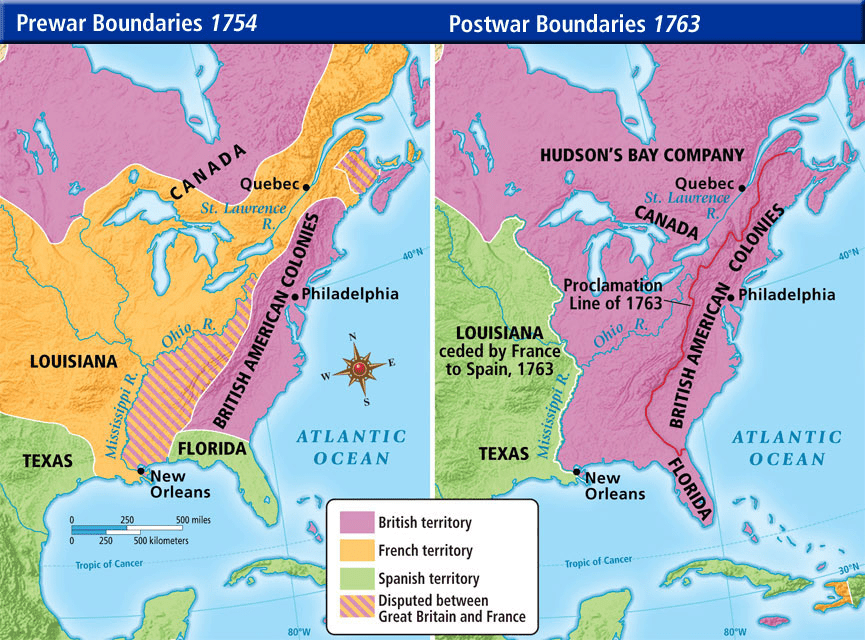
The Proclamation of 1763
200
What group organized protests against British taxes and policies?
Sons of Liberty
200
Which European country lost most of its North American territory after the French & Indian War?
France
200
What word means an action or statement that shows disagreement with something?
France
300
Give one reason Indigenous peoples in the Ohio River Valley might have preferred the French over the British.
Answers may vary. Could include: the French had stronger trade relationships with Indigenous peoples; French traders exchanged useful European goods for furs; the French were viewed as treating Indigenous peoples better; French settlement was less focused on taking land for farms.
300
Why did Britain begin enforcing laws and imposing new taxes on the colonies after the French & Indian War?
Britain had war debts/costs after the French & Indian War and wanted the colonies to help pay expenses.
300
Why did colonists make and wear homespun clothing?
To avoid buying British imports/protest British policies and support goods made in the colonies.
300
Give one reason Pontiac was angry with the British after the French & Indian War.
Answers may vary; Could be: British goods were more expensive; the British refused credit; Pontiac believed the British treated Indigenous peoples disrespectfully; he believed British policies threatened Native communities.
300
Proclamation
What is an official public announcement or order made by a government or leader?
400
How did the outcome of the French & Indian War change British power in North America?
Britain gained much more territory/control in North America, while French power was greatly reduced. Their Pontiac activity specifically had students compare the 1754 and 1763 maps to identify this change.
400
Which act placed a tax on printed materials such as newspapers, legal documents, and playing cards?
The Stamp Act
400
How could a boycott put pressure on Britain to change its policies?
It reduced demand for British goods, hurting British merchants economically and creating pressure to change/repeal policies.
400
Why did the Proclamation of 1763 anger many American colonists?
It prevented colonists from settling west of the Appalachian Mountains/on land many colonists wanted or believed they had earned access to after the war.
400
What term describes people fighting back against or challenging a government they believe is unfair?
Rebellion
500
How did British colonists moving into the Ohio River Valley contribute to conflict among the British, French, and Indigenous peoples?
Colonists moved west seeking land/resources, while France also claimed the region and traded there; Indigenous peoples already lived on the land. These competing claims over land, trade, and migration created conflict.
500
Why was the end of salutary neglect such an important change in the relationship between Britain and its colonies?
Colonists had grown accustomed to governing and trading with relatively little British interference; afterward, Britain exercised greater control and enforced laws/taxes more strictly.
500
How did colonial resistance show that British policies could sometimes backfire?
Answers may vary. Could be: taxes/control produced resistance rather than simply increasing British authority—for example, colonists organized, protested, boycotted British goods, and increased colonial production.
500
Explain how the French & Indian War helped lead to both Pontiac’s Rebellion and growing conflict between Britain and its American colonists.
Britain’s victory removed French power from much of the region and changed British-Indigenous relationships, contributing to Pontiac’s Rebellion. The war also left Britain with expenses/debt and contributed to tighter colonial control and taxation, increasing conflict with colonists.
500
What is the difference between a Patriot and a Loyalist?
A Patriot supported independence from Britain; a Loyalist wanted to remain loyal to Britain.